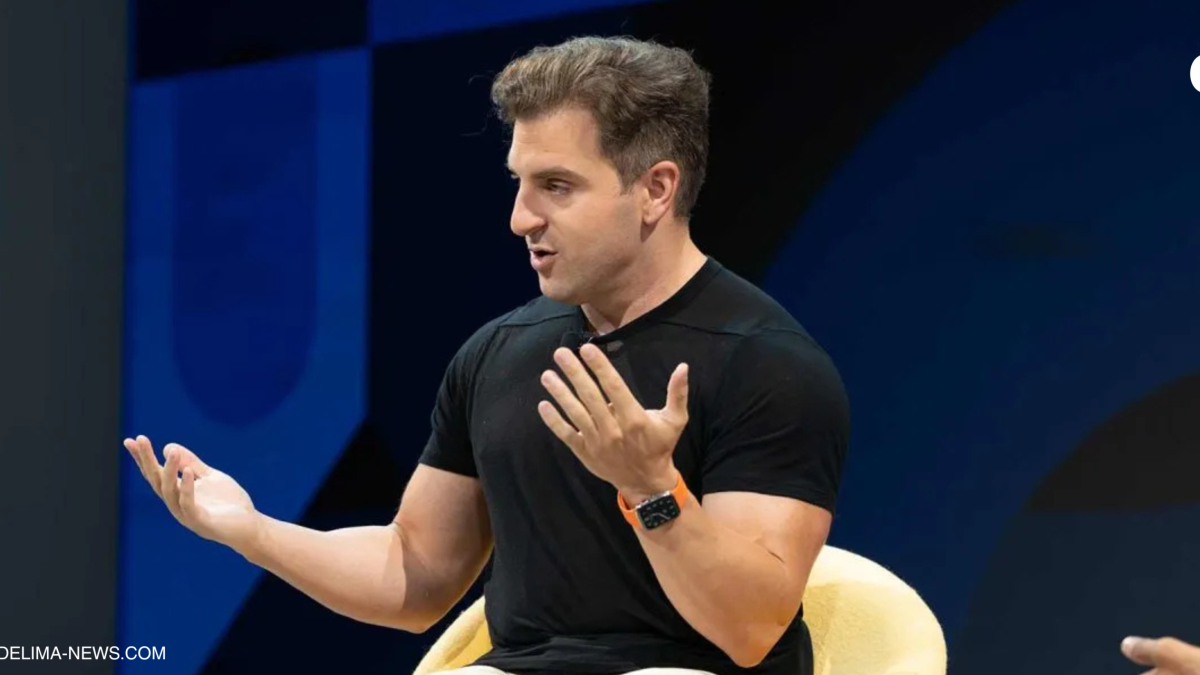
Brian Chesky is the founder of Airbnb, and this article talks about the founder’s journey from his childhood to Airbnb.
Brian Chesky is one of the most influential entrepreneurs of the modern travel industry. As the co-founder and CEO of Airbnb, he helped transform an unusual idea—letting strangers stay in one another’s homes—into a global hospitality platform. His journey is particularly remarkable because he did not begin as a technology entrepreneur. He studied design, worked as an industrial designer and was once struggling to pay his rent before eventually becoming a billionaire. Forbes lists Chesky as Airbnb’s co-founder and CEO, with nearly 14% ownership of the company. His estimated real-time net worth was approximately $12.4 billion as of August 18, 2026.
Brian Joseph Chesky was born on August 29, 1981, in Niskayuna, New York. He grew up in a middle-class family with his parents, Robert and Deborah Chesky, both of whom worked as social workers. He also has a younger sister, Allison. His childhood interests gave an early indication of the creativity that would later become central to Airbnb. Chesky was initially passionate about hockey, but during his teenage years he became increasingly fascinated by art and design. He would spend hours drawing and recreating paintings and became interested in redesigning everyday objects.
His parents supported his creativity but were understandably concerned about his career prospects. Chesky originally wanted to become an artist, while his parents encouraged him to eventually find a stable profession. His mother famously worried that choosing art could lead to financial struggles. That tension between creativity and practicality eventually shaped his career.
After graduating from Niskayuna High School in 1999, Chesky attended the prestigious Rhode Island School of Design (RISD). He initially studied illustration but later switched to industrial design because he believed it would provide broader career opportunities.
At RISD, Chesky met Joe Gebbia, who would later become his co-founder at Airbnb. The two shared an entrepreneurial mindset and were heavily involved in student activities. Chesky even served as captain of the college hockey team and eventually became the commencement speaker at his graduation. Chesky graduated from RISD in 2004 with a degree in industrial design.
His education became much more important to his future than simply providing him with a qualification. The design philosophy he learned at RISD would eventually influence Airbnb’s product, branding and customer experience. Airbnb itself says Chesky’s design background became embedded in the company’s culture and approach to building trust between strangers.
After graduating, Chesky moved to Los Angeles and worked as an industrial designer. He worked at the design company 3DID, where he contributed to projects involving products such as toys, guitars and medical equipment. At the time, Chesky was far from wealthy. Forbes notes that he was earning roughly $40,000 a year as an industrial designer before Airbnb became successful. Eventually, Chesky moved to San Francisco in 2007 to live with his former RISD classmate Joe Gebbia. That decision would completely change his life.
The origin of Airbnb is almost accidental. Chesky and Gebbia were struggling to pay the rent on their San Francisco apartment. At the same time, a major design conference was coming to the city and hotels were running out of rooms. The two friends realized they could rent out sleeping space in their apartment using air mattresses. They purchased air beds, created a simple website and offered visitors a place to stay along with breakfast. The idea became known as “Air Bed and Breakfast.” Rather than seeing their financial problem as an obstacle, Chesky and Gebbia turned it into a business experiment. They later brought in Nathan Blecharczyk, a programmer and another key co-founder, to help build the technology behind the idea. Airbnb officially emerged from this experiment in 2008.
Airbnb’s early years were anything but easy. Investors were skeptical about the concept. The idea of allowing strangers to stay inside people’s homes sounded risky and unusual, and the founders struggled to raise money. At one point, Chesky and his co-founders famously sold limited-edition election-themed cereal boxes to help finance the company and pay off debt. They also personally photographed properties because they realized that better photographs could make listings more attractive.
The breakthrough came when Airbnb was accepted into Y Combinator, the influential startup accelerator. The company subsequently began attracting investment and expanding beyond simple shared rooms to entire homes and other unusual accommodations. The company that started with air mattresses eventually became one of the world’s largest accommodation platforms.
Chesky did not have a traditional business education or years of corporate management experience when he became CEO. He essentially learned how to run a major company while building one. His approach has been heavily influenced by design. Instead of viewing Airbnb simply as a technology platform, Chesky has emphasized the entire experience—from discovering a property to communicating with a host and feeling comfortable staying in a stranger’s home.
During Airbnb’s growth, Chesky developed a reputation for being unusually hands-on and detail-oriented. His leadership style has often been compared to that of product-focused founders such as Steve Jobs, with a strong emphasis on design, storytelling and customer experience.
Airbnb eventually expanded into a global platform connecting millions of hosts and guests. According to Airbnb, the platform now has more than 5.5 million hosts and has served more than 2.5 billion guests across more than 220 countries and regions.
The COVID-19 pandemic represented one of the most difficult periods in Airbnb’s history. Global travel essentially collapsed, creating an existential threat to a company whose business depended on people travelling and staying in homes around the world. Chesky responded with significant changes to the company’s strategy, including cost reductions and a renewed focus on its core product. Airbnb eventually recovered strongly as travel returned. The crisis also reinforced Chesky’s reputation as a founder who remained deeply involved in the company’s strategy and product decisions.
Brian Chesky is not married and does not currently have a wife. Forbes lists his marital status as ‘single’. Because Chesky generally keeps his personal life relatively private, there is considerably more publicly available information about his career than his romantic relationships. He currently lives in San Francisco, the city where the Airbnb story began. Interestingly, in 2022 Chesky announced that he would begin living primarily in Airbnb properties, moving between different cities and towns every few weeks. The experiment reflected his philosophy of staying close to the customer experience.
Brian Chesky’s wealth comes primarily from his ownership stake in Airbnb. His net worth fluctuates with Airbnb’s stock price. Forbes estimated his real-time net worth at approximately ‘$12.4 billion on August 18, 2026′, while another Forbes listing recorded approximately $12.7 billion on August 19. Forbes’ 2026 billionaire profile also listed his net worth at $9.5 billion based on its March 10, 2026 snapshot. These differences demonstrate why billionaire net-worth figures should be treated as estimates rather than fixed amounts.
Chesky has also committed to philanthropy. He is a signatory of the Giving Pledge and has committed to donating the net proceeds of his CEO equity compensation to charitable and philanthropic causes.
Brian Chesky’s journey is not a conventional Silicon Valley success story. He wasn’t a computer scientist who dropped out of college to build a technology company. He was an industrial designer who struggled to pay rent, had little experience running a company and initially pursued a career designing physical products. What made the difference was his ability to approach problems through design.
A shortage of hotel rooms became an opportunity. An inability to pay rent became a business experiment. A background in art became an advantage in building a company centered around experience and human connection. Today, Brian Chesky stands among the world’s most successful entrepreneurs. His journey from a creative child in upstate New York to the billionaire CEO of Airbnb illustrates an important entrepreneurial lesson: “sometimes the biggest opportunities are hidden inside problems that everyone else simply accepts as obstacles.”
Brian Chesky founded Airbnb as a problem of high rent, so he rented out his apartment for conference meeting. Every problem is an opportunity, he proved that.