The S&P 500 and the Nasdaq have both closed at record highs, lifted once again by technology stocks. Investors are betting that spending on artificial intelligence will pay off, despite high oil prices, rising interest rates and a sell-off in US government debt.
The United States stock market has reached an all-time high, as enthusiasm for artificial intelligence continues to drive buying on Wall Street, Al Jazeera reported.
The S&P 500, the benchmark index, closed 0.58 percent higher on Tuesday, October 6, passing the previous peak it reached in mid-August.
The technology-heavy Nasdaq Composite also set a record, finishing up 0.45 percent.
How the Big Technology Stocks Moved
| Company | Change on the day |
|---|---|
| Amazon | +1.95% |
| Microsoft | +0.78% |
| Tesla | +0.51% |
| Apple | +0.22% |
| Alphabet | +0.22% |
| Nvidia | +0.14% |
| Meta | −0.41% |
Meta was the only one of the so-called “Magnificent Seven” to fall. Elsewhere in technology, Marvell Technology rose 5.81 percent and Cisco gained 4.54 percent.
The Year So Far
The S&P 500 has risen 14 percent in 2026, and the Nasdaq Composite is up 18.78 percent. The market is on course for a fourth consecutive year of double-digit returns.
‘A Technology and AI Surge’
Keith Lerner, chief investment officer at Truist Advisory Services, said the rally should be seen as a “technology and AI surge”.
“Technology and communication services were the only two S&P 500 sectors to rise last month, while the other nine declined,” he told Al Jazeera.
What the Market Is Ignoring
Share prices have risen despite an energy crunch caused by the war on Iran and a sell-off of US government bonds, driven partly by rising government debt.
“They are betting that the money pouring into data centres will earn a good return, and so far, that belief has outweighed rising interest rates, more expensive oil and a 10-year bond yield above 5 percent,” said Lochlan Halloway, a senior equity strategist at Morningstar Australia.
The Risks
Halloway cautioned that the market is concentrated in a handful of companies. The outlook for US shares, he said, “relies on the AI story continuing to deliver”.
Lerner said rising interest rates pose the biggest risk. “We do not expect a straight line higher for markets,” he said.
He also pointed to history: since 1950, the fourth quarter of a US midterm-election year has produced an average gain of 7 percent and has been positive 84 percent of the time.
Asia Did Not Follow
Asian markets fell the next day. South Korea’s Kospi dropped 1.98 percent, Japan’s Nikkei 225 fell 0.92 percent, and Hong Kong’s Hang Seng was down 0.57 percent shortly before the close.
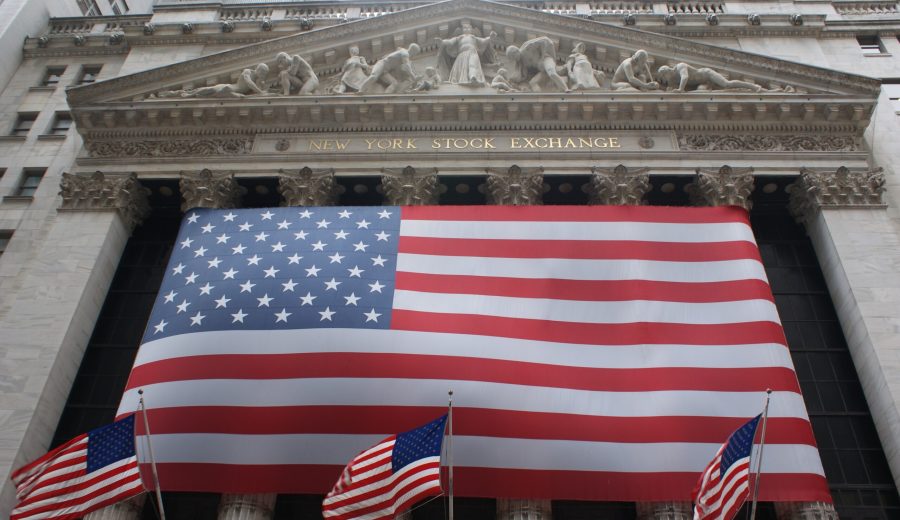
Image: The New York Stock Exchange (file photo). Photo by Elbie Ancona via Wikimedia Commons, CC BY-SA 3.0.