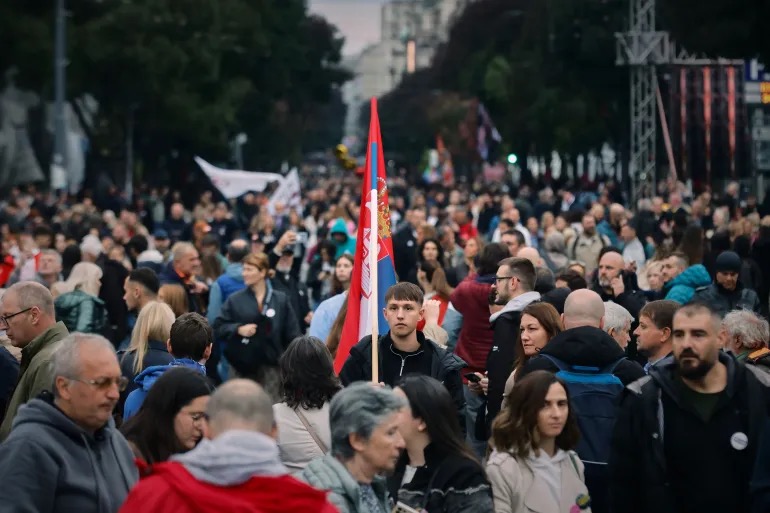
Serbia’s president-turned-candidate Aleksandar Vučić conceded defeat on the night of 25 October after a snap parliamentary election in which the student-led Student List was projected to win a majority. “It is clear that we have lost these elections,” he said, adding that final results were not yet available. He resigned as president in September to run for prime minister. The vote followed almost two years of protests that began after a railway station canopy collapsed in Novi Sad in November 2024, killing 16 people. The question now is whether a protest movement can turn a projection into a government.
The case that this is a decisive break rests on turnout and projected seats. Turnout reached 64.9% by 6pm, the highest since the breakup of Yugoslavia in 1992, according to the State Election Commission, and the CeSID and Ipsos projection estimated final turnout at 69.3%. That projection, based on 96% of the processed sample, gave the Student List 52.9% and Vučić’s United Serbia list 38.8%, or 140 seats against 103; a majority needs 126 of 250. CRTA’s separate projection put the students at 51.47% and Vučić’s list at 40.42%. Vučić himself estimated 135 to 140 seats for the students and 105 for his list. About 6.5 million people were eligible to vote across 18 lists, and tens of thousands celebrated in Belgrade. Ivica Dačić’s list came in at 2.2%, below the threshold, and the CeSID and Ipsos projection gave seven seats to minority lists, which brings the total to the full 250, so the new parliament would hold the students, Vučić’s list and minority parties only.
The case for caution is that none of these figures is an official result. The numbers differ slightly between CeSID and Ipsos, CRTA and Vučić’s own estimate, and the State Election Commission’s tally was still pending. CRTA observers recorded pressure on voters or election workers at almost a third of the 500 polling stations they monitored, and by 5pm CeSID had received about 260 reports of potential irregularities, including ballot photography, group voting and identification problems. The Student List fielded candidates from fields such as medicine and education, many with no political experience, and University of Belgrade researcher Jelena Vasiljevic noted that the Serbian Progressive Party has a reliable voter base while the students needed to attract people who normally do not vote. Some established opposition parties backed the students instead of running their own candidates, so the list’s support reaches beyond the movement itself.
For Serbia and the wider Balkans, the stakes are practical. The Progressive Party has governed since 2012, and its supporters credit Vučić with modernising the economy, while the movement against it was built on allegations of corruption and repression that Vučić and his party deny. European Commission President Ursula von der Leyen said the EU stands “ready to support reforms on the rule of law, media freedom, the fight against corruption.” Riot police were deployed near the election commission’s Belgrade headquarters, and city prosecutors urged everyone to avoid violence. Student List candidate Radomir Saicic said, “Let this night be the beginning of a new chapter,” while voter Jana Vasic described the result as “freedom from a dictatorship that has lasted for 12 years.”
The concession is real, but the transfer of power is not yet done. The official count, any challenges to irregularities and the first sitting of parliament will decide whether the students govern.