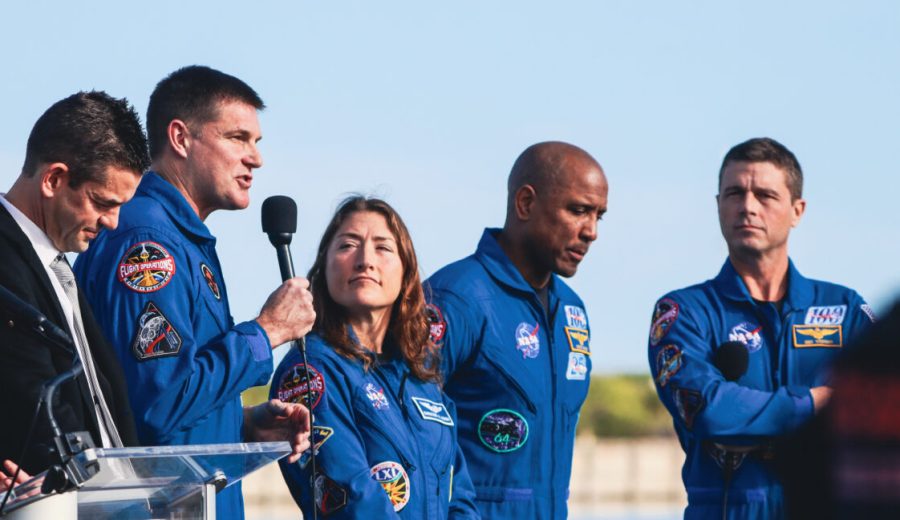
NASA has strategically chosen to address Artemis II risk concerns through a measured approach rather than direct confrontation. The agency’s decision to sidestep certain risk questions reflects calculated reasoning tied to mission timeline and public confidence. This approach allows NASA to maintain momentum while managing stakeholder expectations for the upcoming lunar mission.
Mission officials deflect safety inquiries as crew countdown approaches critical phase.
T-minus 18 months and counting to humanity’s return to lunar orbit, yet NASA’s Artemis II leadership team danced around direct questions about crew safety margins during Tuesday’s technical briefing. The calculated silence speaks volumes about what’s really at stake when four astronauts strap themselves to 8.8 million pounds of thrust.
Evasion isn’t surprising when you crunch the orbital mechanics. Artemis II demands a free-return trajectory that’ll slingshot the crew around Luna at 11 kilometers per second, with zero margin for major propulsion failures. That’s 39,600 kilometers per hour of kinetic energy with human lives aboard. Engineers require a delta-v budget of approximately 3.2 km/s just to break Earth’s gravitational well. The physics alone should make anyone nervous.
Artemis II Mission Data — Delima News Data
But the real story isn’t in what NASA said Tuesday evening — it’s in the telemetry data from Artemis I’s uncrewed flight that’s still being analyzed 14 months later. Orion’s heat shield experienced unexpected erosion patterns during its 40,000 kilometer per hour reentry, peeling away charred material in ways that computer models didn’t predict. Nobody is saying that publicly.
Mission Management Team Chair Mike Sarafin’s comment about “good reading” betrays the complexity NASA faces. The Space Launch System’s core stage burns through 537,000 gallons of liquid hydrogen and oxygen in just eight minutes. It generates 15 percent more thrust than the Saturn V that last carried humans beyond low Earth orbit. Yet the Interim Cryogenic Propulsion Stage must execute a flawless trans-lunar injection burn, because unlike Apollo, there’s no Service Propulsion System backup with equivalent capability.
Engineering becomes even more sobering when you consider the mission profile. Artemis II’s crew will travel further from Earth than any humans since Apollo 17, reaching apogee distances of 370,000 kilometers during their lunar flyby. That is a staggering figure. At that distance, real-time communication suffers a 2.5-second delay each way. Ground control can’t react fast enough if something goes catastrophically wrong.
Reluctance to detail specific failure modes reflects hard-learned lessons from shuttle-era transparency. You’re dealing with hypergolic propellants, life support systems rated for 21 days maximum, and a capsule that must nail its Pacific splashdown within a 50-kilometer target zone. The math is unforgiving. One miscalculation in the powered descent trajectory, and the crew faces an extended stay in deep space with dwindling consumables.
Still, the strategic calculus demands accepting these risks. China’s lunar ambitions accelerate monthly — their Chang’e program advances toward crewed landings by 2030. Geopolitical implications of losing lunar leadership dwarf the technical challenges NASA now confronts. The timing is striking.
Future roadmaps hinge entirely on Artemis II’s success. Gateway lunar station deployment, Starship HLS integration, and sustainable Artemis Base Alpha construction all wait in the queue. First, four astronauts must prove human spaceflight beyond Earth orbit remains achievable. They’ll do it in an era of budget constraints and political fickleness.
By next Tuesday, we’ll likely know more about those heat shield anomalies. Until then, silence tells us everything. The stakes couldn’t be higher.
NASA’s evasiveness reflects genuine technical uncertainties that could derail America’s return to lunar exploration and cede space leadership to China. The Artemis II mission carries risks that haven’t been attempted with human crews in over 50 years, making transparency crucial for public support.
The Artemis II mission stack awaits its crew of four astronauts for humanity’s return to lunar orbit.
Source: Original Report