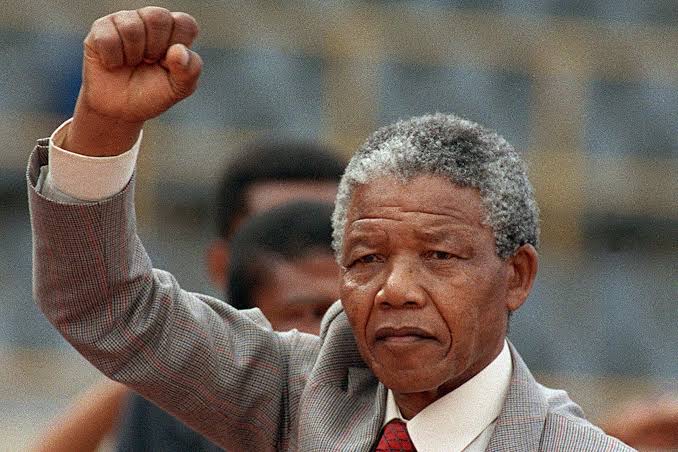
Nelson Mandela (18 July 1918 – 5 December 2013) was a South African anti-apartheid leader who spent 27 years in prison, shared the 1993 Nobel Peace Prize with F. W. de Klerk, and served as South Africa’s president from 10 May 1994 to 14 June 1999. He was the country’s first Black head of state and the first elected in a fully representative democratic election.
Nelson Mandela at a Glance
| Born | 18 July 1918, Mvezo, Cape Province, South Africa |
|---|---|
| Died | 5 December 2013, Johannesburg, aged 95 |
| Profession | Lawyer; anti-apartheid activist; politician |
| Party | African National Congress (ANC) |
| Imprisonment | 27 years (Robben Island, Pollsmoor, Victor Verster) |
| Released | 11 February 1990 |
| Nobel Peace Prize | 1993, shared with F. W. de Klerk |
| President of South Africa | 10 May 1994 – 14 June 1999 (succeeded by Thabo Mbeki) |
Early Life and Education
Mandela was born into the Thembu royal family. His great-grandfather Ngubengcuka ruled the Thembu Kingdom, and his father was a local chief and councillor. He began a BA at the University of Fort Hare in 1939 but was suspended after his first year and never returned. He completed his BA by correspondence through the University of South Africa and later studied law at the University of the Witwatersrand.
Career Journey
Mandela joined the African National Congress in 1943. The ANC Youth League was founded on Easter Sunday 1944, and he served on its executive committee.
In December 1956 he was arrested on charges of high treason. The Treason Trial began in Pretoria in August 1958, and on 29 March 1961 the judges returned a not guilty verdict. He was arrested again in 1962, and on 12 June 1964, in the Rivonia Trial, he and two co-accused were sentenced to life imprisonment rather than the death penalty the prosecution had sought.
27 Years in Prison and Release
Mandela served 27 years at Robben Island, Pollsmoor Prison and Victor Verster Prison. He left Victor Verster on 11 February 1990 after President F. W. de Klerk decided to release him.
Nobel Peace Prize and Presidency
The Norwegian Nobel Committee awarded the 1993 Peace Prize jointly to Mandela and de Klerk “for their work for the peaceful termination of the apartheid regime, and for laying the foundations for a new democratic South Africa”. The award ceremony took place on 10 December 1993.
South Africa held its first fully representative election on 27 April 1994. The ANC won 63% of the vote and Mandela was inaugurated on 10 May 1994. His government created the Truth and Reconciliation Commission to investigate past human rights abuses. In 1995, South Africa hosted the Rugby World Cup, and Mandela presented the trophy to Springboks captain Francois Pienaar after the final against New Zealand.
Writing and Foundation
His autobiography, Long Walk to Freedom, was published in December 1994. The Nelson Mandela Foundation was founded in 1999 and focused on rural development, school construction and combating HIV/AIDS.
Conclusion
Nelson Mandela’s life links the apartheid era and South Africa’s democratic transition: a decades-long struggle, 27 years of imprisonment, a negotiated settlement and a single term as president. He died on 5 December 2013 in Johannesburg at the age of 95.