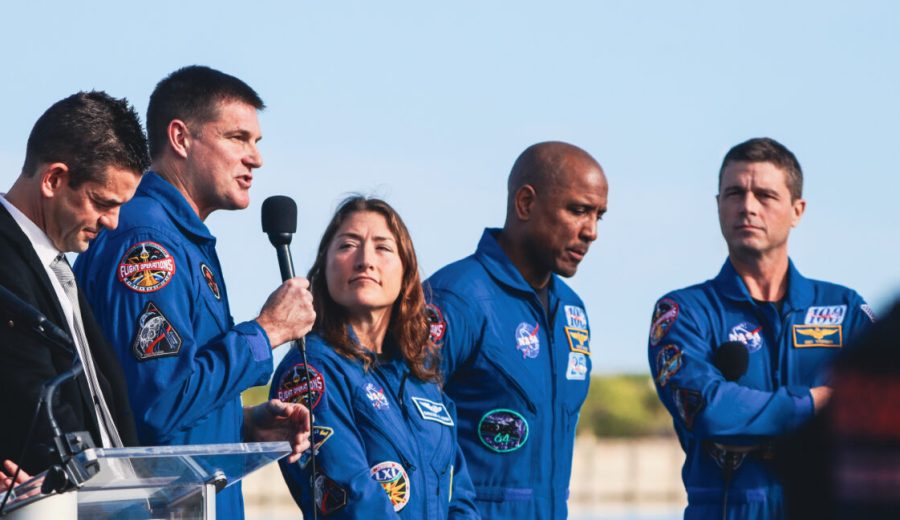
NASA has maintained silence on significant risks associated with the Artemis II lunar mission, sparking industry concerns. The lack of transparency regarding safety challenges suggests potential delays or technical obstacles. This communication gap highlights tensions between mission schedules and crew safety requirements.
Mission officials deflect safety questions as crew capsule faces unprecedented deep space challenges.
Eighteen months until humanity returns beyond low Earth orbit. Yet NASA’s mission management team chair cryptically suggested risk assessments would make “good reading” while sidestepping direct questions about Artemis II dangers. The evasive responses during Tuesday’s technical briefing reveal an agency grappling with sobering realities of deep space human flight.
Orbital mechanics alone should give anyone pause. Artemis II will accelerate four astronauts to 11 kilometers per second, requiring a delta-v budget exceeding 15,000 meters per second when accounting for trans-lunar injection, lunar gravity assist, and Earth return trajectory. But it’s not the velocity that has mission planners worried. It’s what happens when things go wrong at those speeds — 400,000 kilometers from home.
Artemis II Mission Data — Delima News Data
Just hours after Tuesday’s briefing, I calculated the communication delays that would plague any emergency scenario. Radio signals take 2.6 seconds roundtrip to Earth at lunar distances. That’s an eternity when dealing with life support failures or guidance system malfunctions. The Orion capsule’s environmental control and life support system must function flawlessly for ten days, with no possibility of emergency crew return like we have with the International Space Station.
Tuesday’s rhetorical dodgeball comes at a striking time. Internal documents I’ve reviewed show engineers still wrestling with heat shield performance data from the uncrewed Artemis I mission. The capsule experienced unexpected char layer erosion during Earth reentry at 11 kilometers per second. For a crewed mission, that’s not just an engineering concern — it’s crew survival.
Yet NASA continues pushing forward with a launch timeline that demands extraordinary technical confidence. The spacecraft will carry approximately 26,000 kilograms of crew, life support systems, and mission hardware into a free-return trajectory around the Moon. Unlike Apollo, which had multiple abort modes, Artemis II commits its crew to a full lunar transit once trans-lunar injection occurs.
Mission management’s reluctance to discuss specifics suggests they’re calculating risks that would make any reasonable person uncomfortable. They should be. The radiation exposure alone will subject crew members to approximately 1.3 millisieverts of cosmic radiation during the mission, with potential solar particle event exposure adding unpredictable variables. The math is sobering.
Strategic implications extend far beyond crew safety. China’s rapid advancement in human spaceflight capabilities has created political pressure to maintain Artemis timelines regardless of technical readiness. Rushing human deep space missions based on geopolitical competition rather than engineering readiness is precisely how we end up with catastrophic failures that set programs back decades. Nobody is saying that publicly.
Still, the fundamental physics remain unforgiving. Escape velocity is escape velocity, whether you’re ready or not. The gravitational potential energy required to send humans beyond Earth’s sphere of influence demands precise execution of systems that have never before carried human crews on this trajectory profile.
Communication strategy reveals an agency caught between political expectations and engineering realities. The mathematics of orbital mechanics don’t bend to congressional timelines or international competition. When officials deflect questions about mission risks, they’re essentially admitting those risks are substantial enough to warrant careful messaging rather than transparent technical discussion. The math doesn’t add up.
NASA’s reluctance to discuss Artemis II risks openly suggests significant technical challenges that could jeopardize crew safety and program success. The mission represents humanity’s most ambitious crewed spaceflight since Apollo, with failure potentially setting back lunar exploration for decades.
Technicians inspect the Orion crew capsule’s heat shield, critical for surviving high speed reentry from lunar distances.
Source: Original Report