
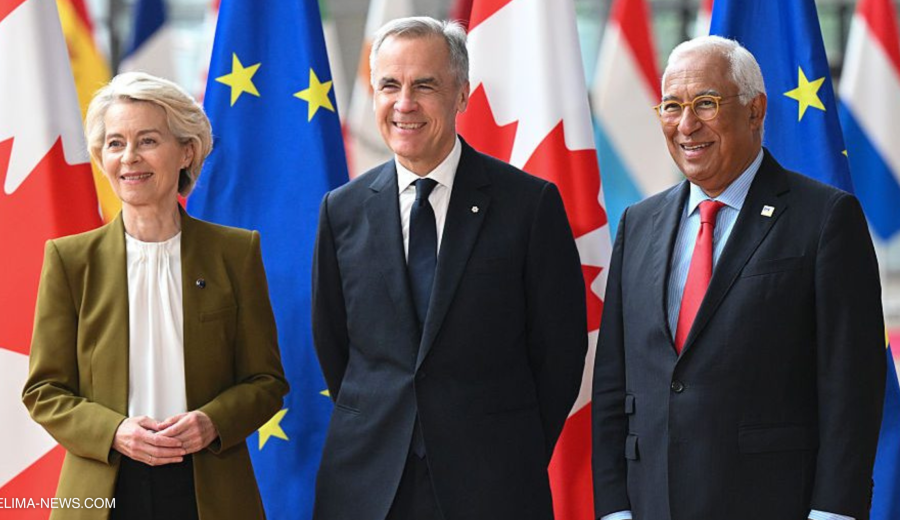
The European Union has proposed an unprecedented new relationship with Canada, as Prime Minister Mark Carney seeks to reduce his country’s economic dependence on the United States. But the proposal is still undefined—and Washington has already threatened retaliation.
Canada is not about to become the European Union’s 28th member. Instead, a far more unusual proposal is now on the table: European Commission President Ursula von der Leyen has invited Canada to become the bloc’s first-ever “associate member.”
The announcement came on September 16, 2026, during von der Leyen’s State of the Union address in Strasbourg, with Canadian Prime Minister Mark Carney in attendance. It follows Carney’s recent call for a “unique alliance” between Canada and Europe as relations with the United States have deteriorated. The proposal is potentially significant—but exactly what it means remains unclear.
Canada Is Not Seeking Full EU Membership
The first distinction is important. Canada cannot simply join the EU as a normal member state under the bloc’s existing framework. EU membership is designed for European states, and Canada is geographically outside Europe. Carney has also said that Ottawa is not seeking full EU membership, but rather a much deeper partnership.
That leaves the concept of associate membership. There is currently no formal “associate member” category in EU treaties. The arrangement would therefore have to be negotiated and designed from scratch. Reuters reports that any treaty-based change would require agreement from all 27 EU governments and domestic ratification.
In practical terms, Canada could potentially gain access to selected European programmes and markets without becoming a full member with voting rights inside EU institutions.
What Could Associate Membership Look Like?
One possible model could resemble aspects of the relationship Norway has with the EU. Norway is not an EU member but participates in the European Economic Area, giving it access to the EU single market in exchange for adopting large parts of EU regulations. Switzerland has also developed extensive access through a series of bilateral agreements.
However, Canada would not automatically receive either arrangement. The emerging Canada-EU proposal could instead focus on sector-by-sector integration. Von der Leyen has proposed cooperation covering:
- technology and artificial intelligence
- defence industries
- Arctic security and projects
- energy
- critical minerals
- batteries
- cyber security
- advanced manufacturing
- research and innovation
Canada is already participating in the EU’s €150 billion SAFE defence initiative, providing a foundation for greater military-industrial cooperation. Ottawa and Brussels are also discussing Canadian participation in programmes such as Erasmus+ and Horizon Europe, as well as mutual recognition of professional qualifications.
CETA Could Be the Starting Point
Canada and the EU already have a major trade agreement: the Comprehensive Economic and Trade Agreement, or CETA. The agreement has been provisionally applied since 2017 and significantly reduced trade barriers between Canada and the EU. Von der Leyen now wants to build beyond CETA through what she calls an “Alliance for the Future.”
The economic logic is straightforward. Canada currently depends heavily on the United States for trade. According to AP, around 70% of Canadian exports go to the U.S.
Greater European integration would give Ottawa another major economic relationship and potentially reduce its vulnerability to changes in U.S. trade policy.
Why Is the United States Reacting So Strongly?
The proposal comes at an especially sensitive moment in U.S.-Canada relations. President Donald Trump has repeatedly pressured Canada over trade and has also publicly discussed the idea of Canada becoming the 51st U.S. state. Ottawa has responded by seeking stronger economic and security relationships elsewhere.
Trump reacted sharply to the EU proposal on September 17. He called the idea of Canada joining the EU “laughable” and warned that Washington could impose “very serious” or “very heavy” tariffs on Europe if he considered the move hostile. He also threatened to restrict trade with the EU.
The European response was equally clear. French Europe Minister Benjamin Haddad said the United States does not have the authority to determine Europe’s geopolitical direction. The European Commission said the proposed strengthening of ties with Canada was “not against anyone else, but for our common strength.”
A New North Atlantic Alignment?
The most important aspect of the proposal may therefore be strategic rather than legal. Canada, the United States and Europe have historically been closely connected through NATO, trade and transatlantic institutions. But the Trump administration’s trade policies and tensions with Ottawa have encouraged Canada and European governments to explore greater economic and security independence.
For Europe, Canada offers natural-resource supplies, Arctic expertise, military capabilities and a major democratic partner outside the EU. For Canada, Europe offers access to a huge consumer market and an alternative source of investment, technology, defence cooperation and trade.
But significant obstacles remain. The EU has never created an associate-member status of this kind, and questions over voting rights, regulatory alignment, market access and the authority of EU institutions would have to be resolved. Even CETA has not yet been fully ratified by every EU member state.
The details are expected to receive greater attention at the Canada-EU summit in Montreal in October.
For now, the proposal should be understood not as Canada joining the European Union, but as the beginning of negotiations over an entirely new form of partnership.
What happens next could determine whether “associate membership” becomes a practical new model for EU relations—or remains an ambitious political idea born out of an increasingly uncertain transatlantic relationship.