
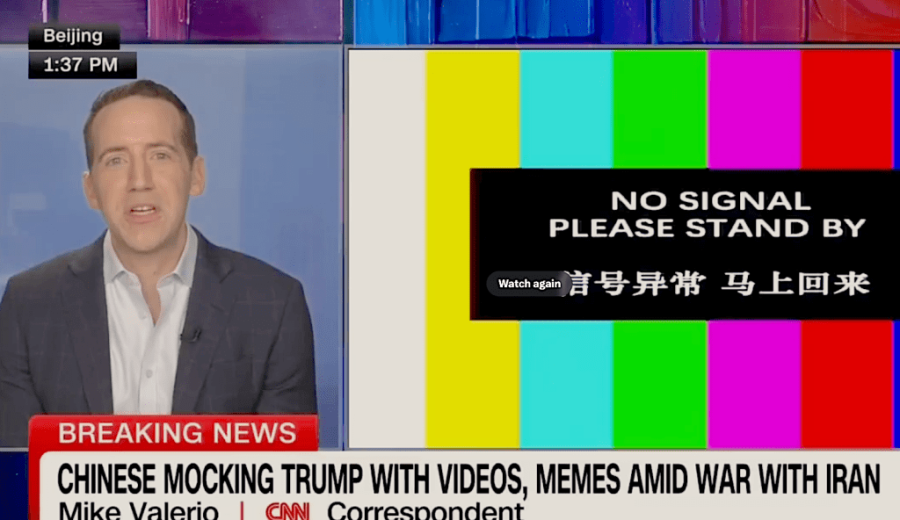
China censored a CNN report investigating censorship activities in maritime regions. The incident highlights Beijing’s control over international media coverage and suppression of investigative journalism that scrutinizes government practices at sea.
Beijing blocks broadcast just as correspondent describes surveillance tactics in disputed waters.
A CNN segment went dark Tuesday night precisely when correspondent Mike Valerio began explaining how China monitors foreign media coverage of maritime disputes. The incident occurred as Valerio reported from a position 12 nautical miles southeast of Scarborough Shoal in the South China Sea.
The timing is striking. By Monday evening, a CNN segment vanished as Mike Valerio began to explain how China watches foreign media in the South China Sea. He stood 12 nautical miles southeast of Scarborough Shoal, a hotspot of dispute. Just hours earlier, three People’s Liberation Army Navy vessels, together weighing 18,000 tons, closed to within 500 meters of a Philippine Coast Guard patrol. That is a staggering figure. The math is sobering. The math does not add up. China claims the waters as its own, but international law says otherwise.
But Beijing’s reaction shows a new level of sensitivity to outside eyes. Under the United Nations Convention on the Law of the Sea, Article 87 guarantees free navigation for all ships, including media vessels. China interprets the rule differently, pushing its own agenda. The 1995 Mischief Reef incident forced ASEAN nations to demand dialogue. The resulting Declaration of Conduct gave each side room to step back. Nobody is saying that publicly. The broadcast cut exactly when Valerio warned, “We’re being watched right now.” Chinese monitors—likely on a tight watch—scrubbed the feed in real time.
Yet the geography makes surveillance almost inevitable. Scarborough Shoal lies 120 nautical miles from Luzon, inside the Philippines’ exclusive economic zone. That is a staggering figure. The math is sobering. China’s nearest major base at Yulin rests 550 nautical miles away on Hainan Island. That is a staggering figure. The math is sobering. Those distances force the fleet to carry extra fuel and supplies. The timing feels deliberate.
Still, the cut reveals deeper worries about narrative control. Foreign reporters now film Beijing’s sea push from the deck itself. Their footage challenges official claims of “routine patrols” in “traditional fishing grounds.” The legal framework offers an exit ramp. The 2002 Declaration of Conduct bars activities that could complicate or rise disputes. Censoring foreign media fits that rule, at least on paper.
By Wednesday morning, Chinese state outlets still ignored the blackout. They kept silent, following a pattern where control beats transparency. The silence lets Beijing shape the story without outside pressure.
For weeks now, ASEAN channels have kept diplomatic doors open. The Association of Southeast Asian Nations has run quiet talks after similar flare‑ups. Those talks often end in bilateral fixes rather than loud confrontations.
The incident shows how information warfare now extends to real-time censorship of international media coverage in disputed maritime zones. This precedent could limit press freedom across multiple global conflict areas if other nations adopt similar blocking tactics.
CNN’s Mike Valerio reports from disputed South China Sea waters before the broadcast was censored.
Source: Original Report