
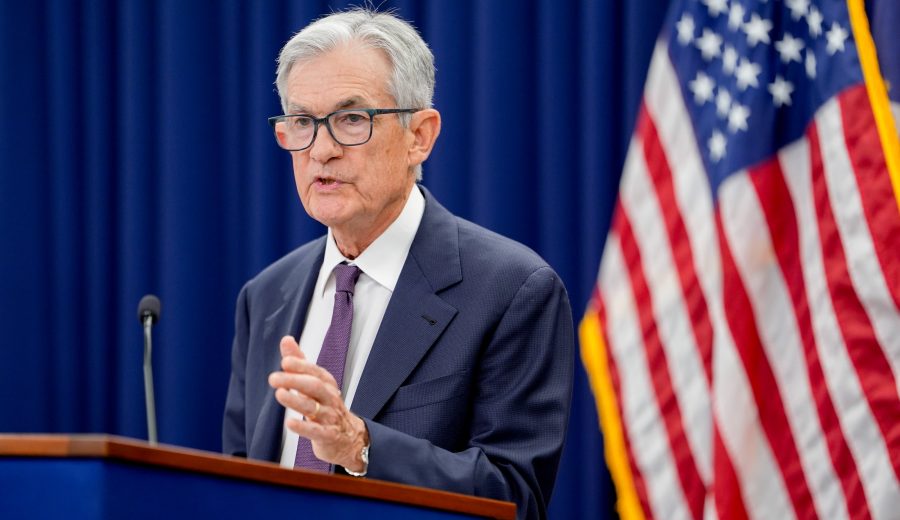
The Federal Reserve is anticipated to hold interest rates steady at its upcoming monetary policy meeting despite ongoing inflation uncertainties. This decision reflects the central bank’s cautious approach to balancing economic growth with price stability. Market analysts suggest the Fed will maintain its current stance while monitoring inflation data closely.
Policymakers face conflicting signals on economic growth and price pressures.
The 10-year Treasury yield retreated 8 basis points to 4.22% Tuesday ahead of Wednesday’s Federal Reserve decision. Markets are pricing in a 97% probability of no rate change, according to CME FedWatch data. The central bank finds itself caught between persistent inflation concerns and signs of economic cooling.
Tuesday’s pause reflects a challenging balancing act facing Fed officials. Recent inflation data shows core PCE at 2.8%, still above the 2% target but trending lower. That’s progress, but not victory.
Data
Key Economic Indicators: Mixed Signals
Source: Delima News analysis | percent
Yet services inflation remains sticky at 3.9%, keeping policymakers cautious about declaring the battle won. They’ve seen this movie before — premature celebrations followed by inflation’s return.
Labor market signals paint a mixed picture that confuses even seasoned economists. Job openings fell to 8.7 million in November, down from 9.2 million the prior month. The decline suggests cooling demand for workers.
But wage growth holds steady at 4.1% annually — a figure that makes inflation hawks nervous. The unemployment rate sits at a historically low 3.7%. Nobody’s calling this a weak job market.
Yield curves tell their own story of economic uncertainty. The 2-year Treasury trades 45 basis points above the 10-year — an inversion that’s persisted for 14 months. Historically, this signals recession ahead.
Still, consumer spending data released Monday showed resilient demand through the holiday season. Americans kept shopping despite higher borrowing costs. The disconnect between bond markets and Main Street continues.
Chair Powell faces pressure from both hawks and doves on the Federal Open Market Committee. Hawks worry about cutting rates too early and reigniting inflation. They remember the 1970s mistakes.
Doves point to cooling wage pressures and declining job openings as signs the economy’s slowing naturally. Why keep hitting the brakes when the car’s already decelerating?
Credit markets show growing stress that policymakers can’t ignore. Corporate bond spreads have widened 25 basis points since early December. Regional bank stocks fell 3.2% over the past week on commercial real estate concerns. The timing is striking given the Fed’s own warnings about financial stability risks.
Housing data complicates Powell’s decision even further. Mortgage rates near 7% have frozen home sales — existing home sales dropped 7.3% year over year. That’s a massive pullback in a key economic sector.
Yet home prices continue rising in most metros, up 4.8% nationally. The math doesn’t add up at first glance. The disconnect reflects supply constraints rather than demand strength.
Wall Street economists overwhelmingly expect no change to the federal funds rate range of 5.25% to 5.50%. Goldman Sachs, JPMorgan, and Morgan Stanley all forecast a hold. The consensus sees the first cut coming in May, assuming inflation continues its gradual decline.
But the Fed’s dot plot projections could shift market expectations dramatically. December’s summary showed officials split on 2024 rate cuts. Three projected no changes, while eight saw at least two quarter-point cuts. That’s hardly unanimous.
International factors add complexity to an already difficult decision. The European Central Bank signaled potential cuts by mid-2024. The Bank of Japan maintains ultra-loose policy despite rising inflation. Currency volatility from policy differences could complicate Fed moves.
Core goods deflation is slowing — bad news for inflation fighters. Housing services inflation, which lags rent growth, may remain high through spring. Energy prices have stabilized after earlier declines. The math is sobering for rate cut advocates.
Financial conditions have eased dramatically since October’s banking stress. The dollar weakened 4% against major currencies over recent weeks. Equity markets rallied on rate cut hopes. These looser conditions may actually delay Fed easing by boosting economic activity.
Wednesday’s statement language will be crucial for market direction. Any softening of hawkish rhetoric could spark bond rallies across the curve. Markets will scrutinize every word change from December’s cautious tone. The timing couldn’t be more sensitive.
The Fed’s decision affects borrowing costs for mortgages, business loans, and credit cards — hitting millions of Americans directly. Any shift in rate expectations will ripple through global markets and currency values. The central bank’s credibility on fighting inflation remains at stake with this pivotal decision.
The Federal Reserve faces competing pressures as it weighs its next policy move Wednesday.
Source: Original Report