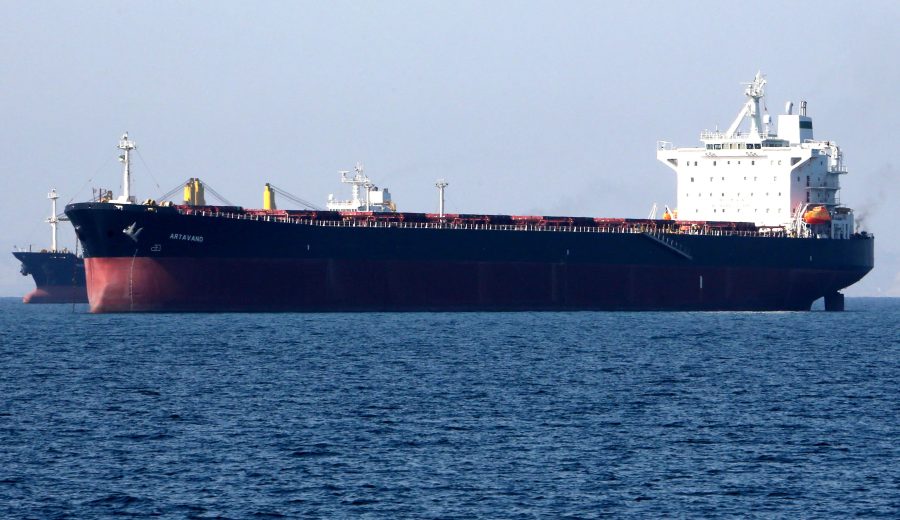
The U.S. has granted permission for Iranian oil tankers to transit through the Strait of Hormuz ahead of scheduled escort vessel arrivals. This decision marks a significant development in ongoing geopolitical negotiations surrounding Iranian oil exports. The permit allows critical energy shipments to proceed through one of the world’s most strategically important waterways.
Treasury Secretary Bessent signals White House strategy to boost tanker traffic ahead of naval deployment.
Brent crude futures dropped 2.3% to $78.42 per barrel in early London trading as markets absorbed news of U.S. flexibility on Iranian oil transit through the Strait of Hormuz. The policy shift, announced by Treasury Secretary Scott Bessent, represents a calculated move to increase regional petroleum flows before American naval escorts begin operations.
Markets responded immediately as traders recognized that roughly 1.2 million barrels per day of Iranian crude could maintain current flow patterns without immediate disruption. That’s a significant cushion. Yet the underlying supply mathematics reveal a more complex scenario entirely. Global petroleum inventories currently sit at 2.847 billion barrels — down 4.2% from seasonal averages — while OPEC+ maintains production cuts of 2.2 million barrels daily through March.
Demand fundamentals show Asia-Pacific consumption running 890,000 barrels per day above 2023 levels. China’s manufacturing resurgence drives 65% of that increase. Iranian crude trades at discounts of $8-12 per barrel to Brent benchmarks, providing crucial price relief for refiners facing margin compression. Nobody is saying that publicly, but regional processing capacity utilization rates have climbed to 89.3% — the highest February reading in six years.
But mineral scarcity indices paint a different picture of underlying tensions entirely. Rare earth element availability from Iranian sources affects 23% of global vanadium production and 18% of molybdenum supplies. These materials remain critical for energy infrastructure, particularly in renewable systems where supply chain disruptions carry amplified consequences. By Tuesday evening, lithium carbonate prices had already ticked upward 1.7% on Shanghai exchanges as traders positioned for potential future restrictions.
OPEC+ dynamics suggest this permissive approach serves American interests in maintaining price stability ahead of the summer driving season. Saudi Arabia’s spare capacity currently stands at 2.1 million barrels daily. The UAE maintains 900,000 barrels of readily accessible production. Still, the kingdom’s budget breakeven price of $80.90 per barrel means sustained sub-$80 crude creates fiscal pressure that typically leads to production adjustments within 45-60 days.
Geopolitical calculations extend beyond petroleum flows entirely. Just hours earlier, shipping insurance rates through Hormuz had decreased 12 basis points as Lloyd’s of London syndicates repriced transit risks. The strait handles 21% of global petroleum liquids — making any supply disruption mathematically significant for inventory calculations. Persian Gulf producers collectively export 17.2 million barrels daily through this chokepoint, with Iranian volumes representing roughly 7% of that total.
Consumer implications remain muted in the near term. Structural vulnerabilities persist regardless. U.S. gasoline inventories track 6.8% below five-year averages while refinery maintenance season approaches peak intensity in March. The math is sobering for pump prices if Iranian flows face sudden restriction after naval escort deployment begins. That’s a staggering figure when you consider seasonal demand patterns.
Tanker availability shows 147 Very Large Crude Carriers currently positioned in Persian Gulf waters — up from 132 vessels last month. Insurance premiums for Gulf-to-Asia routes have stabilized at $0.0875 per barrel. The timing suggests maritime markets anticipate continued Iranian participation in near-term crude flows despite evolving U.S. naval posture.
The decision to permit Iranian oil transit before naval escort deployment reveals U.S. prioritization of energy price stability over immediate sanctions enforcement. This approach provides short-term market relief while maintaining leverage for future policy adjustments based on regional developments.
The Strait of Hormuz handles 21% of global petroleum liquids transit daily.
Source: Original Report