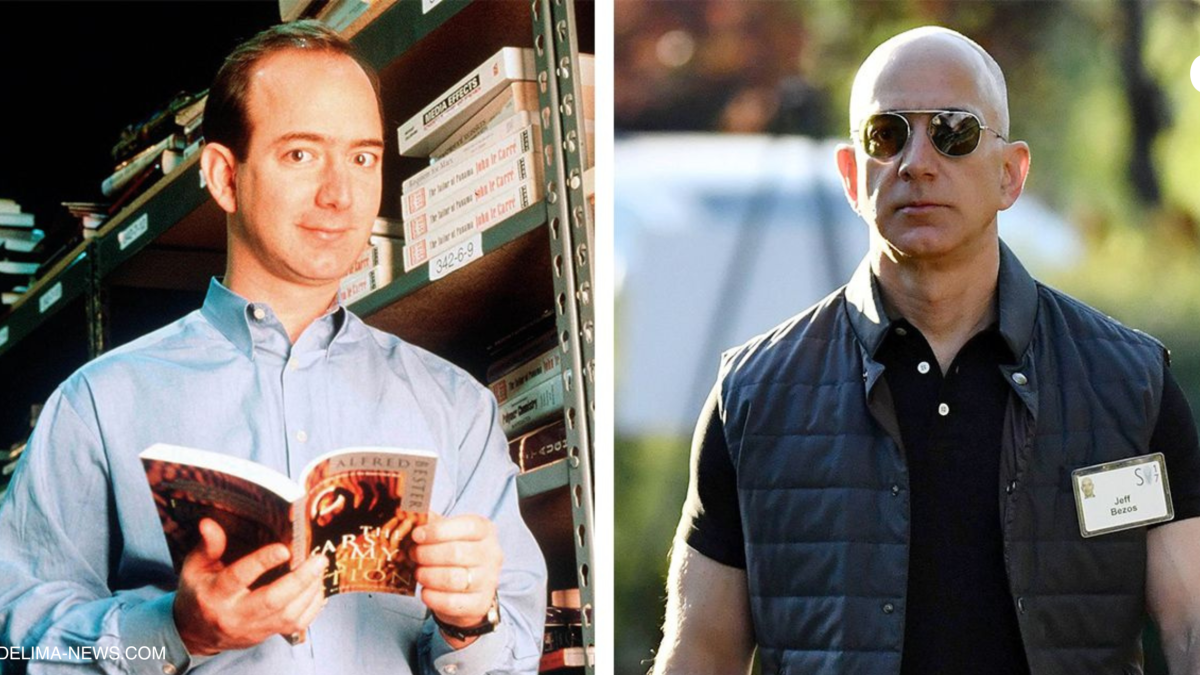
Jeff Bezos is an American Billionaire, well known for Amazon. This article talks about his life, schooling, and career, and how he came to build Amazon.
Jeff Bezos is one of the most influential entrepreneurs of the modern era. The founder of Amazon transformed a simple online bookstore into one of the world’s most powerful technology and commerce companies. Yet his story is not simply about becoming extraordinarily wealthy. It is also a story of curiosity, calculated risk-taking, long-term thinking and an unusual willingness to keep working after achieving financial success. As of August 2026, Bezos is 62 years old and remains Amazon’s executive chairman. Forbes estimates his fortune at roughly $280 billion, placing him among the world’s richest people.
Jeffrey Preston Bezos was born on January 12, 1964, in Albuquerque, New Mexico. His mother, Jacklyn, was a teenager when he was born. His biological father, Ted Jorgensen, separated from his mother when Jeff was very young. When Bezos was four, his mother married Miguel “Mike” Bezos, a Cuban immigrant who had come to the United States as a teenager. Mike adopted Jeff and became the father figure who raised him. The family eventually lived in Houston, Texas, and later Miami, Florida. From childhood, Bezos displayed a fascination with science and technology. He reportedly transformed his parents’ garage into a small laboratory and experimented with electrical devices. He also spent summers on his grandparents’ ranch in Texas, where he learned practical skills and developed an appreciation for hard work.
Bezos attended Miami Palmetto Senior High School in Florida, where he graduated as valedictorian in 1982. Even as a teenager, his ambitions extended beyond ordinary career paths. He was particularly interested in computers, science and eventually space exploration. He went on to Princeton University, studying electrical engineering and computer science. In 1986, he graduated summa cum laude and was elected to Phi Beta Kappa. His education gave him the technical foundation that would later prove valuable when he entered the rapidly developing world of the internet.
After Princeton, Bezos worked in technology and finance. He began at Fitel and later worked at Bankers Trust before joining the investment firm D.E. Shaw. At D.E. Shaw, Bezos quickly rose through the ranks and became one of the firm’s youngest senior vice presidents. His career was already highly successful, and he had a comfortable path ahead of him. Then he discovered something that changed his life. While researching the growth of the internet, Bezos noticed that internet usage was expanding at an extraordinary rate. He began thinking about products that could be sold online and recognized books as an ideal starting point because a physical bookstore could stock only a limited selection, while an online store could theoretically offer millions of titles. In 1994, Bezos made a decision that would define his life: he left his lucrative Wall Street career and moved to Seattle to build an internet company.
Bezos initially called his company Cadabra before eventually settling on the name Amazon. The company began operating as an online bookstore in 1995. The early Amazon was nothing like the global corporation people know today. Bezos and his small team worked from a garage, and orders were initially packed and shipped manually. His then-wife, MacKenzie Scott, helped with the early business, including accounting and operational work.The idea was simple but revolutionary: give customers an enormous selection, make shopping convenient and continually improve the experience. Bezos did not want Amazon to remain a bookstore. His larger ambition was to build an “everything store” capable of selling virtually anything. That philosophy eventually led Amazon into electronics, clothing, groceries, entertainment, logistics, artificial intelligence and cloud computing. Amazon Web Services became another major turning point. What began as infrastructure developed for Amazon eventually became a massive cloud-computing business serving companies and governments around the world.
Bezos eventually expanded far beyond e-commerce. In 2000, he founded Blue Origin, an aerospace company focused on making spaceflight more accessible and developing technologies for long-term human activity in space. Bezos has repeatedly described space as a major part of his long-term vision. In 2013, he purchased The Washington Post, adding a major media organization to his portfolio. He has also invested through Bezos Expeditions and created philanthropic initiatives including the Bezos Day One Fund and the Bezos Earth Fund. The Earth Fund represents a $10 billion commitment toward climate and nature-related efforts, with funds intended to be allocated by 2030. In 2026, Bezos and the Bezos Earth Fund were also involved in a $200 million initiative with Leonardo DiCaprio’s Re:wild to support the recovery of 100 threatened species.
Bezos married novelist MacKenzie Scott in 1993 after the two met while working at D.E. Shaw. They had four children, including a daughter adopted from China. After 25 years of marriage, they divorced in 2019. As part of the settlement, Scott received a substantial portion of Bezos’ Amazon holdings. Bezos later entered a relationship with journalist and television personality Lauren Sánchez. They married in 2025.Despite his enormous public profile, Bezos has generally kept much of his family life away from the spotlight.
Perhaps the most fascinating part of Bezos’ story is what happened after he became unimaginably wealthy. In 2021, he stepped down as Amazon’s CEO and became executive chairman. That could have been the moment when he completely retired. Instead, he continued working on his other ambitions, particularly Blue Origin and his investment and philanthropic activities. For Bezos, money appears to be less important than building things and pursuing enormous long-term goals. His interest in space is a good example. He has described Blue Origin as an effort to create a future in which millions of people can eventually live and work in space. That is a goal that cannot be completed in a few years—or even necessarily within one person’s lifetime. This helps explain why wealth has not brought Bezos’ career to an end. Once basic financial security is completely removed, the motivation changes. The challenge becomes the goal itself: Can something enormous be built? Can a difficult problem be solved? Can an idea survive decades of work?
One of Bezos’ most famous ideas is the importance of thinking long term. Amazon spent years sacrificing short-term profits to build infrastructure, technology and customer loyalty. Critics frequently questioned the strategy, but Bezos continued investing in the future. His career also demonstrates his willingness to take calculated risks. Leaving a successful Wall Street career to start an internet bookstore in 1994 could have ended in failure. Instead, it became one of the greatest entrepreneurial successes in history. Bezos has also spoken about the importance of avoiding regret. His decision to leave D.E. Shaw was influenced by the fear that he might regret not trying to build an internet company while the opportunity existed.
Jeff Bezos’ journey is unusual because his story did not end when Amazon made him wealthy. A curious child became a top student. A Princeton graduate became a Wall Street executive. A successful financier became an internet entrepreneur. The entrepreneur built Amazon into a global giant, then turned his attention toward space, media, climate and other long-term projects. At 62, Bezos has more money than he could realistically spend in several lifetimes. Yet he continues to invest his time and resources into projects that may take decades to reach their full potential. Perhaps that is the most important lesson from his life: for some entrepreneurs, wealth is not the finish line. It is the freedom to pursue bigger ambitions.
Jeff Bezos is a cornerstone of the Tech Industry as he revolutionised E-commerce. He continues to break barriers and build beyond Amazon.