Nobel-winning economist Paul Krugman has warned that France may have become “too big to save” if investors lose confidence in its debt. A former head of the European Central Bank says help is available, but only if French politicians first agree a credible budget.
France is on a “fiscally unsustainable path” and may have become “too big to save” for the European Central Bank, the economist Paul Krugman has warned, according to CNBC.
The Nobel laureate made the argument in a blog post on Thursday, October 8, as Prime Minister Sébastien Lecornu struggles to pass a contentious 2027 budget and student protests continue across the country.
Krugman’s Argument
Krugman wrote that France faces mounting interest on its government debt, while large budget deficits make its high ratio of debt to economic output worse.
A key problem, he argued, is the country’s failure to address its relatively low retirement age as its population ages.
Because France uses the euro, he said, a loss of investor confidence could become “an ugly crisis”, as happened in Greece, Portugal, Spain and Italy between 2009 and 2012.
He described how that would work: investors stop buying a country’s bonds, raising fears that the government will run out of cash and default. That fear drives more money out, which pushes interest rates higher, “and the vicious circle deepens”.
Why France Is Different
In 2012, the ECB’s then president, Mario Draghi, calmed markets by promising to do “whatever it takes”. Krugman noted that the promise was accepted in large part because southern European countries were making “massive spending cuts”.
Rescuing France, he wrote, would be “extremely expensive” for the ECB and politically contentious for as long as the country is moving “even further from fiscal responsibility”.
“France may have crossed the line from too big to fail to too big to save,” he wrote.
France is the European Union’s second-biggest economy.
Trichet: ‘Hard Work to Do’
Jean-Claude Trichet, who led the ECB from 2004 to 2011, told CNBC on Friday that the tools to deal with a crisis exist and have worked before.
“The ball is in the camp of the French government and parliament, and they have hard work to do,” he said.
The tools include the European Stability Mechanism and, at the most extreme end, the ECB’s Transmission Protection Instrument, a measure finalised in 2022 that has never been used.
Any intervention would require the French government to ask the ECB for help, which it currently says it does not need, Trichet said.
A Call for Compromise
Trichet urged all political parties to act responsibly, acknowledging that the approach of a presidential election makes that harder.
He said they must “prove that they can deliver something which would be credible”, adding that this is one of the conditions for the ECB’s instrument to be activated.
“You first have to help yourself,” he said, drawing on his experience of the earlier debt crisis, “because we cannot win if you are not yourself convincing market participants, investors, and savers that you are credible.”
The Backdrop
Lecornu’s 2027 budget seeks tens of billions of dollars’ worth of savings. At the same time, students are protesting over what they say is underfunding in education.
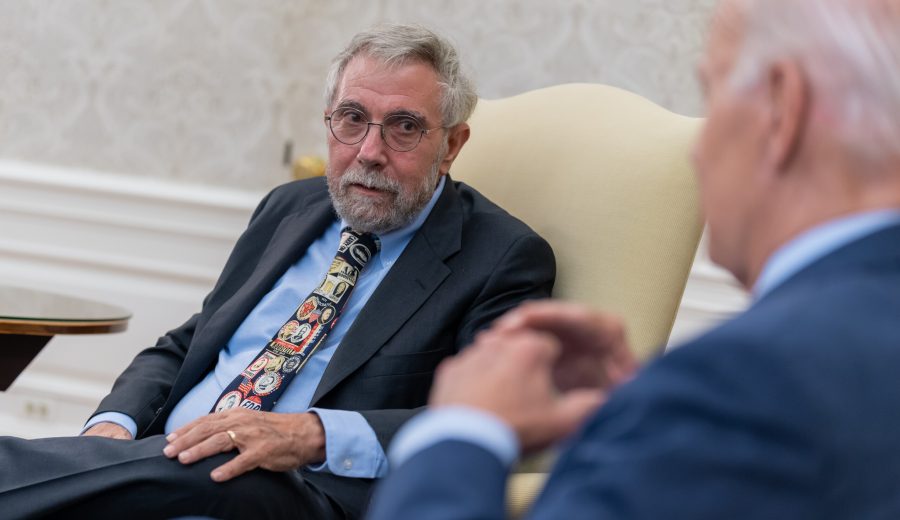
Image: Paul Krugman at the White House, August 2023. Official White House photo via Wikimedia Commons, public domain.