
Three scientists who found a way to switch nerve cells on with light have won the 2026 Nobel Prize in Physiology or Medicine. The technique, optogenetics, began with a protein from a single-celled alga and has changed how the brain is studied.
The 2026 Nobel Prize in Physiology or Medicine has been awarded jointly to Karl Deisseroth, Peter Hegemann and Georg Nagel.
The Nobel Assembly at Karolinska Institutet announced the prize on October 5, “for their discoveries concerning light-gated ion channels and optogenetics”.
What Optogenetics Is
Optogenetics is a method for controlling nerve signals with light. According to the Nobel Assembly, it makes it possible to show how nerve cells shape memories, feelings and behaviours in the living brain.
In the 20th century, researchers began to work out which areas of the brain affect which functions, but the methods available meant they could not prove causal relationships. The Assembly compared the resulting picture of the brain to “a sketch map, full of question marks and unknowns”.
“Optogenetics provides opportunities for mapping the brain in a way that we could once only dream of,” said Per Svenningsson, chair of the Nobel Committee for Physiology or Medicine.
It Began With an Alga
The story started with Peter Hegemann’s curiosity about Chlamydomonas, a single-celled alga that is able to swim towards a light source.
In the early 2000s, he and Georg Nagel discovered channelrhodopsin, a protein on the surface of the algal cell. When it is illuminated by blue light, a channel opens through the protein. Charged ions flow into the cell and create an electrical impulse.
They found that whichever cell they put the protein in, that cell became sensitive to light.
A Switch for Nerve Cells
Karl Deisseroth took the next step. He introduced the gene for channelrhodopsin into nerve cells from rats and, by illuminating the cells with blue light, was able to trigger a nerve signal.
He published that breakthrough in 2005. Two years later, he made the light-controlled switch work in the brains of living mice.
What It Has Made Possible
Using optogenetics, the Assembly said, researchers have been able to reveal neural circuits governing specific memories, feelings and behaviours relevant to neurological and psychiatric disorders.
In clinical medicine, researchers are using the method in attempts to restore sight in people with visual impairment.
The Laureates
- Karl Deisseroth, born 1971, of the Howard Hughes Medical Institute and Stanford University in the United States
- Peter Hegemann, born 1954, of Humboldt University of Berlin, Germany
- Georg Nagel, born 1953, of the University of Würzburg, Germany
The prize amount of 12 million Swedish kronor will be shared equally between the three.
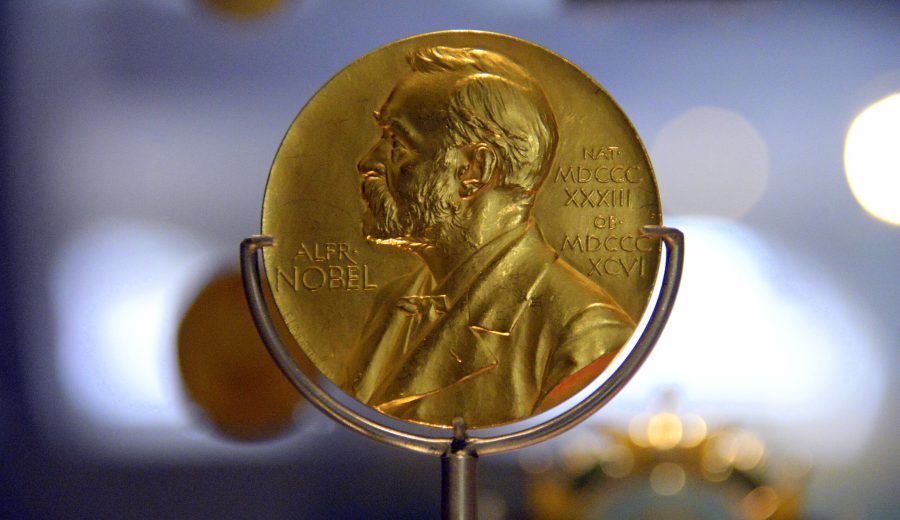
Image: A Nobel Prize medal for medicine, awarded to Alexander Fleming in 1945 (file photo). Photo by Osama Shukir Muhammed Amin via Wikimedia Commons, CC BY-SA 4.0.