
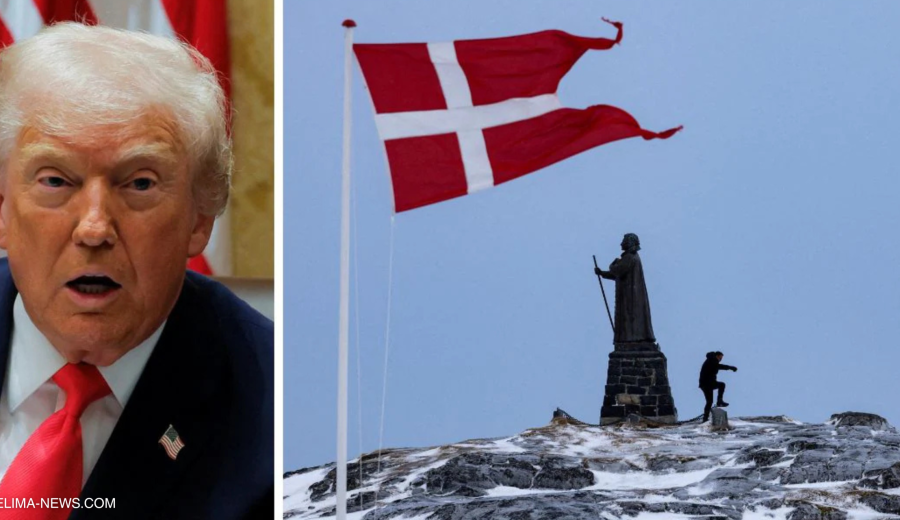
The agreement would expand the US military presence in Greenland and restrict potential Russian and Chinese activity, while Denmark and Greenland say their sovereignty and right to self-determination remain intact.
The United States and Denmark have reached an agreement on Greenland’s security that could significantly expand Washington’s military presence on the strategically important Arctic island, President Donald Trump announced Friday.
The agreement marks a major shift from the confrontation that has defined US-Danish relations since Trump returned to the White House. Trump had repeatedly argued that the United States needed to acquire Greenland and had refused to rule out using force to achieve that objective.
The new arrangement, however, does not transfer Greenland to the United States. Greenland will remain a self-governing territory within the Kingdom of Denmark. Danish and Greenlandic officials have specifically emphasized that their sovereignty and the Greenlandic people’s right to self-determination are preserved.
What Has Been Agreed?
Trump described the agreement as giving the United States “permanent control” over security and other security-related needs in Greenland.
He said Washington would immediately begin developing plans for a larger US military presence on the island. Trump also said that US adversaries would not be permitted to establish military bases, station forces or make sensitive investments in Greenland without Washington’s approval.
The precise legal scope of those powers remains unclear because the full agreement has not yet been published.
Reuters reported that the arrangement is designed to give the United States expanded and potentially permanent rights concerning military access, basing and overflight. The agreement would also prevent US strategic competitors from establishing a military foothold on the island.
That represents an important distinction from Trump’s earlier demand for American ownership of Greenland.
Greenland Remains Under Danish Sovereignty
For Copenhagen, preserving sovereignty was central to the agreement. Danish Prime Minister Mette Frederiksen said the arrangement strengthens security in the Arctic and North Atlantic while recognizing the sovereignty and territorial integrity of the Kingdom of Denmark and the Greenlandic people’s right to self-determination.
Greenland’s Prime Minister Jens-Frederik Nielsen likewise said the agreement strengthens the security of Greenland, Denmark, the United States and their Western allies while recognizing Greenland’s interests.
The three governments are expected to sign the agreement during the United Nations General Assembly in New York next week. It will then have to go through the necessary parliamentary procedures in Denmark and Greenland before entering into force.
The US Already Has a Military Presence
The agreement does not establish an American military presence from scratch. The United States has maintained military facilities in Greenland for decades. Its most important current installation is Pituffik Space Base, located in the northwest of the island. The base supports missile-warning, missile-defence and space-surveillance missions and is strategically important because of Greenland’s position between North America, the Arctic and the North Atlantic.
A 1951 US-Danish defence agreement already provides Washington with extensive military access to Greenland. It was subsequently updated in 2004.
Consequently, the new agreement appears to build on an existing security framework rather than completely rewriting the relationship.
The key question is how much additional freedom Washington will receive to expand its military footprint.
Why Greenland Matters to Washington
Greenland’s geographical position makes it strategically important to the defence of North America. The island sits between North America and Europe and is close to major Arctic and North Atlantic routes. Its location provides advantages for monitoring air and maritime activity across the region.
The Arctic is also becoming increasingly important as climate change makes previously inaccessible areas more navigable and as Russia expands its military infrastructure in the region. China has also increased its economic and strategic interest in the Arctic.
For Washington, preventing rival powers from obtaining military bases or establishing sensitive infrastructure in Greenland has therefore become a major security concern.
The new agreement specifically addresses that issue by restricting potential military and sensitive investment activity by US adversaries.
From Threats of Acquisition to a Security Agreement
The agreement represents a dramatic change from the dispute that dominated headlines earlier in Trump’s presidency. Trump had repeatedly said that Greenland was essential to US national security and pushed Denmark to give up control of the territory. Denmark and Greenland consistently rejected the idea, maintaining that Greenland was not for sale.
At the height of the dispute, Trump also refused to rule out military force. That created an unusual crisis between two NATO allies and generated strong opposition in Denmark, Greenland and across Europe.
The new arrangement allows Washington to obtain greater security access without changing Greenland’s formal political status. For Denmark and Greenland, it provides a framework for closer US security involvement while explicitly preserving sovereignty and self-determination.
What Happens Next?
The biggest uncertainty is the agreement’s precise legal content. Because the text has not yet been released publicly, it is not yet possible to determine exactly how much authority the United States will have over future military construction, investments and security decisions.
The Danish and Greenlandic governments have also made clear that the agreement must go through parliamentary procedures before taking effect.
If implemented, however, the deal could fundamentally reshape the American military footprint in the Arctic.
For Trump, it provides a path toward achieving a major strategic objective without acquiring Greenland itself. For Denmark and Greenland, it offers expanded security cooperation with the United States while retaining their formal sovereignty.
The agreement therefore stops short of the territorial takeover Trump once demanded, but it could give Washington substantially greater strategic influence over the security environment of one of the world’s most important Arctic territories.
The final significance of the deal will depend on the text that is eventually signed—and on how its new military and investment provisions are implemented.