
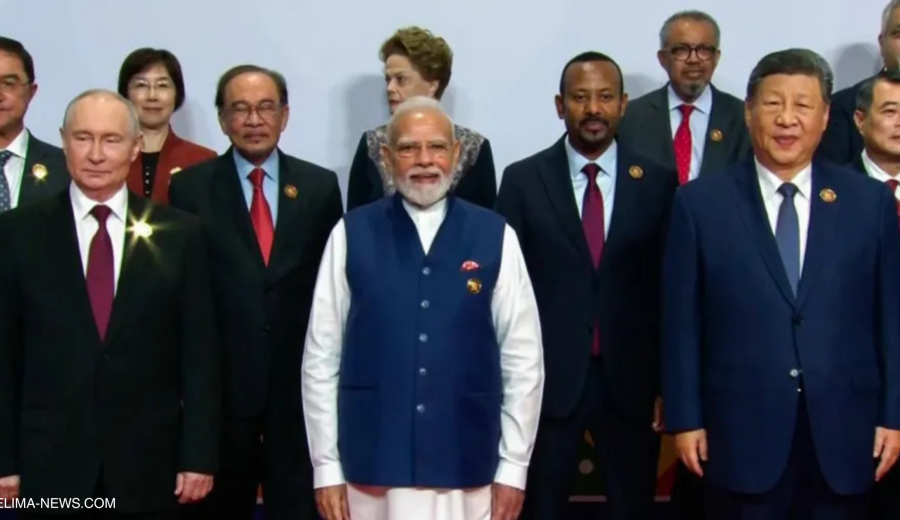
The 18th BRICS Summit in New Delhi produced a wide-ranging joint declaration covering global governance, trade, sanctions, conflicts, terrorism, technology and climate change. For India, the agreement was also a diplomatic test: the expanded grouping managed to reach consensus despite sharp differences among its members.
The 18th BRICS Summit concluded in New Delhi on September 13 after two days of meetings under India’s 2026 chairship. Leaders adopted the New Delhi Declaration, a 140-point document setting out the bloc’s position on global governance, international trade, security, development and cooperation among emerging economies. The declaration was adopted unanimously after several days of negotiations, particularly over language concerning the conflict in West Asia.
The summit was particularly important because it came at a time of heightened geopolitical tensions, including the conflict involving Iran, continuing instability in Gaza and the war in Ukraine. BRICS also enters its third decade with a larger membership and an increasingly explicit ambition to give developing countries a greater role in global decision-making.
A larger BRICS seeks greater global influence
BRICS has expanded significantly from its original five members. The current grouping includes Brazil, Russia, India, China, South Africa, Egypt, Ethiopia, Iran, Indonesia and the United Arab Emirates, with Saudi Arabia’s status treated separately in current reporting.
The bloc’s growing membership has increased its economic and geopolitical weight, but it has also made consensus more difficult. Members have different foreign-policy priorities, political systems and relationships with the United States and Europe.
The New Delhi Declaration nevertheless reaffirmed the group’s commitment to **multilateralism, multipolarity and a greater role for emerging markets and developing economies**. Members called for international institutions to better reflect the distribution of economic and political power in the 21st century.
Reform of the United Nations and global institutions
One of the declaration’s most important themes was reform of the international system. BRICS members reiterated their support for reforming the ‘United Nations Security Council’ and increasing the representation of developing countries. China and Russia specifically reaffirmed their support for India and Brazil playing a greater role in the UN system, including the Security Council.
The declaration also called for greater representation of emerging markets and developing economies within the ‘IMF and World Bank’. The broader objective is to give countries in Africa, Asia and Latin America greater influence over institutions that were largely designed in the aftermath of the Second World War. For India, this is a central element of its BRICS strategy: rather than replacing existing institutions, New Delhi has generally argued for reforming them so that developing countries have greater representation.
Trade and opposition to protectionism
Trade was another major focus. The declaration expressed concern over rising tariffs and other trade restrictions, warning that unilateral measures could disrupt global supply chains and increase uncertainty for businesses and developing economies. BRICS members called for strengthening the World Trade Organization and restoring a functioning multilateral trading system. The language is significant because it comes amid an increasingly protectionist global trading environment.
The declaration also criticized ‘unilateral economic sanctions and other coercive measures’ that are not authorized by the UN Security Council. BRICS argued that such measures can affect food security, health, development and international trade.
Although the declaration does not turn BRICS into an anti-American alliance, its position clearly challenges several elements of the Western-led economic order.
Local currencies and reducing dependence on the dollar
BRICS also continued discussions aimed at reducing the costs and risks associated with cross-border payments. The declaration welcomed work by the BRICS Payment Task Force on making payment and messaging systems more interoperable. It also backed further discussions on settling trade and investment in ‘BRICS members’ local currencies’. Importantly, however, the summit did not establish a common BRICS currency.
The approach remains incremental: increasing the use of local currencies and improving payment connectivity rather than immediately attempting to replace the dollar in international trade. This distinction is important because creating an alternative global currency would require considerably greater financial and monetary integration among countries whose economic systems remain very different.
West Asia exposes BRICS’ internal divisions
The most difficult negotiations concerned the conflict in West Asia. BRICS includes Iran, which is directly involved in the conflict, while the United Arab Emirates has its own regional security interests and close relations with the United States. Reaching common language was therefore difficult.
The final declaration called for ‘maximum restraint’, protection of civilians and civilian infrastructure, respect for sovereignty and territorial integrity, and greater reliance on dialogue and diplomacy. It also stressed the importance of maintaining international trade, supply chains and energy flows.
The agreement itself was diplomatically significant because the members managed to produce a joint position despite their competing interests. Negotiations reportedly continued for several days, with differences over the wording on West Asia among the major obstacles.
Gaza and Palestine
The declaration also devoted significant attention to the Israel-Palestine conflict. BRICS called for maintaining the Gaza ceasefire and ensuring full and unhindered humanitarian access. It rejected forced displacement of Palestinians and reaffirmed support for a two-state solution, with an independent Palestinian state based on the internationally recognized 1967 borders and East Jerusalem as its capital. The bloc also backed Palestine’s full membership in the United Nations. This represents one of the clearest areas where BRICS’ position differs from the policies of Washington and some of its Western allies.
Terrorism and India’s priorities
Counter-terrorism was another important issue for India. The declaration reaffirmed a zero-tolerance approach to terrorism and called for international cooperation against terrorist financing, cross-border terrorism and safe havens. The members also condemned the April 2025 terrorist attack in Jammu and Kashmir’s Pahalgam area, according to reporting on the declaration.
For New Delhi, securing such language was an important diplomatic objective, given India’s long-standing emphasis on terrorism as a central international security challenge.
India has now handed the BRICS chairship to China for 2027. The next phase will show whether the consensus achieved in New Delhi can survive beyond the summit and translate into concrete economic and geopolitical influence.