This year’s Nobel science prizes honour tools for controlling brain cells with light, a neutrino telescope buried in Antarctic ice and the discovery of how chemical reactions can produce molecules of only one handedness.
The 2026 Nobel Prize in Physiology or Medicine was awarded jointly to Karl Deisseroth, Peter Hegemann and Georg Nagel for discoveries concerning light-gated ion channels and optogenetics, according to the Nobel Assembly at Karolinska Institutet, which announced it on 5 October 2026. Time lists Deisseroth at Stanford University, Hegemann at Humboldt University Berlin and Nagel at the University of Würzburg.
Optogenetics is a technique that uses light to switch on and off specific nerve cells, so researchers can discover which cells control particular brain functions. Time says it has been used to study pain, social behaviour and reward processing. The sources reviewed do not describe the individual contributions of the three winners beyond the shared citation.
The Nobel Prize in Physics, announced on 6 October by the Royal Swedish Academy of Sciences in Stockholm, went to Francis Halzen of the University of Wisconsin-Madison for decisive contributions to the IceCube Neutrino Observatory and the discovery of high-energy neutrinos of astrophysical origin, according to a search summary. Time says his work tracking neutrinos through the ice at the South Pole has opened a new kind of astronomy, which allows scientists to detect high-energy neutrinos from distant galaxies and learn about phenomena such as black holes.
Halzen is the sole physics laureate in the summary. The sources reviewed do not mention other IceCube scientists, and Delima News cannot say whether the Academy’s own announcement credits the collaboration.
The chemistry prize, announced on 7 October, went to the French chemist Henri B. Kagan and the Japanese chemist Kenso Soai for the discovery of non-linear effects and autocatalysis in asymmetric organic synthesis, according to the search summary. Time presents the work as solving how molecules achieve homochirality, in which only one mirror-image form is produced, and says the work resolved a chemical mystery more than a century old. Time lists Kagan at Université Paris-Sud and Soai at the Tokyo University of Science.
Chirality matters in medicine because the two mirror-image forms of a molecule can have different effects on the body, and Time says the work has enabled drug development in which only a specific form is therapeutic. The Time article is a general summary, and the Academy’s fuller explanation was not reviewed.
Each prize is worth 12 million Swedish crowns, about $1.2 million at current rates according to Time. The same amount applies to the literature prize, which went to Anne Carson, as Delima News reports separately, and the prize for medicine is shared among three people, which means each will receive a share and not the full sum, although the sources reviewed do not give the split.
The sciences were announced over three consecutive days, from 5 to 7 October.
The physics and chemistry citations are taken from a search summary of the Nobel announcements and Time’s overview, and readers who want the exact wording should check NobelPrize.org.
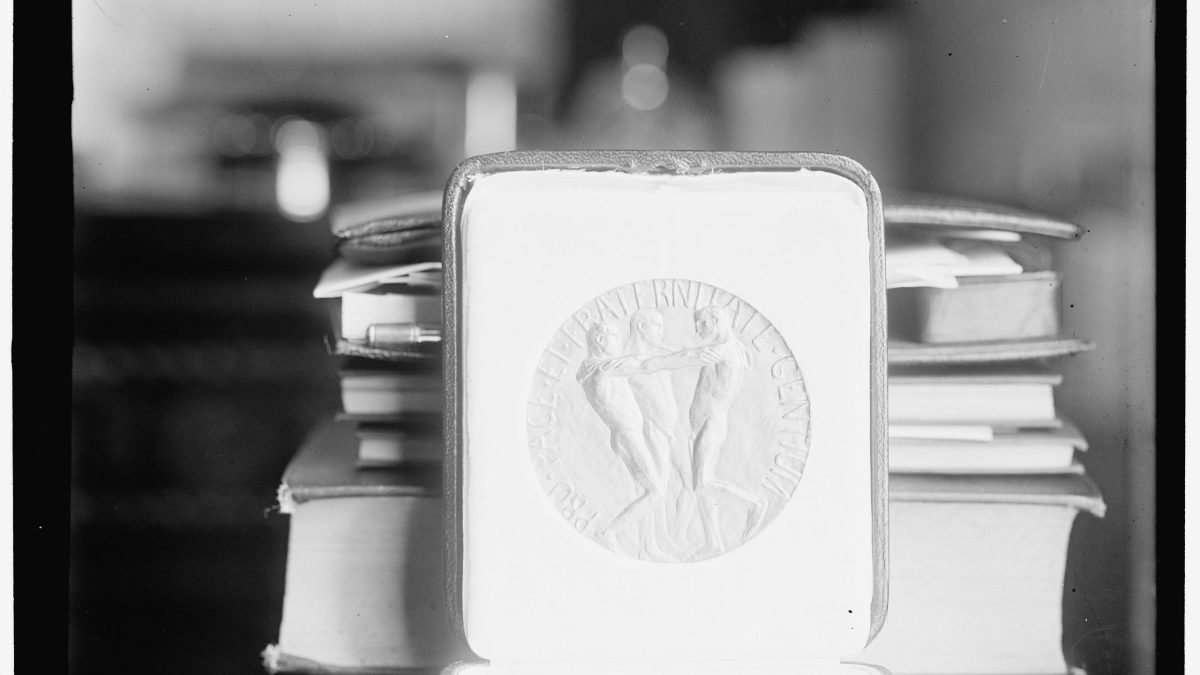
Image: A Nobel Prize medal (file photo; the peace prize medal, shown as a stand-in). Photo: Harris & Ewing, photographer / Wikimedia Commons (Public domain)