Bulgaria holds its presidential election on 25 October, and the acting president, Iliana Iotova, leads the former caretaker prime minister Andrey Gyurov by 44.5% to 26.1% in the latest Alpha Research poll.
Bulgaria will elect a president on 25 October 2026, with a runoff on 1 November if needed, according to Sofia Globe’s report on an Alpha Research poll. Twenty-seven presidential tickets are on the ballot, drawn from 8 parties and 25 initiative committees, according to a search summary of the Bulgarian press.
The poll, carried out from 24 September to 1 October among 1,000 adults by direct interviews at their homes, gives the ticket of Iliana Iotova and her running mate Kiril Vulchev 44.5% among those who intend to vote. The ticket of Andrey Gyurov and Georgi Kandev has 26.1% and the ticket of Kostadin Kostadinov of Vazrazhdane and Petar Volgin has 10.5%. A Sofia Globe report on an earlier poll, from 30 September, had Iotova on 41.4% and Gyurov on 21.9%. Sofia Globe spells her name Yotova, and other reports use Iotova.
Iotova is the incumbent head of state and the acting president, according to the summary, and Gyurov is a pro-Ukrainian former caretaker prime minister. The Eurointegration headline asks how Bulgaria’s pro-Russian prime minister could gain his own president, and a Balkan Insight headline says the election will test the prime minister Rumen Radev’s grip on power. The articles themselves were not reviewed, so Delima News does not set out their arguments or the nature of the support for Iotova.
The poll expects low turnout, of 37% to 38% of registered voters, according to Sofia Globe. It also finds that almost half of the supporters of GERB-UDF and of the Movement for Rights and Freedoms say they will not vote, which suggests that the choices of the parties’ leaders could mobilise those voters.
The rules matter in a race with 27 tickets. The president is elected in two rounds, and a runoff between the top two is held if no candidate gets a majority, or if a candidate gets a majority but turnout is below 50%, according to a search summary of the Wikipedia page. With turnout expected at about 37% to 38%, that second condition is relevant, but Delima News does not know how the rule would apply and does not predict a runoff.
The gap between the first two candidates in the latest poll is 18.4 percentage points, which is Delima News’ calculation from 44.5 and 26.1. In the earlier poll of 30 September the gap was 19.5 points, from 41.4 and 21.9, so it narrowed slightly while both candidates gained support. A one-point change is small for a poll of 1,000 adults.
Kostadinov’s third place at 10.5% is some distance behind the leaders: it is 16.6 points behind Gyurov and 34 points behind Iotova on the figures in the poll, a calculation by Delima News. With 27 tickets on the ballot, the remaining candidates share the rest of the vote, but the poll report does not give their individual support.
Polling for a presidential election with a low turnout is uncertain because the people who say they will vote may not do so, and the poll reports only those who intend to vote.
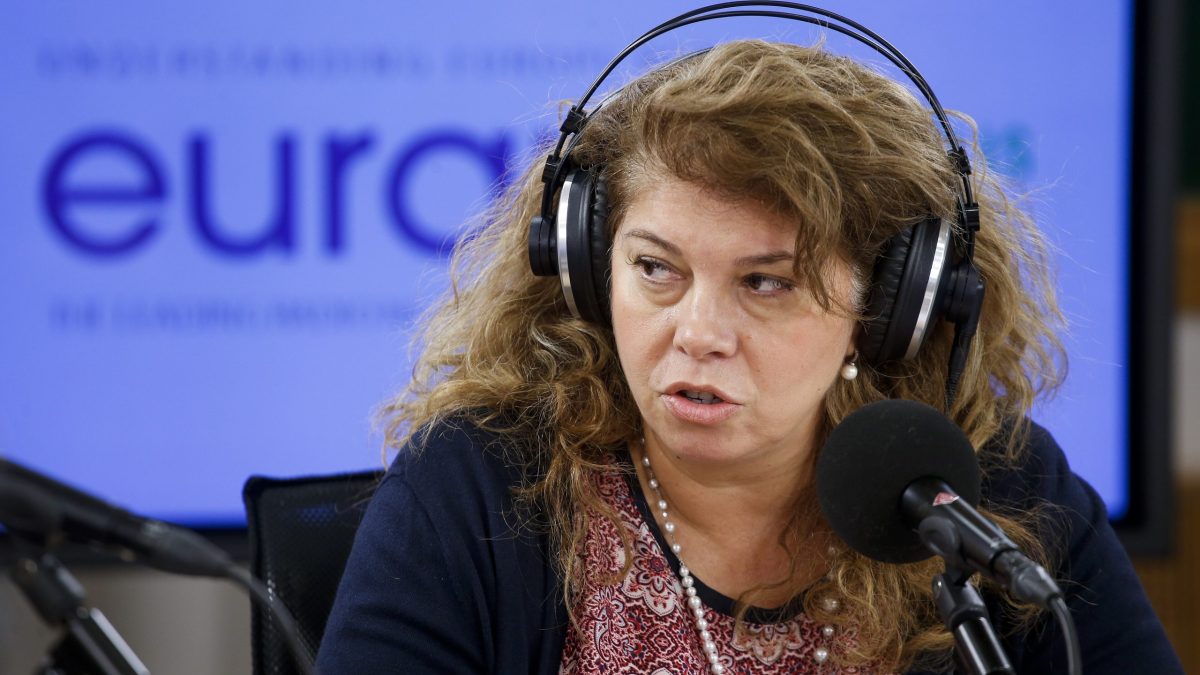
Image: Iliana Iotova (file photo). Photo: euranet_plus / Wikimedia Commons (CC BY-SA 2.0)