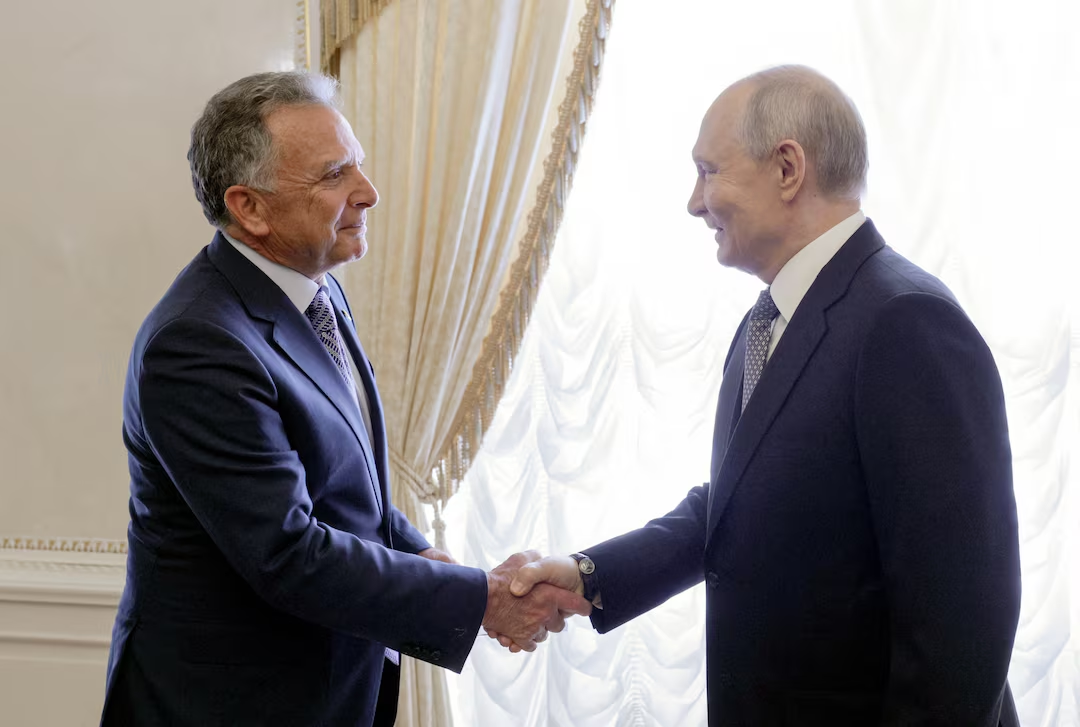
US special envoy Steve Witkoff met Russian President Vladimir Putin in St Petersburg on Wednesday, October 21, 2026, their ninth in-person meeting, and Russia released the American Stephen Hubbard during the talks, according to Al Jazeera and France 24. Witkoff said he hoped to discuss the resumption of trilateral talks between the United States, Russia and Ukraine. The meeting came a day after Witkoff held talks with Ukrainian President Volodymyr Zelensky in Oslo, which US Secretary of State Marco Rubio described as “positive”. Hubbard, a retired US school teacher, was freed as a goodwill gesture and was at Pulkovo Airport in St Petersburg after his release. The war began more than four and a half years ago with Russia’s full-scale invasion of Ukraine.
The case that the meeting is a step toward a settlement rests on the sequence of contacts and on what Putin put on the table. Witkoff spoke to Zelensky on Tuesday and to Putin on Wednesday, and France 24 reported that Jared Kushner took part by video while the Russian special envoy Kirill Dmitriev attended, so both channels are active at a senior level. Putin thanked President Donald Trump and Witkoff for their efforts to end the war, offered to help the United States address concerns over Iran’s nuclear programme through Russia’s decades-long relationship with Tehran, offered large quantities of fertiliser to American farmers, and suggested a possible meeting in China next month with Trump and Chinese President Xi Jinping. The release of Hubbard, who was sentenced to nearly seven years in a closed trial in 2024 for fighting as a mercenary for Ukraine after being captured two months after the February 2022 invasion, shows that Moscow is willing to make a visible concession.
The case for caution is that none of this amounts to a ceasefire and that Ukraine’s position is firm. Zelensky insisted that “if there are issues about Ukraine, our future, it can be acceptable only when we are at the table”, a reminder that Kyiv will resist any arrangement made without it. Trump has said Ukraine must “end the war or face a very bad thing”, and Al Jazeera reported that relations between Washington and Kyiv deteriorated after Trump’s diesel export deal with Russia, with Ukrainian concern also over a slowdown in Starshield internet service. Putin’s offers on Iran and fertiliser serve Russian interests as much as American ones, and a prisoner release, while a humanitarian relief for one family, does not change the situation on the front line. The meeting was the ninth between the two men, which also shows that earlier rounds have not ended the war.
The meeting matters for Europe and the wider world because the war, now in its fifth year, has affected energy prices, food supplies and security across the continent. A restart of three-way talks would bring all three governments back into the same format, while a failure would leave the conflict where it is. A possible gathering in China next month would put Xi in the role of host, which would raise Beijing’s profile in any settlement. For the United States, the mix of pressure on Kyiv and offers from Moscow will be watched closely by allies who fear a deal reached over Ukraine’s head.
The release of Stephen Hubbard and the ninth Witkoff–Putin meeting show that diplomacy is moving, but only the return of Ukraine to the table will show whether it is moving toward peace.