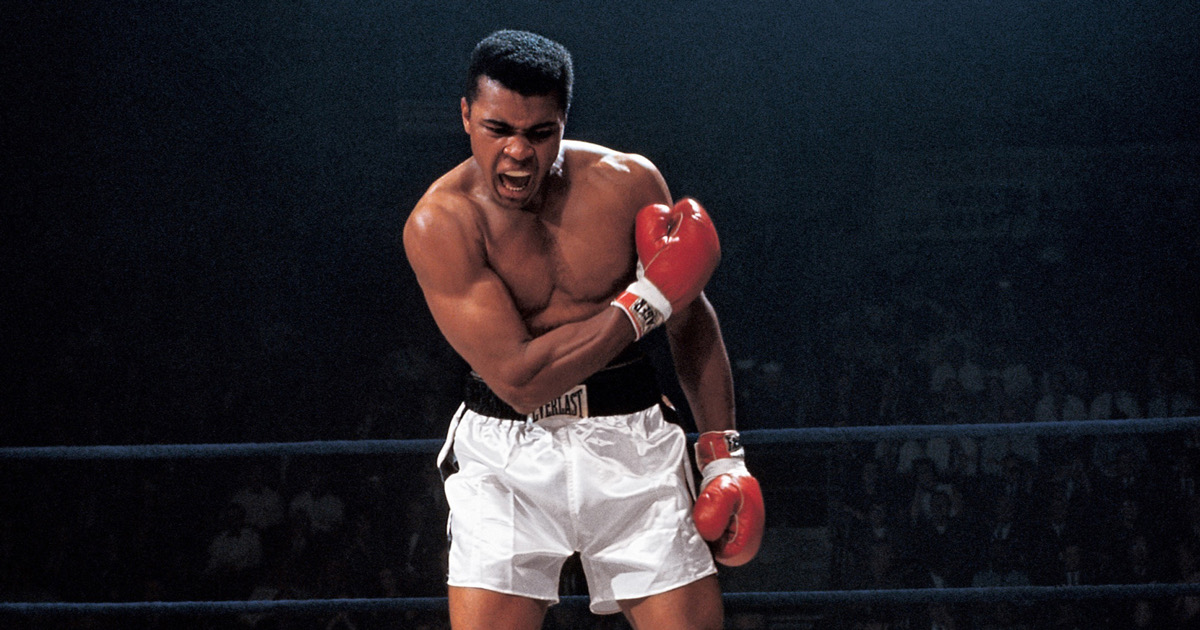
Muhammad Ali (born Cassius Marcellus Clay Jr., 17 January 1942 – 3 June 2016) was an American professional boxer and activist, widely known as "the Greatest" and often regarded as the greatest heavyweight boxer of all time. He won the Olympic light heavyweight gold medal in 1960, won the world heavyweight championship in 1964, and became a global symbol of racial pride and resistance to the Vietnam War draft. In 1999 he was named Sportsman of the Century by Sports Illustrated.
Muhammad Ali at a Glance
| Birth name | Cassius Marcellus Clay Jr. |
| Born | 17 January 1942, Louisville, Kentucky, United States |
| Died | 3 June 2016, aged 74 |
| Profession | Professional boxer and activist |
| Olympic medal | Gold, light heavyweight, 1960 Summer Olympics |
| Professional record | 61 fights: 56 wins (37 by knockout) and 5 losses |
| Heavyweight titles | Won the world title in 1964, 1974 and 1978 |
| Retired | 1981 |
| Illness | Parkinson's syndrome, announced 1984 |
| Marriages | Four |
| Children | Nine (seven daughters and two sons) |
Early Life and Olympic Gold
Cassius Clay was born in Louisville, Kentucky, and grew up under racial segregation. He began training as an amateur boxer at the age of 12, made his amateur debut in 1954, and went on to win six Kentucky Golden Gloves titles, two Chicago Golden Gloves and two national Golden Gloves titles. At 18 he won the light heavyweight gold medal at the 1960 Summer Olympics in Rome and turned professional later that year. He made his professional debut on 29 October 1960 with a six-round decision over Tunney Hunsaker.
World Champion and a New Name
On 25 February 1964 Clay beat Sonny Liston in a major upset to win the world heavyweight championship at the age of 22. He had joined the Nation of Islam, and in 1964 he announced that he was giving up his birth name, calling it a "slave name", and he became Muhammad Ali. He later moved to Sunni Islam in the mid-1970s. In the ring he was known for unorthodox movement, footwork, head movement and the rope-a-dope technique, and for provocative, rhyming trash talk that made him a pioneer of what became hip-hop.
Draft Resistance and Exile
In 1967 Ali refused to be drafted into the military because of his religious beliefs and his opposition to the Vietnam War. On 20 June 1967 a jury found him guilty of violating the Selective Service laws after only 21 minutes of deliberation, and he was stripped of his boxing titles. He stayed out of prison while he appealed, and on 28 June 1971 the United States Supreme Court overturned his conviction by an 8–0 decision in Clay v. United States. He did not fight for nearly four years, during what would have been the peak of his athletic life, and he became a symbol for the counterculture of the 1960s.
Return and Great Fights
Ali fought Joe Frazier in the "Fight of the Century" at Madison Square Garden on 8 March 1971, and lost. On 30 October 1974 he beat the heavyweight champion George Foreman in Kinshasa, Zaire, in the "Rumble in the Jungle", to regain the title. On 1 October 1975 he beat Frazier in the "Thrilla in Manila" in extreme heat. In February 1978 he lost to Leon Spinks, and he won the title back in a rematch to become the first man to win the heavyweight title three times. He retired in July 1979 and came back to fight Larry Holmes on 2 October 1980, when his corner stopped the fight after ten rounds. He retired for good in 1981 with a record of 56 wins, including 37 knockouts, and five losses.
Life After Boxing
In 1984 Ali made public his diagnosis of Parkinson's syndrome. He worked on religion, philanthropy and activism, and he released two spoken-word albums, I Am the Greatest! (1963) and The Adventures of Ali and His Gang vs. Mr. Tooth Decay (1976), both nominated for Grammy Awards. On 27 July 2012 he was a titular bearer of the Olympic flag at the opening ceremony of the London Olympics. The Muhammad Ali Center opened in Louisville in November 2005. He died on 3 June 2016, and his funeral was held in Louisville on 9 June 2016.
Personal Life
Ali was married four times, to Sonji Roi (1964 to 1966), Belinda Boyd (from 1967), Veronica Porche (from the late 1970s) and Yolanda "Lonnie" Williams (from 19 November 1986). He had seven daughters and two sons. His daughter Laila became a professional boxer from 1999 to 2007.
Legacy
Ali was a world champion and also a figure whose stand on the war, religion and race made him one of the most recognisable people on earth. He was named Sports Personality of the Century by the BBC in 1999. This biography draws on [Wikipedia](https://en.wikipedia.org/wiki/Muhammad_Ali), [Wikipedia's article on his boxing career](https://en.wikipedia.org/wiki/Boxing_career_of_Muhammad_Ali) and [Britannica](https://britannica.com/question/What-were-Muhammad-Alis-achievements).