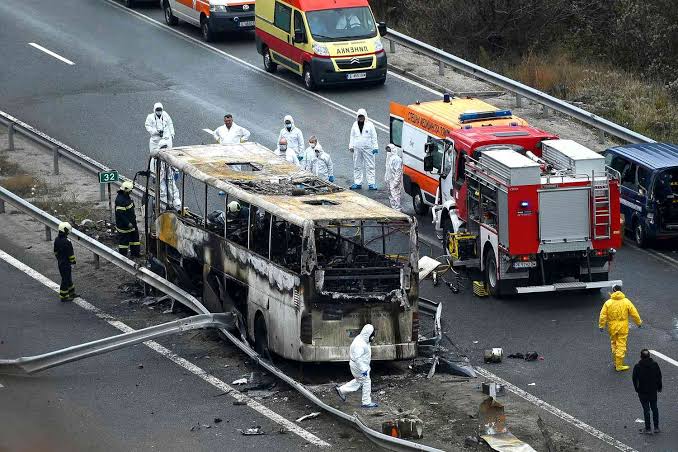
At least 12 people were killed and dozens more injured in a series of crashes on both sides of a highway in Bulgaria on Tuesday, authorities said, according to DW. The interior ministry said a bus and a truck collided on the A1 highway near the southeastern city of Yambol, which led to a pileup, and the ministry's general secretary, Lyubomir Nikolov, said fog was likely the cause. The regional governor of Yambol, Georgi Chalakov, said an estimated 50 cars and trucks were involved. Health Minister Katya Ivkova said 10 people "died on the spot" and two others died while being taken to hospital, and that 46 people were injured and transported to medical facilities. Early reports from some agencies gave a toll of 11 dead, so the figure moved as the rescue work continued.
The immediate response was about getting people out. Chief Inspector Todor Mishinev of the Yambol regional directorate of the interior ministry told Nova TV that some people were still trapped in their cars as he spoke, and said the priority was rescue operations, with the procedural and investigative actions to follow once those were complete. Police, firefighters and paramedics were dispatched, and authorities sent two aircraft carrying medical teams and stretcher equipment, while the injured were taken to hospitals in nearby cities. The crash happened on the A1 highway that connects the capital, Sofia, to the Black Sea city of Burgas, one of the country's major routes between the interior and the coast.
The argument over cause is already taking shape. Fog was named by the ministry as the likely cause, and dense fog does cause chain collisions when drivers do not slow down enough to stop within the distance they can see. But the explanation leaves a question that investigators will have to answer, which is why a bus and a truck collided in the first place and why so many vehicles were unable to stop. Victims and campaigners say the country's road deaths are driven by reckless driving, neglected road infrastructure and an inefficient justice system, according to DW, and those are the factors that a pileup in poor visibility would test. Whether speeds, spacing, vehicle condition or the road itself played a part is not yet known, and the authorities have not reported any finding beyond the likely role of the fog.
The wider road-safety record sets the context. According to European Commission figures cited by DW, Bulgaria saw 71 road fatalities per million inhabitants in 2025, the highest rate in the European Union, against an EU average of 43 per million. That means Bulgaria's rate is about 65% higher than the average, so a disaster on this scale lands in a country already identified by the Commission as the worst in the bloc for deaths on the road. The timing also drew in the political leadership: Prime Minister Rumen Radev was welcoming European Commission President Ursula von der Leyen when the crash happened, cleared his schedule for the rest of Tuesday, and von der Leyen said she would cut her visit short.
In the coming days the information to watch is the final death toll, the condition of those still in hospital, and whether prosecutors open criminal proceedings against any driver or operator. The inquiry will also need to say whether warning signs, speed limits or traffic management were in place on that stretch of the A1 in fog. For a government that was in the middle of hosting the head of the European Commission, the crash puts road safety at the front of the national agenda. Whether it leads to changes, such as stricter enforcement or investment in the road network, will be judged by whether the next fog on the A1 produces a different result.