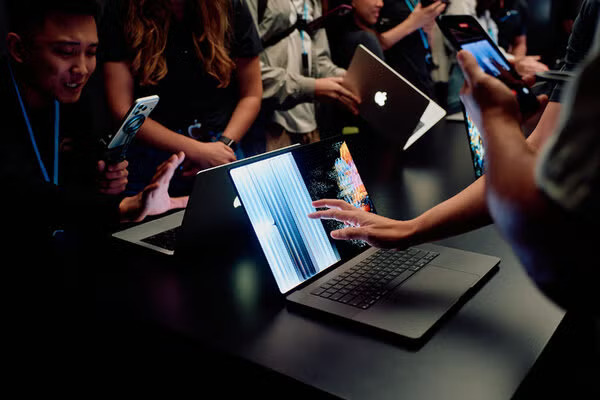
Apple announced its first touchscreen MacBook Pro on 28 October, with the 14-inch model starting at $2,899 and the 16-inch at $3,399, according to TechCrunch. Preorders open on 30 October and sales start on 6 November. Both sizes use a new display that Apple calls PROLED XDR, with a peak brightness of 2,000 nits for both HDR and standard content and a 10,000,000:1 contrast ratio, and the notch has been replaced by a Dynamic Island-style cutout. The laptops run M5 Pro or M5 Max chips, with up to 128GB of unified memory and up to 16TB of storage. It is Apple’s first touchscreen Mac since the Touch Bar era, and it arrives a day after Apple released a standard 14-inch MacBook Pro with the M6 chip at $1,999.
The argument for the new design is that Apple has built hardware around touch rather than adding it as an afterthought. A new hinge stabilises the screen when it is touched, which also steadies the camera during video calls. TechCrunch reports that both models are lighter than their non-touch predecessors, at 3.0 pounds (1.38 kg) for the 14-inch and 4.0 pounds (1.82 kg) for the 16-inch. The laptops have three Thunderbolt 5 ports, an HDMI port, an SDXC card slot, MagSafe and a headphone jack, a six-speaker audio system with a new woofer design, and support for up to three external displays on the M5 Pro and up to four on the M5 Max. For professionals who edit video, sketch or annotate, the addition of touch could make the machines faster to use, although the details reported so far do not say how Mac software will be adapted for touch.
The argument against is about price and history. At $2,899 and $3,399, the touchscreen models cost far more than the standard MacBook Pro, and TechCrunch notes that a standard 14-inch MacBook Pro with the M6 chip launched the day before at $1,999. The two lines use different chips, so the gap is not purely the price of touch, but it shows how much buyers will pay for the feature. The company also has to overcome its own past. TechCrunch notes that Steve Jobs once called the idea of a touchscreen Mac “ergonomically terrible”, and that rumours of a touchscreen Mac began about three years before the launch. The article does not report battery life, so buyers will have to wait for independent reviews before judging whether the new display and hinge justify the cost.
The launch matters because it changes a product line that professionals have relied on for years. If customers accept touch on a Mac, rivals that already offer touchscreens on their Windows laptops will face a competitor with a different approach, and developers will have to decide whether to build touch-first interfaces for Mac software. The higher price also shows that Apple is aiming at the top of the market.
Apple has finally answered the question it avoided for years, and it has done so at a premium price. Whether professionals pay for it will become clear after 6 November.