With Washington gaining access to more than half of Australia’s military facilities, critics warn that Canberra is becoming less a sovereign ally and more a launchpad for American power in the Indo-Pacific.
For decades, Australia has described its alliance with the United States as the foundation of its national security. But a new investigation by The Guardian raises a more uncomfortable question: at what point does military cooperation become strategic dependence?
The scale of the American military presence across Australia is striking. According to data compiled by the Nautilus Institute and published by The Guardian, the U.S. military and American defence companies now have control of or access to 110 Australian defence facilities — more than half of the country’s military installations. The United States directly controls 17 facilities, has military access to dozens of Australian-run sites, and American defence corporations have access to additional facilities.
That does not mean Australia has officially become an American colony or that every Australian military base is controlled by Washington. Canberra insists that Australia retains sovereignty over its territory and that there are no foreign military bases on Australian soil. Yet the sheer depth of integration is increasingly blurring that distinction.
Australia’s geography makes it exceptionally valuable to Washington. Its enormous territory lies relatively close to Southeast Asia and the Pacific, while remaining far from the American mainland. For the Pentagon, it offers something few other allies can: space, strategic depth and relatively secure facilities from which military operations can be supported. The Guardian describes Australia, in the words of a retired U.S. general, simply as “location, location, location.”
At RAAF Base Amberley near Brisbane, American B-2 stealth bombers have operated from Australian soil. At Tindal in the Northern Territory, Australia is spending billions upgrading facilities capable of accommodating American B-52 bombers. These aircraft are capable of carrying nuclear weapons, although Washington does not disclose whether nuclear weapons are actually present when American aircraft visit Australia.
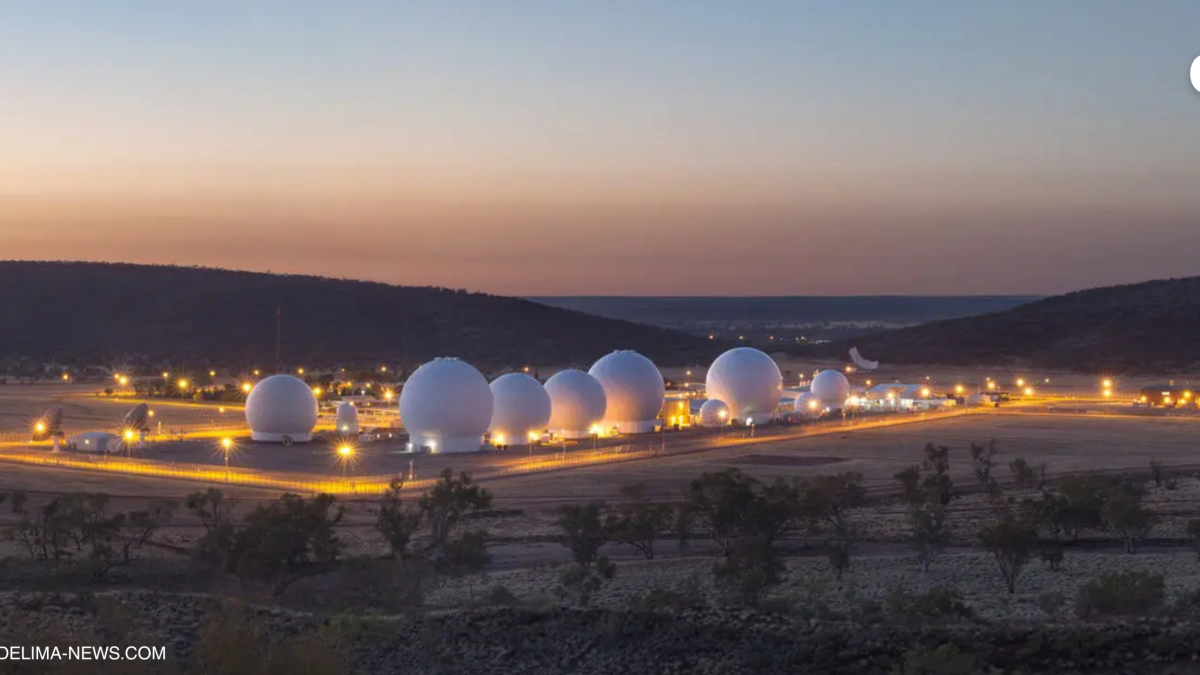
The Northern Territory is also home to the rotational deployment of thousands of U.S. Marines. Then there is Pine Gap — perhaps the most consequential piece of the entire arrangement. Located near Alice Springs, the joint Australian-American facility performs satellite surveillance and signals intelligence. It can detect missile launches, intercept communications and provide information that can contribute to targeting by U.S. forces around the world. Although formally a joint facility, the Guardian reports that it is commanded by an American.
In other words, Australia’s role is not simply about hosting foreign troops. It increasingly involves intelligence, communications, logistics, weapons storage, training and military targeting infrastructure. The expansion of the American footprint is closely connected to AUKUS, the Australia-UK-U.S. security partnership. AUKUS was sold to Australians primarily as a means of acquiring nuclear-powered submarines and strengthening Australia’s ability to deter potential adversaries, particularly China. But the arrangement has another consequence: it ties Australia’s military infrastructure, personnel and strategic planning increasingly closely to the United States.
From 2027, up to 1,200 U.S. military personnel are expected to operate from HMAS Stirling in Western Australia as part of the planned rotational submarine force. Canberra insists this will not constitute an American base. Critics argue that the terminology matters less than the strategic reality. A former Australian defence minister, Christopher Pyne, has even described AUKUS as having a broader strategic significance for Washington: the ability to establish a submarine presence in the Indian Ocean represents a major advantage for the United States.
Meanwhile, Australia has agreed to spend hundreds of billions of dollars over the coming decades on the AUKUS submarine program, while also helping strengthen America’s own submarine industrial base. In May 2026, Australia decided to purchase three second-hand Virginia-class submarines from the United States as part of the pathway. The paradox is becoming harder to ignore: Australia is spending enormous sums to become more militarily capable, while simultaneously becoming more dependent on America’s military system.
The strongest argument against describing Australia simply as a beneficiary of the alliance is the risk that comes with hosting the machinery of American power. If Australia becomes a critical platform for U.S. operations, an adversary may no longer distinguish neatly between American and Australian military infrastructure.
That concern became particularly visible during the recent U.S.-Iran conflict. The Guardian has reported questions over the role of facilities such as Pine Gap and Australian personnel operating alongside U.S. forces, while Australian officials have continued to insist that Australia’s involvement is limited and defensive. The same dilemma would be even more consequential in a potential U.S.-China conflict.
If American aircraft, submarines, intelligence systems, weapons and logistics networks are operating from Australian territory, Australia’s government could face an extraordinarily difficult choice: remain outside the conflict while hosting infrastructure being used by one of the combatants?
Critics argue that the distinction could eventually become impossible to maintain. One analyst quoted by The Guardian described Australia as potentially becoming the “tip of the spear” for U.S. power projection in the region. Another called the expanding network a form of “voluntary subordination.”
The Australian government strongly rejects the idea that the country has surrendered its sovereignty. Defence Minister Richard Marles argues that the growing American presence strengthens Australia’s own military capabilities and helps deter conflict in the Indo-Pacific, particularly amid China’s military expansion. Canberra maintains that Australia retains control over the deployment of its own armed forces and territory.
There is also a practical argument behind the alliance. Australia has a relatively small population and military compared with the major powers surrounding the Indo-Pacific. Partnership with the world’s most powerful military provides capabilities Australia would struggle to develop independently.
For Canberra, therefore, the choice may not be between dependence and independence. It may be between American-backed deterrence and a much more expensive attempt at strategic self-reliance.
The political problem is that public confidence in the alliance appears to be weakening. According to polling cited by The Guardian, only 31% of Australians now trust the United States to act responsibly in the world, while 59% believe Australia’s interests are better served by a more independent foreign policy rather than a closer relationship with Washington. Only 13% regard the U.S. as a “very reliable” security ally.
That is significant. Australia may still see America as indispensable, but an increasing number of Australians appear to be asking whether being protected by a superpower also means becoming entangled in its wars. The answer remains uncertain. What is clear, however, is that Australia’s relationship with Washington has moved far beyond a conventional military alliance. American personnel, intelligence infrastructure, defence contractors, aircraft, submarines, weapons, fuel and logistics networks are becoming increasingly embedded across the Australian continent.
Calling Australia “another U.S. military base” is therefore an intentionally provocative description, not a literal legal one. But the underlying question raised by The Guardian is harder to dismiss: If more than half of Australia’s military facilities are accessible to the United States, how much strategic distance can Canberra realistically maintain when Washington goes to war?