Brazil will decide its presidency in a runoff on 25 October between Flávio Bolsonaro, who won 47.03% of the first-round vote, and President Luiz Inácio Lula da Silva, who won 45.16%.
Brazil’s presidential election will go to a second round on Sunday, 25 October 2026, between Senator Flávio Bolsonaro of the Liberal Party and President Luiz Inácio Lula da Silva of the Workers’ Party, after neither received a majority in the first round on 4 October, according to Wikipedia. Bolsonaro received 56,104,503 votes, or 47.03%, and Lula 53,879,538 votes, or 45.16%.
The gap between them was 2,224,965 votes, about 1.9 percentage points, which is Delima News’ own arithmetic from the figures in the article. The other candidates received a combined share of about 7.8% of the vote. Augusto Cury of Avante received 2.89%, Ronaldo Caiado of the Social Democratic Party 2.18% and Romeu Zema of Novo 0.27%, according to the same page, while the remaining candidates are not listed in the part of the page that could be read.
Turnout was 78.92%, down 0.13 percentage points from 2022, according to Wikipedia. Brazil has compulsory voting, though the article does not discuss how turnout is affected. A Washington Post headline of 4 October described the result as Bolsonaro and Lula heading to a runoff, but the full article could not be loaded, so the analysis in it is not reported here.
The candidacy of Flávio Bolsonaro follows the legal troubles of his father. Wikipedia says that former president Jair Bolsonaro was declared ineligible until 2030 for abuse of political power and was later sentenced to 27 years in prison for his role in the plot to overturn the 2022 election, which led to his son’s candidacy.
The election also reshaped Congress. In the 513-seat Chamber of Deputies, the Liberal Party won 121 seats, a gain of 22, the Brazil of Hope Federation, which includes the Workers’ Party, won 88, a gain of seven, the Progressive Union won 87, a loss of 19, the Social Democratic Party won 43 and Republicanos won 41. In the Senate, where 54 of 81 seats were contested, the Liberal Party won 29 seats, a gain of 14, the Workers’ Party nine, the MDB eight, Progressistas six and Republicanos six.
Those numbers show that the right-wing party is the largest force in both houses on the first-round results. The Senate figures are seats won in this election and may not equal the seats the party holds in total, since 27 senators were not up for election. The page does not give the total, so it is not stated here.
The campaign was dominated by scandals and institutional questions. Wikipedia lists the Banco Master scandal and an INSS fraud scheme, which implicated several branches of government, a crisis in the Supreme Federal Court and concerns about possible US interference favouring Bolsonaro as key controversies. The sources reviewed do not give details of those cases, so they cannot be described further.
The runoff will be a contest between two camps that were nearly equal in the first round. A lead of 1.9 points is small, and the votes of the roughly 7.8% who backed other candidates will matter, though the sources reviewed do not give polls for the runoff, so no forecast is offered.
Delima News will report the result when the polls close on 25 October.
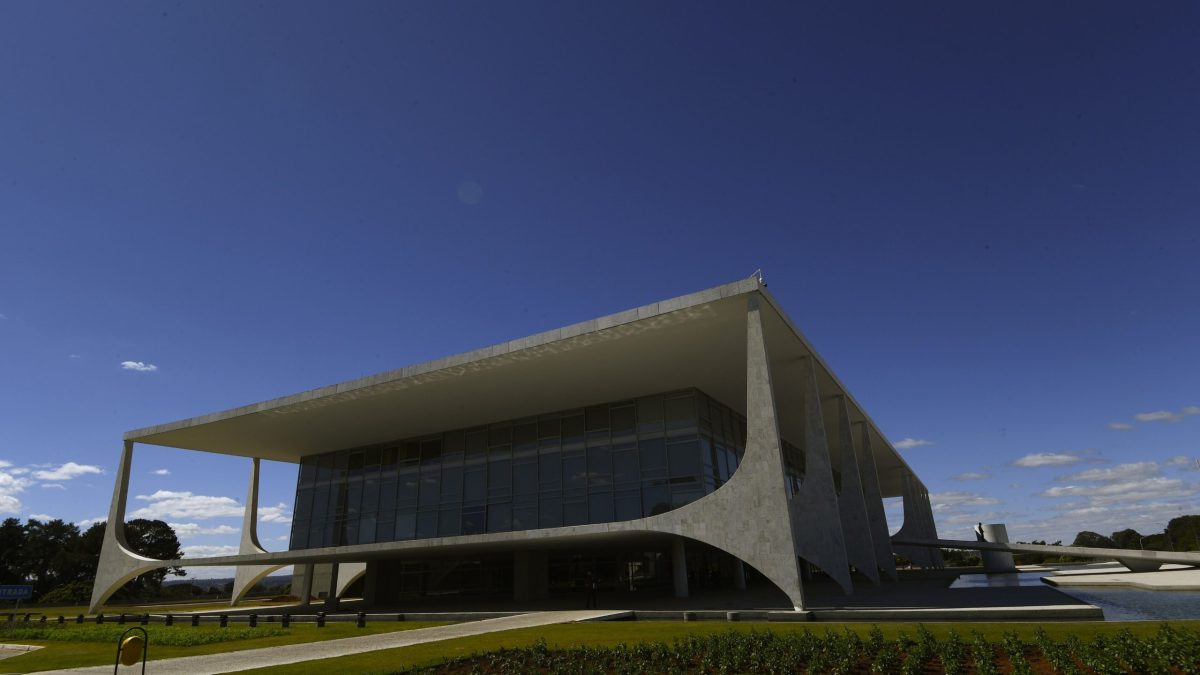
Image: The Palácio do Planalto in Brasília, the seat of Brazil’s presidency (file photo, 2020). Photo: Senado Federal / Wikimedia Commons (CC BY 2.0)