China’s exports rose 36.3% in September from a year earlier, accelerating from August’s 25% and marking the fastest pace since February, according to customs data compiled by FactSet and reported by the Associated Press on 14 October. Imports rose 31%. The monthly trade surplus widened to $133.5 billion from $119.1 billion in August, and the surplus for January to September reached $938.1 billion. Trading partners are asking whether this is a sign of strength or of a problem the world will not tolerate.
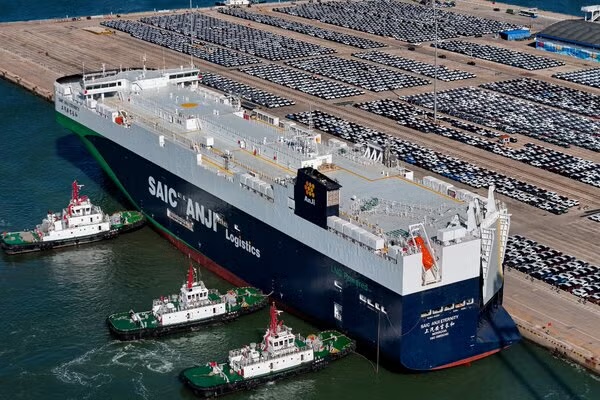
The case that this is genuine strength points to what is being sold. Semiconductors rose 108.1% in value in the first nine months, automatic data processing equipment and parts rose 54.6%, and auto exports rose 54.3%, driven by global demand for Chinese electric vehicles and hybrids. Expectations are growing that the surplus could exceed last year’s full-year record of $1.2 trillion. Imports are rising too, up 31%, and Premier Li Qiang told a trade fair in Guangzhou that China will import more high-quality goods, describing the country as both a “super seller” and a “super buyer.” China’s central bank said it has “no need or intent” to gain competitive advantages through currency devaluation.
The case that this is a warning sign comes from partners and from China’s own economy. The European Union’s trade deficit with China exceeds $1.1 billion a day, and EU trade chief Maroš Šefčovič said that talks in Beijing produced a deal that includes halving Chinese hybrid car imports into the bloc over the next few years. The United States has launched a probe into China and other partners over excess industrial capacity. At home, the IMF lowered its 2026 growth forecast for China to 4.5%, down 0.1 percentage point, and warned that strong exports cannot fully offset weak domestic demand. Consumption and investment remain sluggish after a years-long real estate downturn, and although authorities recently introduced subsidies for homebuyers’ mortgage interest payments, AP says analysts see boosting domestic demand as not yet a priority. AP also notes that policymakers have pointed to an undervalued yuan as making Chinese exports cheaper overseas. Cornell’s Eswar Prasad said many trading partners fear their manufacturing sectors will be overrun, and Max Zenglein of The Conference Board said a slowdown in the global AI investment cycle could pose a greater threat to China’s export growth than other countries’ trade restrictions.
The consequences extend to every manufacturing economy. Washington and Beijing agreed last month to extend their trade truce and cut tariffs on $60 billion worth of goods, but the EU’s push to rebalance targets high-value exports directly, as BNP Paribas Asset Management’s Ecaterina Bigos put it; she added that diversifying into Southeast Asia and Latin America can help but cannot fully replace Western demand. China’s growth target is 4.5% to 5%, so the export engine is carrying more of the load than the domestic economy; Vice Premier He Lifeng met Šefčovič in Beijing on 9 October, and the IMF’s 4.5% forecast sits at the bottom of the government’s range.
Beijing’s exporters are winning orders, but the more they win, the louder the demand for rebalancing is likely to become.