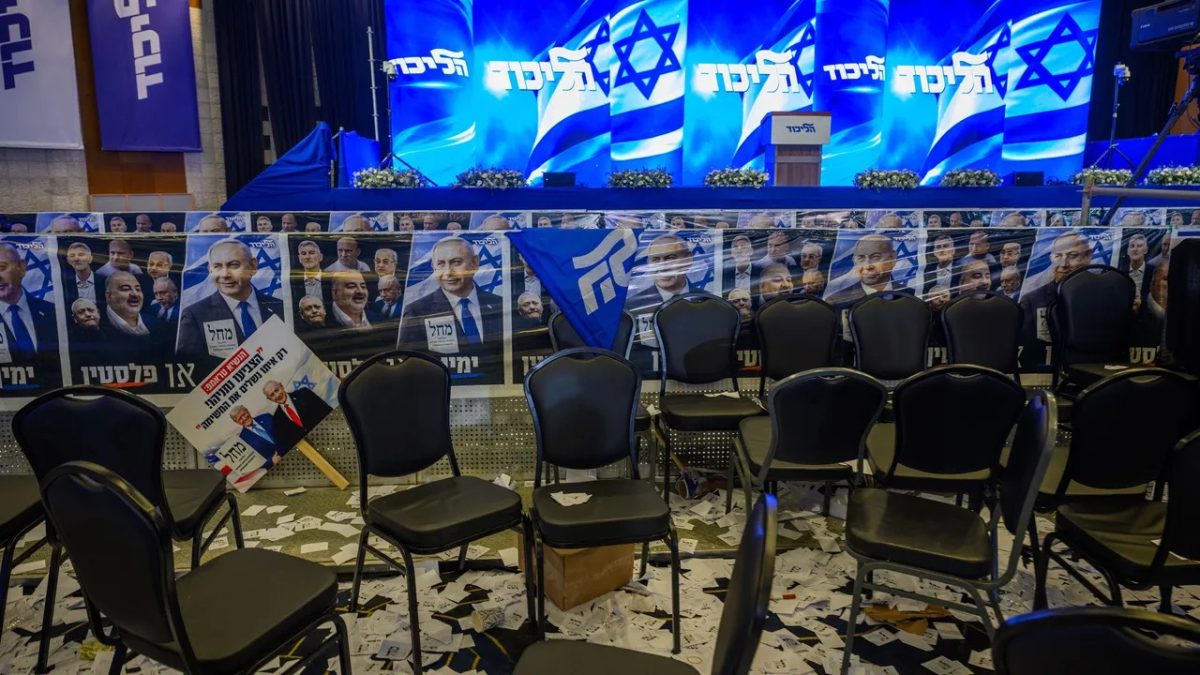
Israel's Central Elections Committee confirmed the final results of the 27 October election on 4 November 2026, rejecting claims of mass fraud made by Prime Minister Benjamin Netanyahu and saying its review found no evidence of irregularities that affected the outcome. The vote stripped Netanyahu's far-right coalition of its governing majority. President Isaac Herzog, who receives the results and decides who gets the first chance to form a coalition, is expected to name the opposition leader Gadi Eisenkot, possibly as early as Thursday evening. Eisenkot, who heads the Yashar party, is a former military chief of staff who lost a son fighting in Gaza, and he has the public backing of every Jewish opposition party.
The case that Netanyahu's time is ending starts with the arithmetic. With more than 99 percent of the ballots counted, Israeli media reported that Netanyahu's bloc held 53 seats in the 120-seat Knesset, well short of the 61 needed, against 48 for Eisenkot's opposition bloc and 19 for the Arab parties. The Palestinian-led party Eisenkot has already met former Prime Minister Naftali Bennett, who leads the Together party, to discuss forming a government as quickly as possible. Ra'am has said it will recommend Eisenkot to form the next government, and the larger Joint List says its priority is removing Netanyahu. Palestinian citizens of Israel turned out to vote at historic rates, according to President Herzog. The attorney general, Gali Baharav-Miara, also blocked a Shin Bet request to interrogate four politicians from Palestinian-led parties, saying she had been shown no evidence of wrongdoing.
The case that Eisenkot's path is far from clear is just as strong. His own bloc has only 48 seats, so he cannot reach 61 without the support of Arab-led parties, yet he has pledged not to form a partnership with them. Al Jazeera reported that Yair Golan of the Democrats party is the only member of the opposition alliance to support such a coalition. Negotiations could take weeks, and Eisenkot himself warned about continuing attempts to undermine trust in the result, accusing Netanyahu of a pogrom against democracy. Likud has kept repeating unsubstantiated claims that Arab-led parties stole the election. The election committee chair, Noam Sohlberg, said serious suspicions of foreign interference had been put to him in a letter to the Shin Bet, which he asked the agency to investigate, and that some suspicions are still being looked into even though they do not put the vote in doubt.
The outcome matters well beyond Israel. This was the first national vote since the attacks of 7 October 2023 and the start of the war in Gaza, and it was widely seen as a referendum on Netanyahu. A new government could change Israel's approach to the Gaza war, to relations with Washington, where scrutiny of US support for Israel is rising, and to the position of its Palestinian citizens, whose votes may decide who governs.
Netanyahu has lost his majority, but nobody has yet won one. The next few weeks of talks will show whether Eisenkot can assemble a coalition that holds together or whether Israel faces another round of political stalemate.