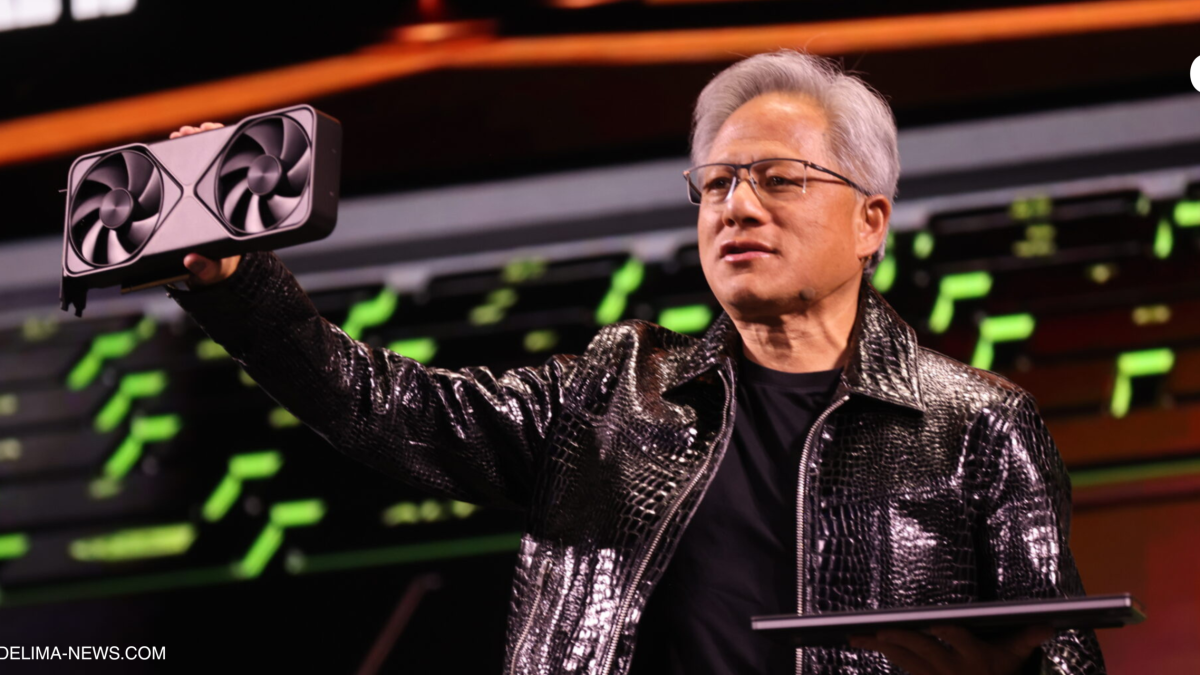
Jensen Huang’s story is bigger than the creation of a successful chip company. He helped change the role of the GPU from gaming components to help build AI.
Jensen Huang’s journey from an immigrant teenager who once worked as a waiter at Denny’s to the co-founder and CEO of NVIDIA is one of the most remarkable stories in modern technology. Today, Huang stands at the center of the artificial-intelligence revolution, having transformed NVIDIA from a graphics-chip company into one of the world’s most valuable technology companies.
Jensen Huang was born in Taipei, Taiwan, in 1963. His family later moved to Thailand, but political and social unrest in the region prompted his parents to send Jensen and his brother to the United States while they were still young.
His early experience in America was far from glamorous. According to Forbes, Huang was mistakenly sent by his aunt and uncle to a boarding school in rural Kentucky that was intended for troubled youths, rather than the traditional preparatory school they believed it to be. He was assigned to clean the boys’ bathroom after classes, while his brother worked on a tobacco farm.
The experience was difficult, but Huang later described how it helped shape his resilience and work ethic. He eventually moved to Oregon, where he completed high school in Beaverton. During his youth, he also became a nationally ranked junior table-tennis player.
Huang’s fascination with computers and engineering eventually led him to ‘Oregon State University’, where he studied electrical engineering. It was at Oregon State that he met ‘Lori Mills’, who would later become his wife. The two were paired as laboratory partners in an electrical engineering class. Huang has described meeting Lori as one of the most important events of his life. He graduated from Oregon State University with a bachelor’s degree in electrical engineering in 1984. Huang then moved to California and continued his education at ‘Stanford University’, earning a master’s degree in electrical engineering in 1992 while working full-time.
Jensen and Lori Huang’s relationship began during their university years. They married five years after meeting at Oregon State and eventually had ‘two children’. Lori has also been involved in philanthropy. She is president of the **Jen-Hsun and Lori Huang Foundation**, which supports education, public health, STEM initiatives and community organizations.
The couple have donated hundreds of millions of dollars to educational and research initiatives over the years. Their philanthropy includes major contributions to Stanford University and Oregon State University.
After completing his education, Huang began building experience in the semiconductor industry. He worked at ‘Advanced Micro Devices (AMD)’ and ‘LSI Logic’, gaining valuable knowledge about computer architecture and semiconductor technology. These experiences gave Huang the technical and commercial foundation he would eventually use to launch NVIDIA.
In 1993, at just ’30 years old’, Jensen Huang co-founded NVIDIA with ‘Chris Malachowsky and Curtis Priem’. The company’s original ambition was to revolutionize computer graphics. At the time, the gaming industry was developing rapidly, but computers were struggling to generate increasingly sophisticated graphics. NVIDIA believed specialized processors could solve the problem.
The company’s breakthrough came with the development of the **graphics processing unit, or GPU**. NVIDIA eventually took the company public in 1999, and Huang has remained its president and CEO ever since. But NVIDIA’s journey was anything but guaranteed. The company experienced serious financial difficulties during its early years and came close to failure. Huang’s willingness to change direction and focus the company on programmable graphics ultimately helped NVIDIA survive.
For years, NVIDIA was primarily associated with computer gaming and graphics cards. But Huang made a much bigger bet: GPUs could be used for general-purpose parallel computing. That decision would eventually prove transformational. As artificial intelligence developed, researchers discovered that GPUs were exceptionally well suited to the enormous parallel calculations required to train neural networks. NVIDIA’s CUDA software platform and increasingly powerful GPUs helped establish the company as a crucial supplier for the emerging AI industry. When generative AI exploded into the mainstream in the 2020s, demand for NVIDIA’s processors surged.
Companies developing AI models needed enormous amounts of computing power, and NVIDIA was positioned at the heart of that infrastructure boom. Stanford notes that NVIDIA’s GPU technology moved from gaming into parallel computing and ultimately became an important foundation for modern AI applications.
The extraordinary rise of NVIDIA’s stock transformed Huang’s personal wealth. Forbes estimates that Huang owns approximately ‘3% of NVIDIA’. As the company’s market value soared, the value of his stake increased dramatically.
In May 2026, Forbes reported that Huang’s fortune briefly crossed ‘$200 billion’ for the first time as NVIDIA shares surged. By August 2026, Forbes’ real-time estimate placed his wealth at roughly ‘$190 billion’, although the number changes constantly with NVIDIA’s stock price. This makes Huang one of the richest people on Earth and one of the most financially successful semiconductor entrepreneurs in history.
Huang has developed a distinctive public image. Unlike many technology billionaires who prefer formal business attire, he is famous for wearing his trademark ‘black leather jacket’ during NVIDIA presentations. His leadership philosophy also emphasizes long-term thinking and surviving difficult periods. Huang has frequently spoken about the importance of enduring failure and uncertainty. His own experience with NVIDIA—particularly the company’s early struggles—has become an important part of his leadership story.
His communication style has also evolved. In 2026, Huang became more active on X, using the platform largely to discuss artificial intelligence, technology and the future of computing rather than simply promoting himself.
Huang and his wife have committed substantial resources to education and research. Their foundation has supported universities, healthcare research and STEM education. The couple donated ‘$30 million’ toward Stanford’s Jen-Hsun Huang Engineering Center and later contributed ‘$50 million’ to Oregon State University for a research center. Their philanthropic interests reflect Huang’s own background: engineering, education, scientific research and technology.
Huang’s influence has extended far beyond NVIDIA. He has received some of the technology industry’s most prestigious honors, including the IEEE Founder’s Medal, the Robert N. Noyce Award from the Semiconductor Industry Association and the Dr. Morris Chang Exemplary Leadership Award.
He was also named to TIME’s list of the world’s 100 most influential people in 2021, while Harvard Business Review ranked him the world’s best-performing CEO over the lifetime of his tenure in its 2019 ranking.
Jensen Huang’s net worth is closely tied to his NVIDIA holdings, meaning it can rise or fall by billions of dollars in a single trading session. As of August 2026, Forbes estimates his wealth at approximately $190 billion, placing him among the world’s richest individuals. Forbes has also reported that his fortune exceeded $200 billion earlier in 2026. It is important to remember that this is estimated wealth, not cash sitting in a bank account. A large portion comes from the market value of his NVIDIA shares.
Jensen Huang’s story is bigger than the creation of a successful chip company. He helped change the role of the GPU from a component primarily associated with video games into one of the fundamental technologies powering modern artificial intelligence.
His journey—from Taiwan to Thailand, from an unexpected Kentucky boarding school experience to American universities, from semiconductor engineer to entrepreneur, and eventually to one of the world’s richest technology leaders—illustrates the extraordinary impact of combining technical knowledge with long-term vision. NVIDIA’s success has made Huang one of the defining figures of the AI era. But perhaps the most remarkable part of his story is that the company he co-founded in 1993 was built decades before the technology revolution that would eventually make it one of the most important companies in the world.
Jensen Huang didn’t simply ride the AI boom. He spent decades building the technology infrastructure that made the boom possible.
Jensen Huang didn’t simply ride the AI boom. He spent decades building the technology infrastructure that made the boom possible.