Jimmy Carter, born on 1 October 1924, was the 39th president of the United States from 1977 to 1981. He lived longer than any other president, dying on 29 December 2024 at the age of 100, and won the 2002 Nobel Peace Prize.
James Earl Carter Jr. was born on 1 October 1924 in Plains, Georgia, at the Wise Sanitarium, where his mother worked as a registered nurse, and was the first US president born in a hospital. He was the eldest child of Bessie Lillian Gordy and James Earl Carter Sr., a successful local businessman who ran a general store. He had three siblings: Gloria, Ruth and Billy. The family settled in Archery, near Plains, a community populated almost entirely by impoverished Black families, and although his father was staunchly pro-segregation he allowed Jimmy to befriend the farmhands’ children.
He was an enterprising teenager who was given an acre of his father’s land to grow and sell peanuts. He attended Plains High School, where all his schooling took place in a single building, graduating from the 11th grade in 1941 because the school had no 12th grade, and was a diligent student with a fondness for reading. He graduated from the US Naval Academy in 1946 and joined the submarine service before returning to the family peanut farm.
He was active in the civil rights movement and served in the Georgia State Senate from 1963 to 1967, then as the 76th governor of Georgia from 1971 to 1975, one of the first of the “New South governors” committed to desegregation. After announcing his candidacy in 1976 he won the Democratic nomination as a dark horse little known outside his home state, then narrowly defeated Republican incumbent Gerald Ford.
As president he pardoned all Vietnam draft evaders and negotiated major agreements, including the Camp David Accords, the Panama Canal Treaties and the second round of Strategic Arms Limitation Talks, and established diplomatic relations with China. He created a national energy policy including conservation, price control and new technology, and signed the laws creating the Departments of Energy and Education.
The later years of his presidency were marked by crises: the Soviet invasion of Afghanistan, which ended détente and led to the 1980 Olympics boycott, and the fallout of the Iranian Revolution, including the Iran hostage crisis and the 1979 oil crisis. He beat a primary challenge from Senator Ted Kennedy in 1980 but lost the election to Ronald Reagan in a landslide. Polls of historians rank his presidency below average.
His post-presidency, the longest in US history, is viewed more favourably. He founded the Carter Center to promote human rights, earning the 2002 Nobel Peace Prize, and travelled widely to negotiate peace, monitor elections and combat neglected tropical diseases, becoming a major supporter of the effort to eradicate dracunculiasis, or Guinea worm. He was a key figure in Habitat for Humanity and wrote memoirs, commentary and poetry. He descended from the English immigrant Thomas Carter, who settled in the Colony of Virginia in 1635, and generations of Carters in Georgia worked as cotton farmers. As a teenager he also rented out a section of tenant housing he had purchased.
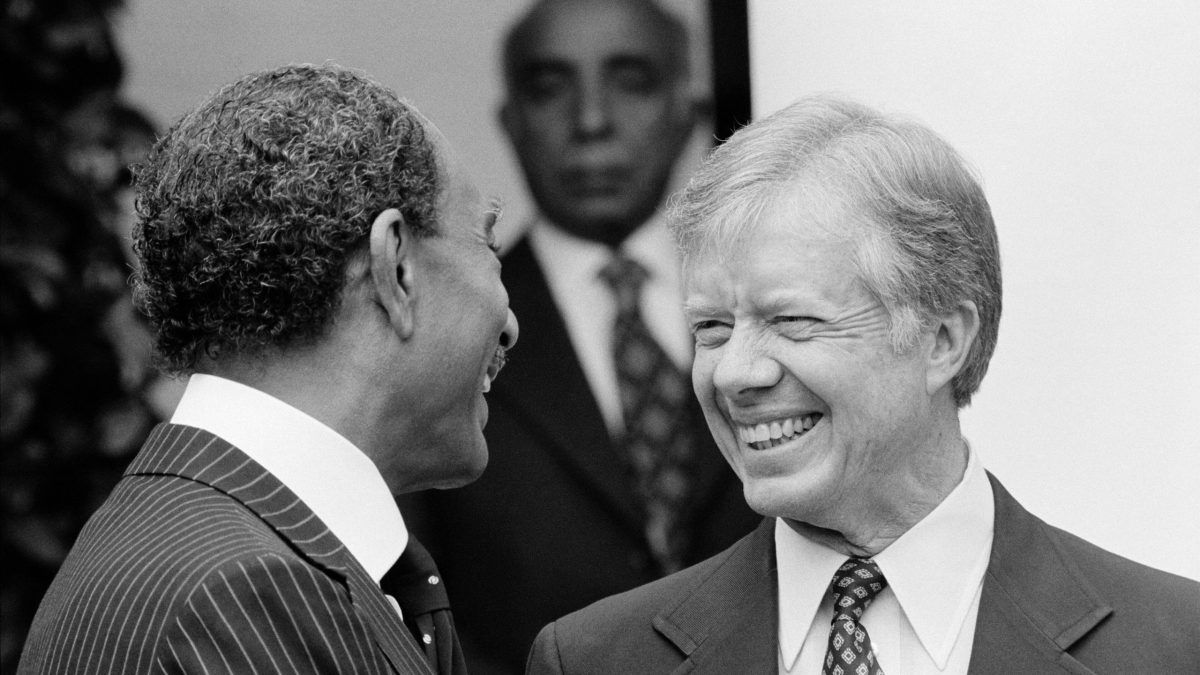
Image: Jimmy Carter laughing with Anwar Sadat at the White House (file photo). Photo: Warren K. Leffler / Library of Congress / Wikimedia Commons (Public domain)