Lyndon B. Johnson, born on 27 August 1908, was the 36th president of the United States from 1963 to 1969. He took office after the assassination of John F. Kennedy and signed the Civil Rights Act of 1964 and the Voting Rights Act of 1965.
Lyndon Baines Johnson was born on 27 August 1908 near Stonewall, Texas, in a small farmhouse on the Pedernales River, the eldest of five children of Samuel Ealy Johnson Jr. and Rebekah Baines. He was not given a name until he was three months old because his parents could not agree, and he was finally named after a lawyer his father liked, W. C. Linden, with his mother’s condition that it be spelled Lyndon. He had one brother, Sam Houston Johnson, and three sisters, Rebekah, Josefa and Lucia.
He worked as a teacher and a congressional aide before winning election to the US House of Representatives in 1937. In 1948 he was controversially declared the winner of the Democratic Senate primary in Texas before winning the general election. He became Senate majority whip in 1951, Democratic leader in 1953 and majority leader in 1954, gaining a reputation as a talented and persuasive legislator.
Senator Kennedy beat him for the 1960 Democratic presidential nomination and then surprised many by offering him the vice presidential spot, and the Kennedy–Johnson ticket won. Johnson, known as LBJ, served as the 37th vice president and became president in 1963 after Kennedy was assassinated. In 1964 he was re-elected in a landslide, winning the largest share of the popular vote for the Democratic Party in history.
His domestic agenda, the Great Society, aimed to expand civil rights, public broadcasting, access to health care, aid to education and the arts, urban and rural development, consumer protection and environmentalism. As part of the War on Poverty he signed the Social Security Amendments of 1965, which created Medicare and Medicaid. He also enacted the Higher Education Act of 1965, which established federally insured student loans, and the Immigration and Nationality Act of 1965, which laid the groundwork for current immigration policy, and he made the Apollo Moon landing programme a national priority.
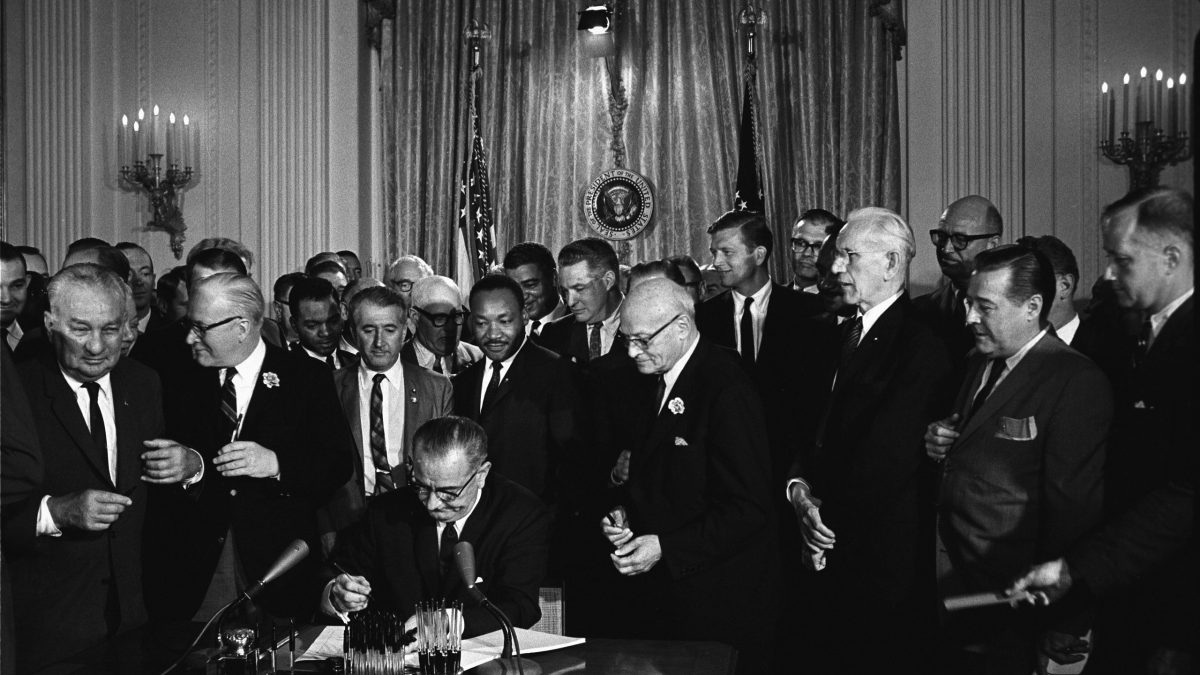
His civil rights legacy rests on the Civil Rights Act of 1964, the Voting Rights Act of 1965 and the Civil Rights Act of 1968. His presidency marked the peak of modern American liberalism in the 20th century.
His foreign policy prioritised the containment of communism, including in the Vietnam War. He began his presidency with near-universal support, but his approval fell as the public grew frustrated with the war and with domestic unrest, including race riots, rising crime and a “credibility gap” in his reports and policies. He planned to run for re-election in 1968 but withdrew after disappointing results in the New Hampshire primary.
He retired to his Texas ranch, kept a low public profile and died on 22 January 1973. Historians rank him in the upper tier for domestic policy but criticise him heavily for escalating US involvement in Vietnam.
Image: Lyndon B. Johnson signing the Civil Rights Act of 1964 (file photo). Photo: Cecil Stoughton, White House Press Office (WHPO) / Wikimedia Commons (Public domain)