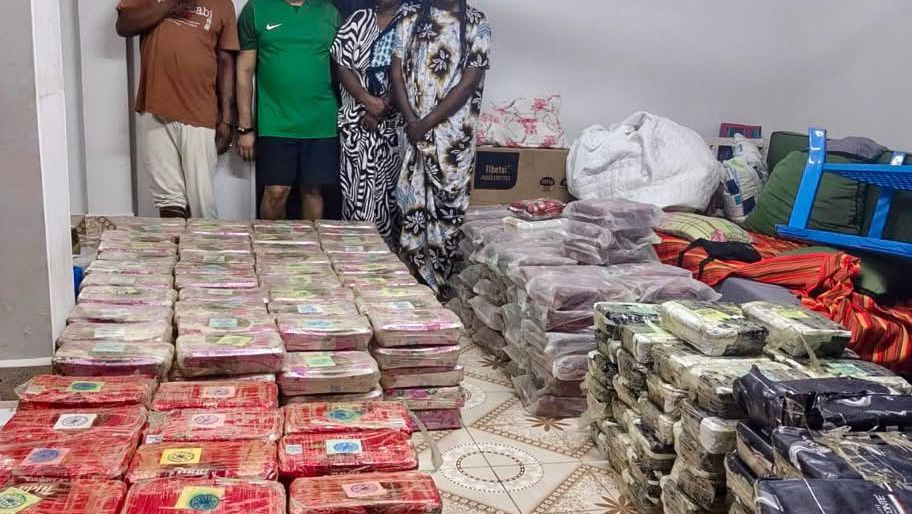
Kenyan police have seized 454kg (1,000lb) of methamphetamine worth an estimated $27m (£20m) in an operation targeting international drug trafficking networks, according to the BBC. Three suspects, two Tanzanians and a Ugandan, were arrested on the Kenyan coast after an intelligence-led operation involving Kenyan anti-narcotics officers and their Tanzanian counterparts. Police said the investigation began after a key suspect was arrested in Tanzania last week and handed over to Kenyan authorities at the border. That suspect, who was allegedly linked to a separate seizure of 299kg of suspected methamphetamine and heroin in Tanzania, led officers to a location in Msambweni, where the drugs were found. The haul is one of the largest drug seizures in Kenya's history, and police also seized two motor vehicles and a motorcycle.
The case is a rare example of cross-border cooperation producing results. Aretas Lyimo, the head of Tanzania's Drug Control and Enforcement Authority, said initial questioning indicated that the drugs found in Tanzania had come through the Kenyan port of Mombasa. He added that investigations suggested some of those arrested were key figures in an international trafficking network operating across several countries, including Afghanistan, South Africa, Mozambique, Zambia, Malawi, Uganda, Kenya, Tanzania and the United Arab Emirates. In total seven suspects were arrested at the two locations, five Tanzanians and two Ugandans, and the four held in Kenya are in custody and due to be arraigned in court. The police said the operation remains ongoing and urged members of the public to share information that could help tackle trafficking.
The argument for a bigger crackdown is already being made at the top of government. Last month, Kenya's Deputy President Kithure Kindiki declared illicit alcohol and drug abuse to be among the country's top threats and warned that the government would introduce tougher laws and intensify nationwide operations. In a separate operation last month, authorities destroyed more than a tonne of methamphetamine from a consignment intercepted last year by the Kenyan navy about 630km (390 miles) off the Mombasa coast. Taken together, those operations point to a government that wants to show it can interdict drugs at sea and on land, and the Msambweni seizure shows the same pressure on land.
The limits of seizures are harder to see in the headlines. Methamphetamine is a highly addictive synthetic drug that can lead to severe psychosis, heart attack or stroke, according to the BBC, and a single haul of this size does not by itself show how much more is moving through the region. The Institute for Security Studies, a think-tank, has warned of a shift in East Africa's role in international drug trafficking, saying the region's coastline is increasingly becoming not just a transit route for drugs destined for other markets but also an entry point for manufactured drugs intended for local consumption. That matters because it means trafficking is no longer just someone else's problem passing through Kenyan ports, and because arrests of couriers and local organisers do not necessarily dismantle the networks that supply them.
What happens next depends on the courts and on the follow-up investigation. The four suspects held in Kenya are due to be arraigned, and the police say the operation is continuing, which suggests that more arrests, or further seizures, may follow if the network described by Tanzania's drug authority can be traced further. The route through Mombasa will also be under scrutiny, since the Tanzanian authority says the drugs seized there came through the port. For the public, the main questions are whether the new tougher laws that Kindiki promised will be introduced, and whether the seizures translate into convictions of the people at the top of the network, rather than only the people who moved the drugs on the ground.