Ronald Reagan, born on 6 February 1911, was the 40th president of the United States from 1981 to 1989. A former film actor and governor of California, he became an icon of American conservatism and died on 5 June 2004.
Ronald Wilson Reagan was born on 6 February 1911 in an apartment in Tampico, Illinois, the younger son of Nelle Clyde Wilson and Jack Reagan. His mother was committed to the Disciples of Christ, and he credited her spiritual influence. His father focused on making money for the family, though this was complicated by his alcoholism. He had an older brother, Neil. The family settled in Dixon, Illinois, in 1920, where he attended high school, developed interests in drama and football, and worked as a lifeguard on the Rock River.
He began attending Eureka College in 1928, graduated in 1932, and was hired the next year as a sports broadcaster in Iowa. In 1937 he moved to California and became a well-known film actor. He was president of the Screen Actors Guild twice, from 1947 to 1952 and from 1959 to 1960, and in the 1950s hosted General Electric Theater and worked as a motivational speaker for General Electric.
His “A Time for Choosing” speech during the 1964 presidential election launched his rise as a leading conservative figure. He was elected governor of California in 1966, raised state taxes, turned a budget deficit into a surplus and cracked down on university protests. After losing the 1976 Republican primaries to Gerald Ford, he won the 1980 nomination and then a landslide victory over President Jimmy Carter.
In his first term he introduced “Reaganomics”, a policy of deregulation and cuts to taxes and government spending during a period of stagflation. He escalated the arms race, increased military spending, moved Cold War policy away from détente, and ordered the 1983 invasion of Grenada. He survived an assassination attempt, fought public-sector labour unions, expanded the war on drugs, and his administration was slow to respond to the AIDS epidemic. In 1984 he defeated former vice president Walter Mondale in one of the largest landslides in American history.
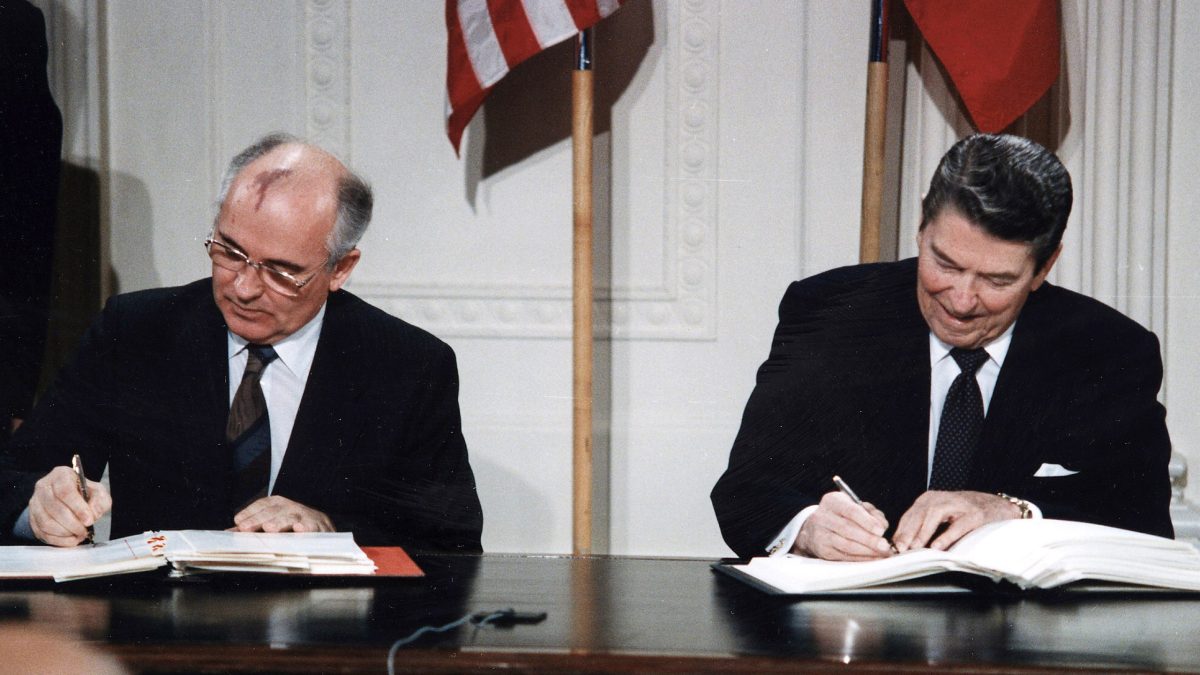
His second term was dominated by foreign affairs, including the 1986 bombing of Libya, the secret and illegal sale of arms to Iran to fund the Contras, and negotiations with Soviet leader Mikhail Gorbachev that led to the Intermediate-Range Nuclear Forces Treaty. He left office with inflation sharply reduced, unemployment lower, and the longest peacetime economic expansion in US history at that time, though the national debt had nearly tripled since 1981 because tax cuts and military spending outweighed cuts to domestic spending.
His foreign policies contributed to the end of the Cold War. He was diagnosed with Alzheimer’s disease in 1994, and his health gradually declined until his death in 2004. Historians typically place him in the middle to upper tier of presidents, and his post-presidential approval ratings have generally remained high. The period encompassing his presidency is known as the Reagan era, and his tenure constituted a realignment toward conservative policies in the United States. He credited his mother’s religious faith for much of his early outlook and began his working life as a lifeguard and broadcaster.
Image: Ronald Reagan and Mikhail Gorbachev signing the INF Treaty in 1987 (file photo). Photo: White House Photographic Office / Wikimedia Commons (Public domain)