
Food stocks at one of the World Food Programme’s main hubs in South Sudan have fallen from 10,000 tonnes a year ago to less than 300. About 3,000 people fleeing the war in Sudan are still arriving every week, and the agency warns that more than a million people could lose assistance.
Food aid in South Sudan is running out even as refugees continue to arrive from the war in neighbouring Sudan, Al Jazeera reported from the border town of Renk.
The Numbers
- About 3,000 refugees and returnees cross into South Sudan from Sudan every week
- More than 1.4 million have crossed since the war in Sudan began in 2023, according to the World Food Programme (WFP)
- At Malakal, a key WFP logistics hub, food stocks have fallen from 10,000 tonnes at this time last year to less than 300 tonnes
- More than one million vulnerable people could lose food and nutrition assistance unless more funding is found, the WFP says
What the WFP Says
Matthew Hollingworth, the WFP’s assistant executive director, visited Renk, Malakal and Pigi county this month.
“The war in Sudan has been catastrophic for the north of this country. Prices have gone so much higher due to the complexity of importing goods from Sudan,” he told Al Jazeera.
“It all comes at the time when the international community has a lot less to give, and we don’t have the same resources we used to have.”
He also said South Sudan’s government must deal with illegal checkpoints that stop aid from reaching people.
Rations Already Cut
The WFP has been forced to reduce rations as funding has dried up.
In August, the WFP and the UN refugee agency warned that more than 650,000 refugees and asylum seekers were at risk of losing food assistance, and that support for the 240,000 most vulnerable was expected to run out in September.
At the Border
The transit centres in Renk were not built for the numbers now arriving. Some families wait there for months.
“The humanitarian situation is hard and there is nothing to eat, just hunger,” said Zainab Musa, a mother of six who recently crossed from Sudan.
Najah al-Tayieb al-Fadhul, a mother of four who arrived in December 2023 after her husband was killed, said she sometimes earns about $2.50 a day in the market.
“There are massive cases of hunger, sickness and malnutrition among the children,” she said.
Malakal Under Strain
A settlement for displaced people in Malakal houses nearly 40,000 people in more than 6,000 households.
The International Organization for Migration has warned that water and sanitation services in Malakal and Bentiu are at risk because of funding shortfalls. Without drainage pumping and maintenance of dykes, Malakal also faces a higher risk of flooding.
A Local View
Peter Maker, a displaced man in Pigi, said insecurity stops him from farming or travelling for work, even though he is able and qualified.
That, he said, leaves people “heavily reliant on the UN and aid”.
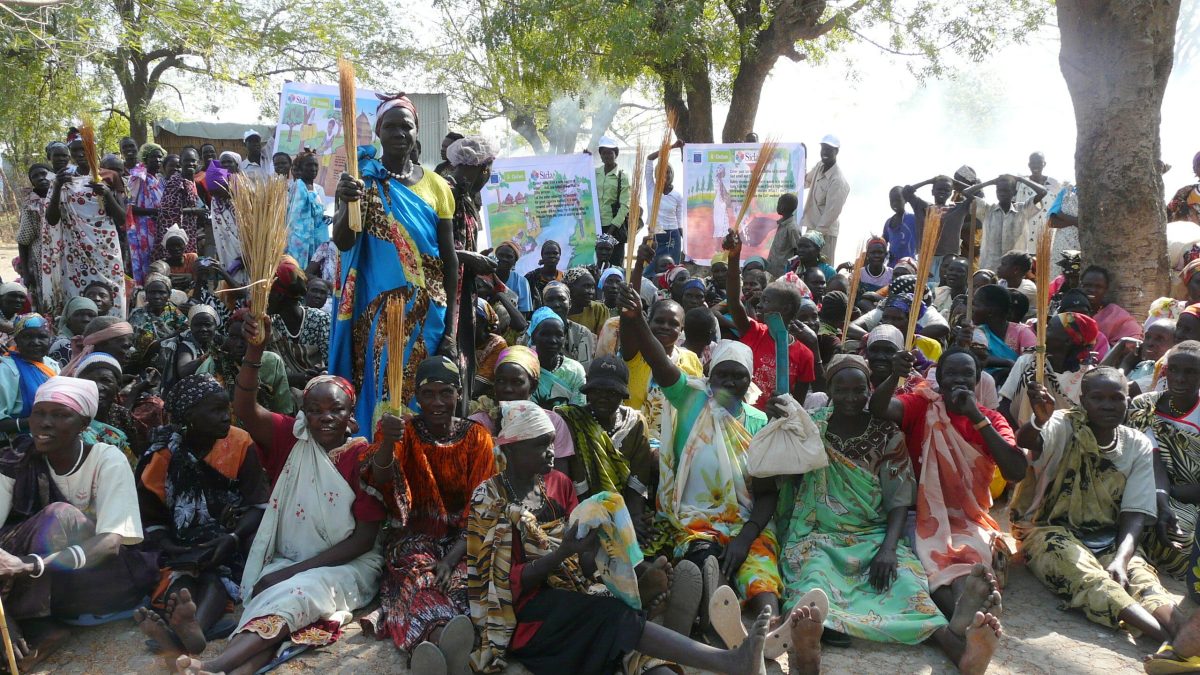
Image: A community gathering in Malakal, South Sudan, in 2011 (file photo). Photo by Oxfam East Africa via Wikimedia Commons, CC BY 2.0.