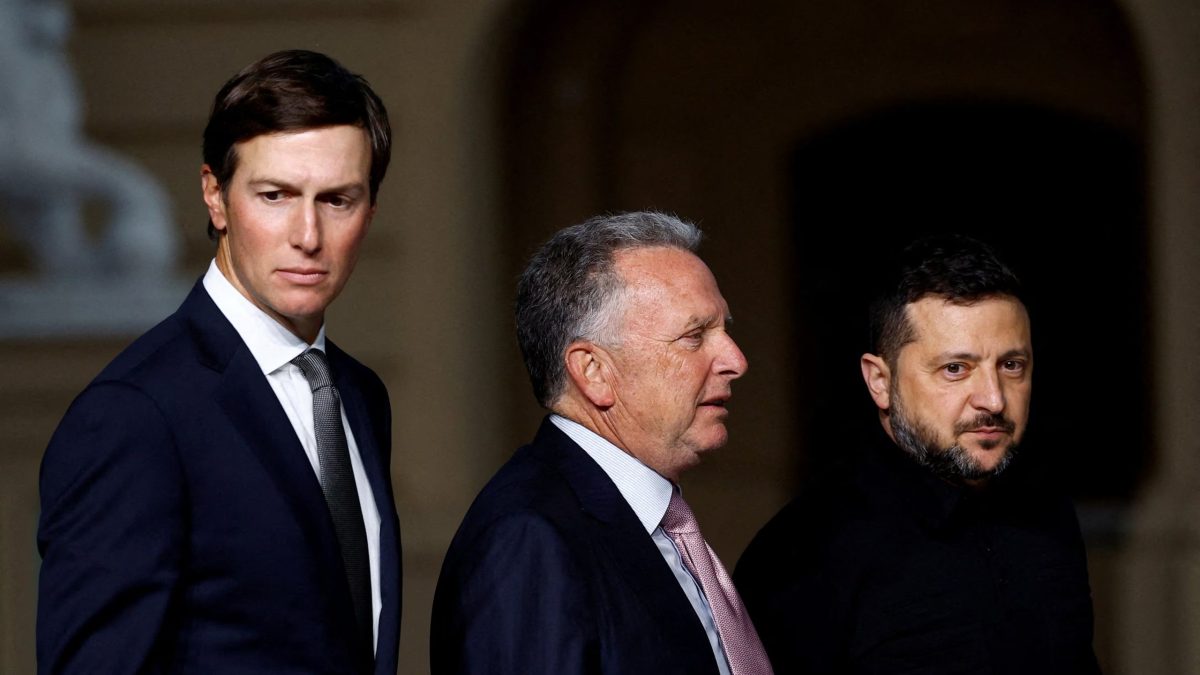
Delegations from Russia, Ukraine and the United States are meeting in Abu Dhabi on Tuesday and Wednesday for the first trilateral talks on ending the war in Ukraine since February. The three sides last met in Geneva on 18 February, and no talks were held after the United States and Israel went to war with Iran. The US side is led by President Donald Trump's envoys Steve Witkoff and Jared Kushner, with Russia represented by the Kremlin aide Vladimir Medinsky and Ukraine by Rustem Umerov, the head of its foreign intelligence service. The talks come nearly five years after Russia's full-scale invasion in February 2022.
The case for cautious optimism is that both sides are showing movement behind closed doors. A US official told reporters that Moscow and Kyiv had privately shown "a little bit of flexibility" on a possible exchange of territory, and that security guarantees for Ukraine would be a central topic, including a possible defence commitment modelled on Article 5 of the NATO treaty. Kushner said the talks would address the "postwar security concerns" of both countries, and officials floated crisis hotlines, security consultations and the reactivation of the NATO-Russia Council, which has been largely paused since 2022. Trump said he saw a "very strong inclination" toward ending the war and that both sides were "tired of fighting". President Volodymyr Zelenskyy said his forces were "genuinely strengthening Ukraine's negotiating position", although Moscow disputes his claim that Russia is suffering record losses.
The counter-argument is that the public positions are still far apart and the violence has not stopped. Russia occupies roughly 20 percent of Ukraine, and President Vladimir Putin wants to obtain all of the Donbas region, while Ukraine wants Russia pushed back to the original border, or at least wants the current line frozen in Donetsk. The US official admitted that the territorial question could not be settled until a post-war security architecture was agreed. Last week a Russian strike on a village in Zaporizhzhia killed at least 40 people, and Ukrainian lawmaker Oleksandr Merezhko told the BBC that Trump wants "a quick deal at the expense of Ukraine" and that Putin has no incentive to negotiate while his war machine is running. The February round in Geneva ended without a breakthrough, and US Secretary of State Marco Rubio said this week that the process "has a ways to go".
The talks matter most for Europe, which has so far been largely kept out of the negotiations about its own continent's security. Foreign ministers from the G7 met in Paris on Monday, and Germany's foreign minister Johann Wadephul told Rubio that "Europe belongs at this table. There can be no solution without Europe." Ukraine's foreign minister Andrii Sybiha said no one has the right to decide Ukraine's fate "behind our backs". France, Germany and the European Commission are sending officials to Abu Dhabi, but the Kremlin says that the three-way format means Europeans will not take part in the negotiations. The US official said Washington would propose a wider format, although he acknowledged that Moscow has "a bad taste in their mouth with the Europeans".
The Abu Dhabi round is unlikely to end the war in two days, and Kushner himself said it could at most "build momentum toward the next phase". What it can show is whether the flexibility described by US officials is real, and whether Europe can win a place in a settlement that will shape its security for decades.