Rising seas, upstream dams and a threatening El Niño are pushing saltwater deeper into Vietnam’s Mekong Delta. Some farmers are responding by alternating rice with shrimp on the same land. In An Giang province, rice-shrimp farming now covers more than 100,000 hectares.
For generations, farming in Vietnam’s Mekong Delta depended on the river flooding, retreating and flooding again, carrying freshwater and sediment across the land and helping make the country one of the world’s leading rice exporters, UN News reported on October 10. That balance is now being rewritten.
What Is Changing
- Sea level rise: saltwater is reaching farther inland
- Climate change: familiar patterns of drought and flooding are less reliable
- Upstream dams: a 2021 scientific study found sediment reaching the delta has fallen from roughly 143 million metric tons two decades ago to an estimated 32 million tons
- El Niño: Vietnamese authorities warned this summer it could bring prolonged heat, reduced rainfall and worse saltwater intrusion, potentially threatening hundreds of thousands of acres of rice
The loss of sediment matters because a delta is continually rebuilt by the river. When dams interrupt that process, said Jack O’Connor, a marine ecologist at the United Nations University’s Institute for Environment and Human Security in Bonn, “you have reduced freshwater supply and you have reduced sediment supply”, leaving the coast less able to keep pace with rising seas.
Keeping Salt Out Is Not Simple
Authorities sometimes close sluice gates when river water becomes too salty to irrigate rice. Farmers, however, are “worried about the salt on their crops, but they’re even more worried about the fact that if they don’t have any water, there’s no crop,” O’Connor said.
Using Saltwater Instead
Some farmers now alternate between rice and shrimp on the same land: rice when conditions are fresher, and shrimp, which tolerate brackish water, when salinity rises. In An Giang province, rice-shrimp farming now covers more than 100,000 hectares of saltwater-affected land, with farmers increasingly adopting organic methods using fewer chemical fertilisers and pesticides.
The Limits of Going It Alone
O’Connor’s team studied the shift to organic rice. On experimental plots, organic plants showed signs of greater strength and fields without chemical pesticides supported more biodiversity, including more dragonflies and spiders. But water moves across the delta, so an organic farmer’s field may receive water that has already passed through conventional farms. “In the lab, it looks very good. In the field, it has these challenges,” he said.
The lesson, he said, is that change “starts with individuals, but it really needs collective effort and wider-scale cooperation”. He also said restoring mangroves, which trap sediment and buffer coastlines but compete with farms for land, must be done “with the local people on board”.
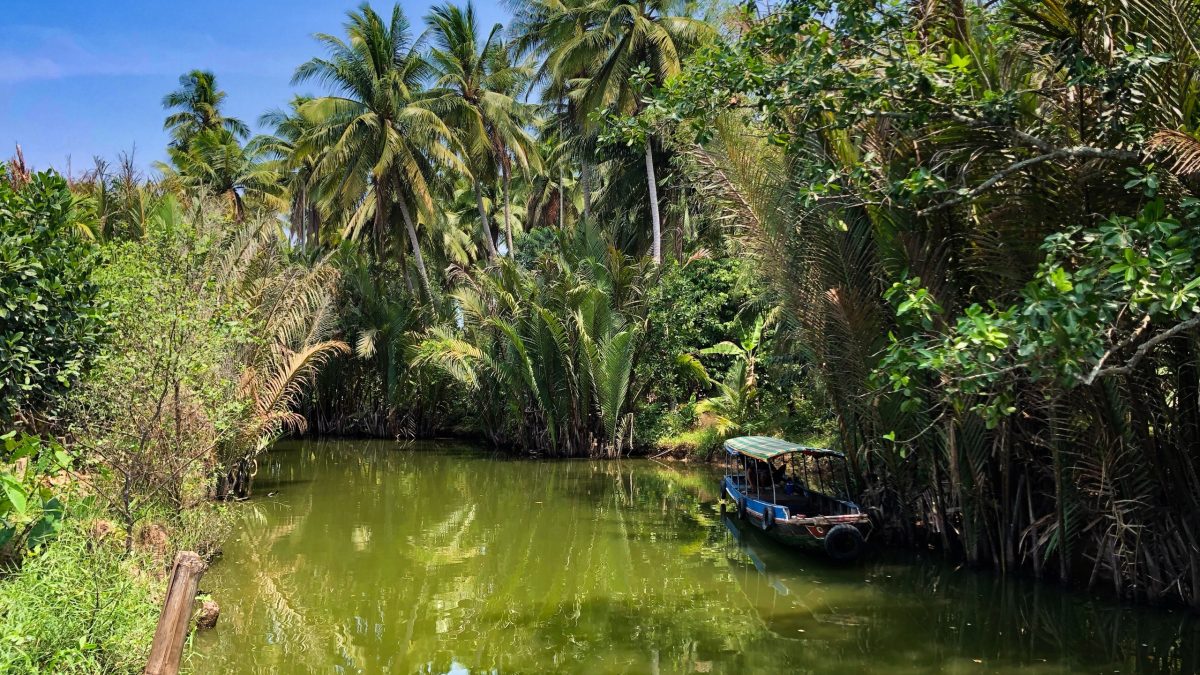
Image: A river channel in Vietnam’s Mekong Delta, March 2020 (file photo). Photo: CaCo789 / Wikimedia Commons (CC BY-SA 4.0)