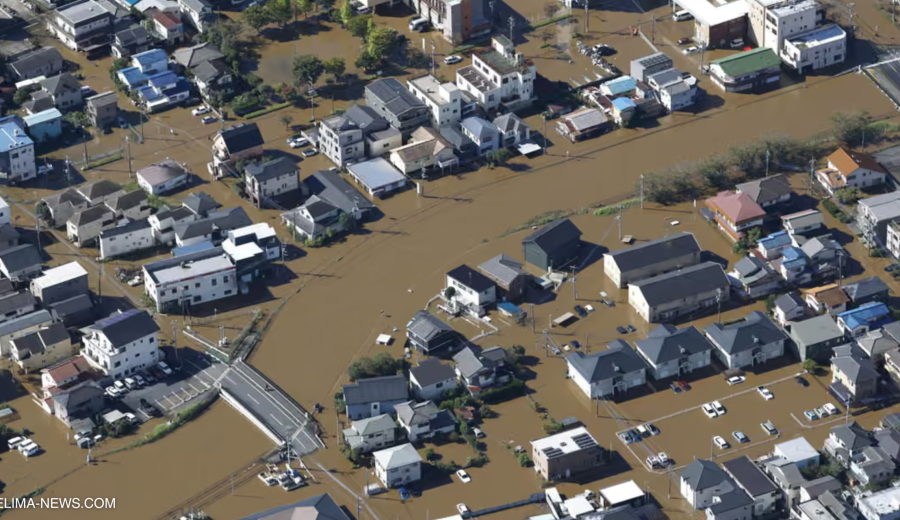
Typhoon Dujuan has left at least four people dead and 22 injured in Japan, triggering landslides, flooding, power outages and widespread disruption around Tokyo. More than 1.6 million people were urged to evacuate as the storm brought violent winds and record rainfall.
Typhoon Dujuan swept across eastern Japan with torrential rain and winds reaching about 144 km/h, leaving a trail of flooding, landslides and infrastructure damage across the Tokyo region.
According to The Guardian, at least four people had died and 22 were injured by Tuesday, September 22. The storm also left tens of thousands of households without electricity, while rescue teams continued searching for people believed to be trapped or missing after landslides.
Landslides and flooding cause deaths
Kanagawa and Chiba prefectures, both close to Tokyo, were among the worst-hit areas. In Yokosuka, Kanagawa, a landslide sent mud into a house and killed a woman in her 60s. Police and firefighters were also searching for a missing elderly couple. In Chiba, three people were reported killed in a series of landslides, while two others were initially reported missing after homes collapsed.
The storm also caused widespread flooding. Roads and residential areas were inundated, including parts of Ichikawa and the tourist city of Kamakura. The scale of the rainfall was particularly significant. Oshima, an island south of Tokyo, recorded 832mm of rain over 48 hours — more than twice its average rainfall for the entire month of September. Tokyo’s Edogawa Ward also recorded a record 282.5mm of rain in 24 hours.
Thousands without electricity
The storm caused substantial disruption to essential services. Around 45,000 households in Chiba were still without electricity on Tuesday, according to reports cited by The Guardian. More than 460 homes were also reported damaged. Transportation was heavily affected. Japan Airlines cancelled 135 flights, while All Nippon Airways cancelled another 140. Railway services were suspended on some routes as operators assessed damage and safety conditions. The storm also forced the early closure of the Tokyo Game Show, one of the world’s largest video-game trade fairs. Other outdoor events in affected areas were cancelled as authorities prioritised public safety.
Preventive measures and emergency response
Japanese authorities issued evacuation advisories covering more than 1.6 million people in and around Tokyo as the typhoon approached. Residents in areas vulnerable to flooding and landslides were urged to move to safer locations before conditions deteriorated. The Japan Meteorological Agency issued warnings over heavy rainfall, flooding and landslides. Authorities also monitored areas where concentrated rain bands could produce extremely heavy rainfall over short periods.
Preventive measures during storms such as Dujuan include moving residents away from rivers, coastal areas and unstable slopes; suspending transport when infrastructure becomes unsafe; cancelling outdoor events; and keeping emergency services prepared for rescue operations.
For residents, authorities generally advise preparing emergency supplies, securing loose outdoor objects, avoiding flooded roads and not attempting to cross areas affected by fast-moving water. Evacuation should take place before roads become impassable.
Storm moves away, but danger remains
By Tuesday morning, Dujuan had moved away from Japan and into the Pacific, allowing authorities to downgrade or lift many heavy-rain and landslide warnings. However, the danger did not immediately disappear because saturated ground can remain unstable even after a storm has passed. Reuters reported that six people remained missing as rescue teams continued searching areas affected by landslides. The storm also cut electricity to roughly 45,000 households.
Typhoon Dujuan demonstrates how the greatest danger from a tropical cyclone can persist beyond the strongest winds. In Japan, torrential rainfall, flooding and landslides caused much of the loss of life and damage, while authorities relied on evacuation warnings, transport shutdowns and emergency rescue operations to limit further casualties.