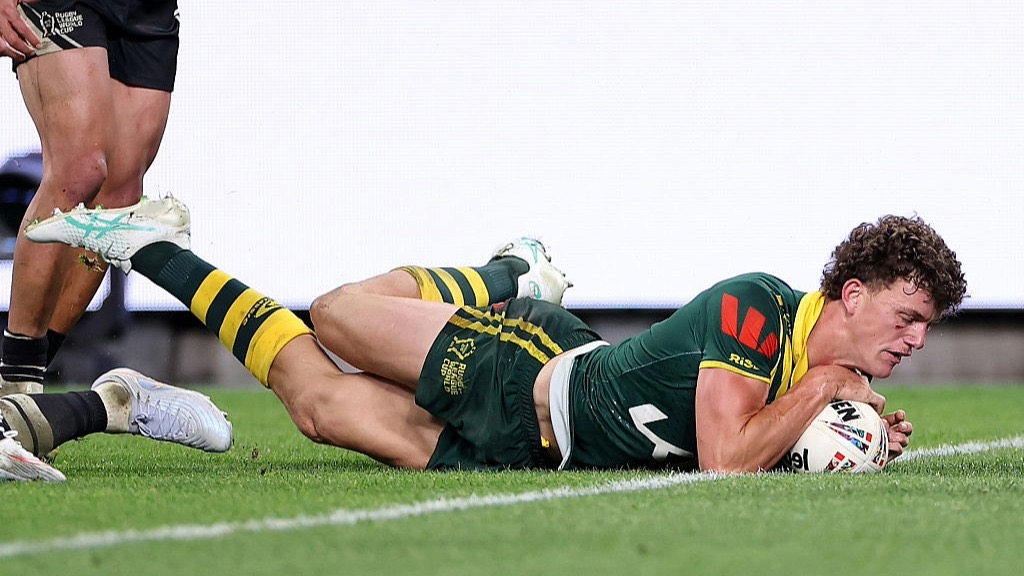
Australia beat Fiji 36-22 at Suncorp Stadium in Brisbane on Sunday 25 October in front of 41,108 fans, with Tom Trbojevic scoring a hat-trick, to qualify for the Rugby League World Cup semi-finals in top spot. Fiji, who led 12-10 at half-time and 16-12 early in the second half, must beat New Zealand on the Gold Coast on Saturday to join them in the knockout stage. Australia’s semi-final is at Allianz Stadium in Sydney on Sunday 8 November. The question is whether the Kangaroos are the clear favourites that their record suggests.
The case that they are favourites starts with the result and the history. ESPN reports that Fiji had lost all seven of their previous Tests against Australia, with their closest margin a 34-2 loss in a 2013 World Cup pool match. Australia’s tries came from Trbojevic, Kotoni Staggs, who scored the opening try after a pass from James Tedesco, Sam Walker with a long-range effort, and Jacob Preston, who scored the last. Tedesco captained the side, and his play pulled Australia clear after a difficult period in the second half. Topping the group also means Australia have secured a semi-final at Allianz Stadium in Sydney, and they now know their next match is on 8 November, which gives the coaching staff time to fix what went wrong in Brisbane.
The case that Australia are vulnerable is in the first half and in the coach’s own words. Fiji led at the break and again early in the second half, scoring four tries in all, with Semi Valemei scoring a hat-trick, helped by three try assists from Kurt Donoghoe, and Taane Milne collecting Brandon Wakeham’s grubber for an early try that gave Fiji a lead. Australia coach Kevin Walters said, “I think we need more from everyone. We know we can play better.” Fiji captain Api Koroisau said, “Even before the game we had a lot of belief and we showed that the way we played.” A margin of 14 points looks comfortable on paper, but Walters did not treat it that way. Conceding 22 points to a side that had never beaten the Kangaroos in seven attempts suggests the margin between the teams has narrowed, and that the semi-final opponent will have studied the tape.
The result matters because the knockout stage punishes the kind of lapse that Fiji exploited. A team that trails at half-time in a pool match can recover, but a semi-final leaves less room, and Walters’s comment that “we know we can play better” will be tested in Sydney. For Fiji, the lesson is that they can compete with the Kangaroos for long periods, which makes their match against New Zealand on Saturday more important, as a win on the Gold Coast would earn them a place in the last four alongside the Kangaroos, because a win would put them into the semi-finals and give them another chance to prove it.
Australia are through as group winners and still have room to improve. Fiji showed that even a team with no wins against them can make them work.