Israelis vote on 27 October 2026 to elect all 120 members of the 26th Knesset, in an election that will decide whether Prime Minister Benjamin Netanyahu’s government is succeeded. A poll-of-polls average puts Netanyahu’s bloc at 55 seats, short of the 61 needed for a majority.
According to the US Library of Congress, the election is the first since 1988 to take place on its originally scheduled date under law, and the Knesset’s term ended on 17 July 2026. Wikipedia says the outgoing 25th Knesset was the first to complete its full four-year term since 1988, ending a period from 2018 to 2022 that saw five snap elections.
Israel uses a proportional system in which parties must pass a 3.25 percent threshold of the valid vote to enter the Knesset. Seats are allocated by dividing the total valid votes by 120. A government needs a vote of confidence from at least 61 of the 120 members, and because no single party has ever won that many seats alone, coalitions are always necessary. Voters must be Israeli citizens aged 18 or older on election day, and Israel does not allow absentee ballots, so everyone must vote in person at their assigned polling station with valid identification.
The latest numbers show a tight race. The Middle East Forum’s poll-of-polls average, which uses the newest poll from each polling house in the previous 14 days and covers fieldwork from 28 September to 12 October, gives Netanyahu’s bloc 55 seats, the opposition 52 and Arab parties 13. By party, Likud under Netanyahu is projected to win 24 seats, Gadi Eisenkot’s Yashar 22, Naftali Bennett’s Together 12 and Yair Golan’s The Democrats 10. The average draws on 324 polls conducted in 2026.
Other polls differ. Search results cited by Delima News showed most polls putting Likud on 20 to 22 seats, down from 32 at the last election, and a Jerusalem Post survey with Eisenkot ahead of Netanyahu but with no clear path to a majority. Polls reported by the pro-Netanyahu Channel 14 show the opposite, projecting a 63-seat majority for the prime minister’s coalition. The spread shows how much the outcome depends on which polls are used and on which smaller parties cross the threshold.
The campaign comes after a turbulent term. Wikipedia lists mass protests over the government’s judicial reform plan in 2023, the 7 October 2023 attacks and the Gaza war, and repeated coalition crises over military conscription for ultra-Orthodox Jews. In July 2025 both factions of United Torah Judaism resigned from the government over the stalled conscription law, and Shas also withdrew its ministers, although the government survived. Al Jazeera notes that the first anniversary of the Gaza ceasefire came just 17 days before the vote.
Delima News stresses that poll averages are not predictions. With the threshold at 3.25 percent and a long list of parties, small shifts could change the balance between blocs, and the Arab parties’ seats may be decisive for the opposition. We will report on the campaign, the latest polling and the results on election night.
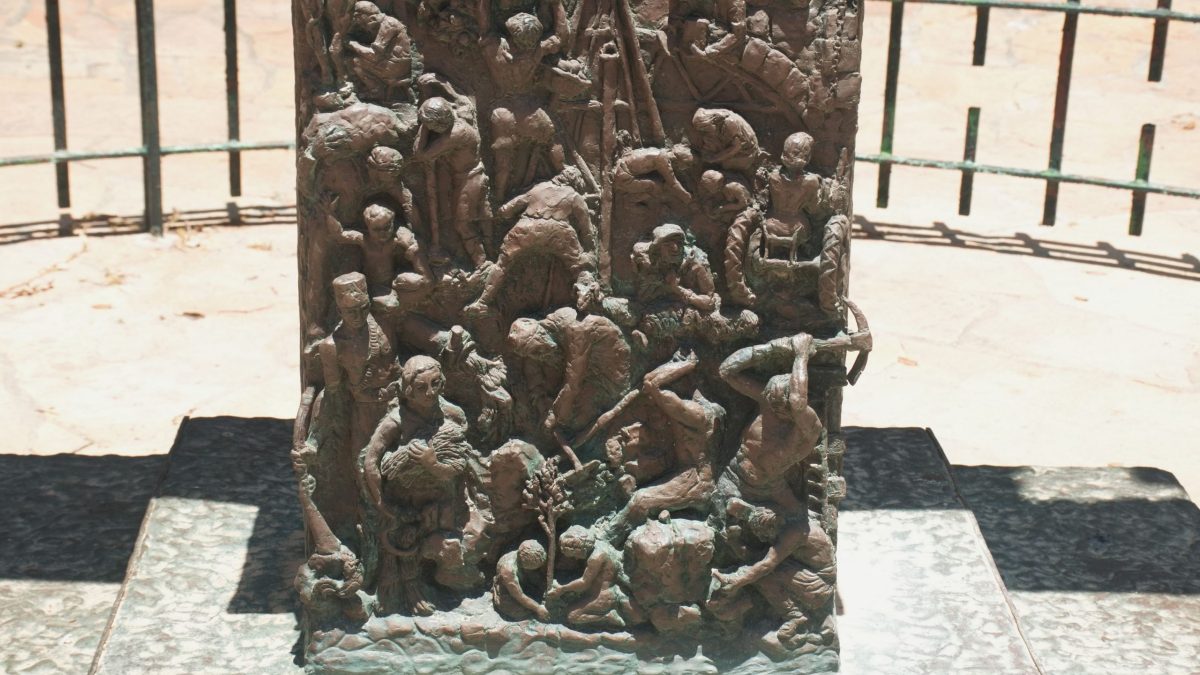
Image: The Knesset Menorah in Jerusalem near Israel's parliament (file photo, not from the events described). Photo: Anat Frank Gurli (ענת פרנק גורלי) / Wikimedia Commons (CC BY 2.5)