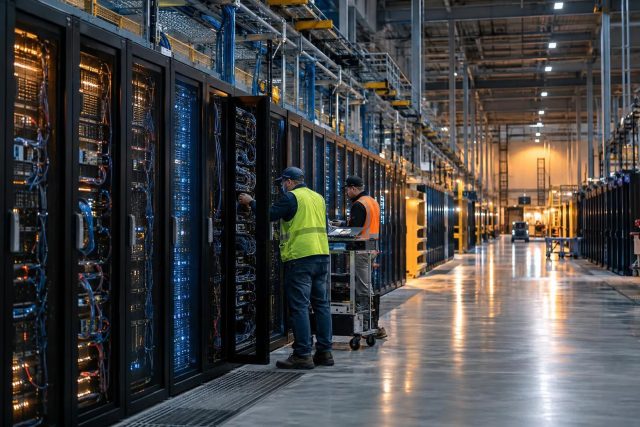
SpaceX has signed a binding commitment for a master finance lease with an entity managed by Apollo Global Management to acquire graphics processing units worth about $40 billion, according to a filing with the US Securities and Exchange Commission dated 24 October and made public on 26 October. Under the plan, the Apollo-managed lessor will buy GPU pods and related equipment and lease them to the company for use in data centres it selects. The equipment will be delivered in tranches, each leased for about five to five and a quarter years. The lease is expected to close before the end of the year, and lease schedules are expected to begin in the first half of 2027, once the chips are delivered.
The case for the deal is that it lets SpaceX add computing capacity at very large scale without paying for it all up front. Rent is payable quarterly in advance, and each payment is generally one-twentieth of the financed cost of the tranche plus interest at a fixed rate, with the rate to be set at pricing before the lease is signed. The company expects total principal payments of about $40 billion over the lease terms. The company’s finances show some room to take on the commitment, because its business has grown quickly. Its quarterly report shows revenue of $14.58 billion for the third quarter against $5.58 billion a year earlier, and cash and cash equivalents of $51.29 billion plus $38.56 billion in marketable securities at the end of September.
The case against is about risk and the scale of spending. The filing says the transaction remains subject to closing conditions, and warns that it may not close on the expected terms or timeline, or at all, and that delivery dates and lease terms may differ. About three-quarters of the revenue increase came from the Super Intelligence segment, which includes the Grok model, the Cursor coding platform and the X social network and reported $7.56 billion of revenue against $0.81 billion a year earlier. The company reported capital expenditures of $48.07 billion across its segments in the first nine months, an increase of $34.2 billion in cash spent on capital expenditures for data centres and launch facilities compared with a year earlier, and a net loss of $413 million for that period, against a loss of $2.59 billion a year earlier. A fixed-rate lease obligation of this size adds a long-term fixed cost to a business that is still not profitable.
The deal matters because it shows how the AI build-out is being financed. Chip purchases that would once have come from a company’s own cash are now being arranged through leases with an outside investment manager, which spreads the cost over five years but creates a fixed payment schedule. SpaceX, whose Class A shares trade on Nasdaq under the symbol SPCX, is using that structure to secure AI hardware.
The commitment gives SpaceX the computing power it wants on a payment plan it can see. Whether the demand for that computing arrives on schedule is the question the lease terms cannot answer.