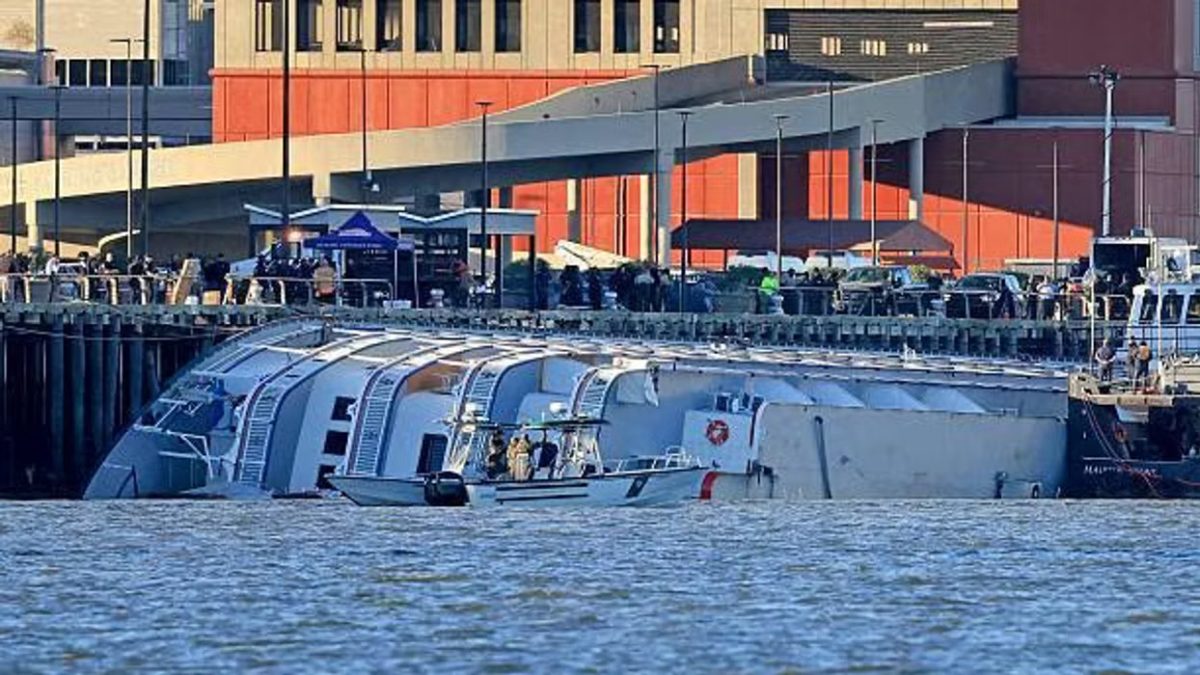
Officials in New Orleans are calling it a "miracle on the Mississippi." On Friday afternoon, the tanker Atlantic Asphalt struck the paddlewheel cruise boat American Heritage, which was docked on the river, and the vessel took on water, listed and eventually rolled onto its side. Yet by the evening, New Orleans Mayor Helena Moreno told a news conference that "we have zero people unaccounted for." About 129 passengers were on board, in addition to crew, according to the Port of New Orleans, and 32 people were taken to local hospitals with non-critical injuries. Calls about the collision came in at about 18:30 GMT, the port's chief said, as people on the dock and the water began helping passengers escape.
The details of the rescue explain why officials used such strong language. The American Heritage, operated by American Cruise Lines, was finishing an eight-day cruise to destinations in Louisiana and Mississippi and had docked about two hours earlier to begin letting passengers off, Al Jazeera reported. Passengers were disembarking when the boat began to sink "and then eventually toppled over and flipped," the mayor said, sending people into the water. Witness Jamie Holford told local television that it took "fifteen minutes from impact to where it rolled over," and described the sound as "like a war movie. Just imagine tons of steel crunching." He said he saw passengers and crew "hollering" and "crying" as they tried to get off. More than a dozen people in life jackets were pulled from the river, where the water temperature was 19 degrees Celsius (66 degrees Fahrenheit), onto nearby ships, according to Al Jazeera's account of AP video.
The speed and scale of the rescue were key. Mayor Moreno credited first responders who "literally jumped right in to help," and tugboat operators, police, the fire department, the Coast Guard and emergency medical staff all took part. The Port of New Orleans set up a triage area inside its administration building and officials closed the Mississippi River to vessel traffic for the search effort. Homeland Security Secretary Markwayne Mullin said the Coast Guard supported local operations, and President Donald Trump called the rescue an "incredible job" on Truth Social. Louisiana Governor Jeff Landry also described the outcome as a "miracle on the Mississippi" given the "sheer number of people" who were on the vessel. Because the river was closed and the ships involved were large, the number of people who needed to be accounted for made the speed of the response all the more important.
The cause is not yet known. Coast Guard Captain Melanie Burnham said "there seems to be some type of a loss of steering," and the mayor said the tanker "lost control and collided into the cruise ship," according to Al Jazeera. Authorities have said the exact cause remains under investigation, and the Atlantic Asphalt, a 160-metre (520-foot) tanker flying the flag of the Marshall Islands and bound for New Orleans, is of a type that specialises in carrying asphalt and bitumen, according to ship-tracking data and a maritime publication cited by Al Jazeera. It is unknown whether it was carrying cargo. Mr Landry noted that ships have operated safely on the Mississippi for years and pledged to investigate what happened. In the meantime, speculation about cause is premature: investigators will need to examine the steering failure, the vessel's maintenance and crew actions, and the navigation conditions in a busy stretch of river.
There are reasons to take comfort in the outcome. The fact that the boat was docked, that passengers were already beginning to disembark, and that responders reached the scene quickly all reduced the risk. The five-deck vessel, built in 2015, can carry up to 150 guests and, according to its operator's website, has a glass-enclosed restaurant, a fitness centre and three lounges; a vessel of that size tipping onto its side could easily have caused far more serious harm. Mr Landry and Mayor Moreno both emphasised that everyone had been accounted for, and American Cruise Lines said that guests and crew had been evacuated and that it was "deeply concerned for everyone involved." Thirty-two people in hospital with non-critical injuries is a serious number for any incident, but it is a long way from the outcome many feared when the first video emerged.
There are also reasons for scrutiny. A loss of steering on a large vessel in a river where passenger boats dock raises obvious questions about maintenance, redundancy and how close a tanker should be to a docked passenger boat. The Mississippi is one of the busiest commercial waterways in the country, and passenger cruises share it with heavy cargo traffic. The investigation will need to determine whether the failure was mechanical, whether it was foreseeable, and whether procedures to prevent a collision, such as emergency anchoring or tug assistance, were available and used. For passengers and families, there will also be questions about compensation, medical care and how they get home, and the operator will face scrutiny on how it handled the evacuation and communication.
The testimony of those who were there adds to the picture. Witness Jamie Holford told CBS, the BBC's US partner, that he watched the cruise ship hit the dock following the collision, and described the scene as looking "like something off the Titanic." His account, and the pictures of passengers standing near the railings as the boat listed further into the water, show how quickly a docked vessel can become an emergency. The interval he gave, about fifteen minutes between impact and the moment the boat rolled over, is a reminder that safe evacuation in such an incident depends on seconds and on people being close enough to help. That the passengers were already disembarking, and that rescuers on the quay and on nearby vessels were able to reach them, appears to have made the decisive difference.
The question now is how the authorities will explain the sequence. The Coast Guard's early reference to a loss of steering needs to be tested against the vessel's records and the testimony of the crew, and the owner of the tanker will be asked how it maintains its steering systems and what its procedures are when approaching docks. The operator of the cruise boat will be asked about its evacuation plans and whether passengers were told promptly what to do. A river that is closed to traffic is also a river where cargo is not moving, so the economic effects of the investigation, though secondary to the human ones, will add to the pressure for answers.
Why does it matter? River cruising has grown into an important part of tourism, and the sight of a paddlewheeler on its side will naturally raise concerns among passengers and regulators. At the same time, the response shows how emergency systems can work when they are well prepared: a quick call, a nearby fleet of tugboats, and coordinated action by city, port, state and federal agencies. The lessons from this episode will include what went wrong, but also what went right.
For now, the facts are limited but clear. Everyone from the American Heritage has been accounted for, 32 people received hospital care, and investigators will work to establish why the tanker lost control. The river has been closed while the vessel is dealt with, and the full account of what happened is likely to take weeks. What officials have already said is that the outcome could have been far worse, and that the first responders who pulled people out of the Mississippi on a Friday afternoon are the reason it was not.