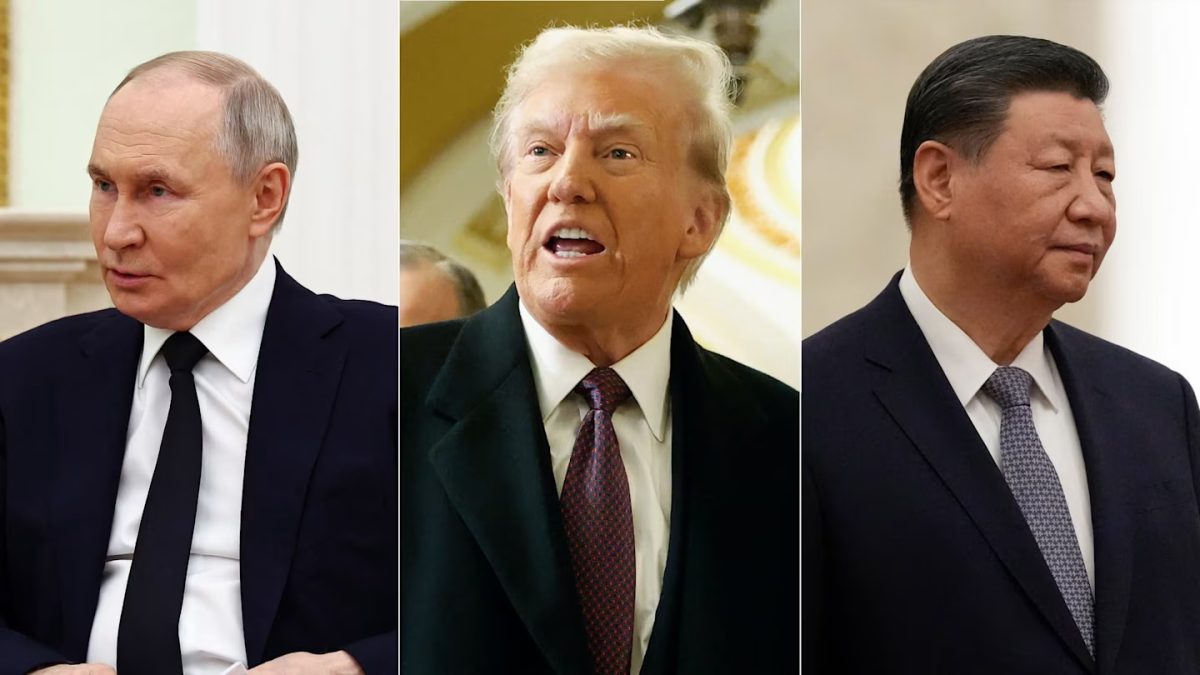
The leaders of the United States, China and Russia are planning to sit down together for the first time, after the White House confirmed that Donald Trump, Xi Jinping and Vladimir Putin will meet on the sidelines of the Asia-Pacific Economic Cooperation summit in the Chinese tech hub of Shenzhen next week. White House spokeswoman Olivia Wales told reporters that Mr Trump "will conclude his visit to China with a trilateral meeting" with the Chinese and Russian presidents, and that among other topics he intends to discuss "the reduction of nuclear weapons in the world, whose proliferation President Trump believes is very dangerous." Moscow and Beijing had not publicly commented on the trilateral format at the time of the announcement, although Chinese state media said Mr Xi would take part in bilateral talks on the summit's margins and the Kremlin had earlier spoken of "signals confirming readiness" for such a meeting.
The scheduling already tells part of the story. Mr Trump is due to arrive in Shenzhen late on Wednesday for the two-day gathering of the 21 APEC member economies, and he will hold bilateral talks with Mr Xi on Thursday, which the BBC reports will be their fourth meeting since the US president returned to office in 2025. Before that, he is set to attend a summit of the Association of Southeast Asian Nations in the Philippines on Tuesday. Ms Wales said the trip would "secure historic wins to the American people and advance America's interests in the Indo Pacific." Al Jazeera reported that Elon Musk will travel with the president to China but will not attend the three-way meeting, and that Mr Trump is not expected to meet North Korean leader Kim Jong Un during the Asia trip.
The strongest argument for the meeting is the vacuum it is meant to fill. The New Strategic Arms Reduction Treaty, known as New START, lapsed in February, leaving the world's two largest nuclear arsenals without agreed caps for the first time in more than 50 years, according to Al Jazeera. Mr Trump rejected a Russian proposal to extend the treaty for another year and demanded a "new, improved and modernized" agreement that would also include China, which has been expanding its arsenal. The United Nations has urged the two sides to agree a new framework without delay. Supporters of direct talks argue that any new guardrails can only work if all three of the largest nuclear powers are in the room, and that a face-to-face meeting at the top is the fastest way to find out whether Beijing is prepared to discuss limits at all. The Stockholm International Peace Research Institute ranks Russia first for nuclear warheads, followed by the United States and then China, so a framework that left out any one of them would be incomplete.
There are also diplomatic arguments for talking even when a deal is unlikely. The White House is also signalling that Iran may be raised, and the war involving Iran has been a sticking point between Washington and Beijing, which is the largest buyer of Tehran's oil and its biggest trade partner. Mr Trump and Mr Xi have sought to project warmer ties during summits in Beijing and in Washington this year. The BBC notes that Mr Xi hosted both Mr Putin and Mr Trump in Beijing within days of each other earlier in the year, and that the US president welcomed the Chinese leader to Washington in September. A trilateral session would be the logical next step in that pattern of personal diplomacy. Mr Putin's spokesman Dmitry Peskov has described the meeting as "extremely significant", even as he rejected comparisons with history.
Those comparisons are the first of the counter-arguments. The planned summit has been likened to the 1945 Yalta Conference, where the leaders of the United States, Britain and the Soviet Union shaped the post-war order. Mr Peskov dismissed the parallel, saying that any agreements reached in Shenzhen cannot be imposed on others. Critics see precisely that risk. Ukrainian President Volodymyr Zelenskyy has voiced concern that the meeting could become a venue to discuss a Ukraine deal behind Kyiv's back, even though the White House has said Ukraine is not expected to be on the agenda. A senior US official briefing reporters said Mr Trump would steer away from Russia's war in Ukraine, and that official also told Reuters that "we do not expect to get to any kind of agreement", describing the encounter as the start of a conversation rather than a negotiation.
Expectations are being kept low for good reason. Former senior US officials and analysts told the BBC when New START expired that securing the cooperation of both Beijing and Moscow could face major hurdles and take years. Neither Moscow nor Beijing has said what it wants from a trilateral discussion of nuclear arms, and the White House announcement does not say whether either has agreed to the topic. Trade, the race for artificial intelligence dominance and Taiwan also remain unresolved between Washington and Beijing, and the BBC reports that little significant progress appeared to have been made on those issues at the earlier summits this year. On the Russian side, European governments were unsettled last month by a controversial US deal to import Russian diesel and by the suspension of sanctions targeting the biggest buyers of Moscow's oil and gas, including China, which they read as a softening of the Trump administration's stance towards the Kremlin.
The trilateral also has to be read against Russia's position in the world. Beijing has become a crucial trading partner for Moscow since it launched its full-scale invasion of Ukraine in 2022, a war that isolated Russia and left it under Western sanctions. Seeing Mr Putin seated alongside the American and Chinese presidents will be presented in Moscow as proof that the country is not isolated, and Russian media have already begun comparing the three leaders to the wartime "Big Three" of Stalin, Roosevelt and Churchill. For Washington, the argument is that engagement does not amount to endorsement, and that a world in which the three largest nuclear powers do not speak to each other is more dangerous than one in which they do. For Europeans and for Ukraine, the concern is that the symbolism itself carries weight, regardless of what is formally agreed.
Why does it matter beyond the summit's own agenda? Because the absence of binding limits on the three biggest arsenals removes the verification, transparency and predictability that arms control once provided. Without New START, neither Washington nor Moscow is bound by the numbers and inspection arrangements that the treaty provided, and the longer that gap lasts, the greater the incentive for each side to plan for worst-case scenarios. A meeting that produces nothing concrete but establishes a working channel, perhaps through expert-level talks on nuclear risk reduction, would still count as a modest gain compared with the current silence. A meeting that produces a spectacle without substance would be a missed chance, and a meeting that is read as a division of spheres of influence would deepen anxiety in Kyiv, Taipei, Tokyo and European capitals.
In the end, the Shenzhen meeting is best understood as a test of intent rather than a negotiation. Nobody in the American delegation expects a signed agreement, and the Chinese and Russian sides have said little about what they want from it. What the world will be watching for is the tone of the readouts, whether a follow-up process on nuclear arms is announced, and whether Iran, the war in Ukraine and trade are discussed in the same room or kept in separate compartments. If the three leaders leave with a commitment to keep talking about nuclear risk, that would be a small but meaningful step. If they leave with only photographs, the arms control vacuum left by New START will remain as wide as it was when they arrived.