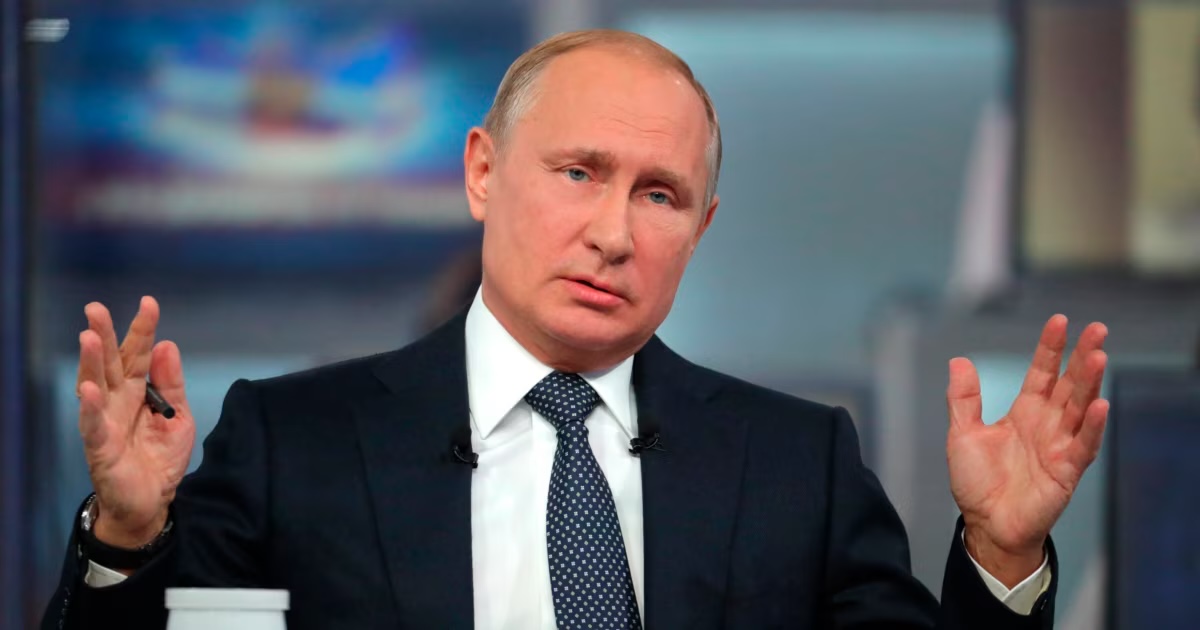
Vladimir Putin says he wishes "eternal peace" for Ukraine, but his terms for getting there amount to a rewrite of Europe's security order. After talks in Moscow with US envoys Steve Witkoff and Jared Kushner, the Kremlin said that a prerequisite for peace is "a new, long-term architecture of indivisible security and peace." As the BBC's Steve Rosenberg writes from Moscow, this is Kremlin language for changing Europe's security set-up in a way that benefits Russia, and Moscow is pursuing what could be the biggest change to European security arrangements since the end of the Cold War. The Russian leader sounded "uncompromising and confident," Rosenberg writes, even though he continues to reject a comprehensive ceasefire, nearly five years after ordering the full-scale invasion.
The substance of the demand is familiar. The Kremlin has put back on the table its December 2021 proposal for "draft treaties" with the United States and Nato, which would have halted the alliance's eastward expansion by giving Moscow guarantees that countries such as Ukraine and Georgia would never join, and rolled back Nato military infrastructure from central and eastern European countries that joined after the Soviet Union dissolved. Western leaders rejected those demands as an unacceptable ultimatum, and two months later Russia launched its full-scale invasion. Now those proposals are being quoted again. Putin's foreign policy aide Yuri Ushakov has also suggested that Moscow is about to "add certain new considerations" to its list of demands in light of Western efforts "to inflict a strategic defeat on Russia."
From Moscow's perspective, the argument is that the war cannot be ended without addressing what it describes as the root causes. The Russian newspaper Komsomolskaya Pravda wrote this week that "in December 2021 Russia actively proposed that Nato rethink the security system in Europe," and that Russian diplomats, having "secured one victory by forcing the West to think about security," now need a second by making the West heed Moscow's concerns about Nato enlargement. The BBC says the fact that European security is now part of the discussion on Ukraine is viewed in Moscow as a victory in itself. And Mr Putin is negotiating from a position that, in his view, is improving: American envoys are knocking at his door seeking a deal, European leaders are contemplating contacts with him, the leaders of Norway and Finland called him last month, and next week he may meet Donald Trump and Xi Jinping in Shenzhen, where Russian media are already comparing the trio to the wartime "Big Three" of Stalin, Roosevelt and Churchill.
Europe sees it very differently. The EU's top diplomat, Kaja Kallas, called Russia's demands for a new European security architecture a "trap" designed to "shift attention away from a ceasefire." She wrote that "the sequencing of Ukraine-Russia talks is important", with the priority being a ceasefire, followed by a peace agreement, and "only then" discussions on Europe's wider security architecture. In this view, accepting Russia's framing would reward the invasion, and any change to Nato's posture or membership would be decided by Nato members and the countries concerned, not by Moscow. Europe's difficulty, the BBC notes, is that it is not at the table: Moscow has had no desire to give it a chair and has criticised European leaders for their military support for Kyiv and their tough stance on Russia.
The diplomacy is moving on several tracks. This week's peace talks in Abu Dhabi involved Ukraine, Russia and the United States. After his Moscow discussions, Mr Witkoff indicated that Mr Putin had agreed to the idea of European representatives joining the next round of talks, and Ukrainian President Volodymyr Zelenskyy welcomed the US effort to bring Europe in. But on Friday, Kremlin spokesman Dmitry Peskov said that a final decision on European participation had not been taken: "Once we understand their true intentions and their readiness to facilitate the peace process, then it will be possible to take a decision about dialogue on Ukraine in a wider format." The Shenzhen meeting adds another layer. According to the BBC and Al Jazeera, the White House says Mr Trump will discuss nuclear arms and the Iran war with the Chinese and Russian leaders, but a senior US official said he would steer away from Ukraine, and Mr Zelenskyy has voiced concern that Ukraine could be discussed without Kyiv.
The pressures on Russia are real, which complicates the Kremlin's confidence. After almost five years of war, Russia has suffered huge losses on the battlefield, according to the BBC, and its economy is under increasing pressure. Ukrainian drone strikes continue to hit Russian oil refineries, raising fears of new fuel shortages. Yet none of this has so far convinced Mr Putin to stop fighting. For Kyiv and its European backers, the question is whether the pressure on Russia will be enough to change its demands before the diplomatic mood shifts in Moscow's favour.
It is worth setting the Kremlin's latest position against what Russia has said before. The proposals now being revived were drawn up before the full-scale invasion, and Western governments judged them unacceptable then because they would have given Moscow a say over the alliance choices of sovereign countries. The fact that the same text is again being presented as a condition for peace suggests that Russia's war aims have not narrowed, even as the war itself has dragged on. Ukraine, for its part, has consistently argued that a ceasefire must come first, and the EU's Ms Kallas has now put that sequencing on the record. The question for Washington is whether its envoys, who have been meeting the Kremlin leader directly, share that order of priorities or are prepared to open a conversation about the wider architecture before the guns fall silent.
The American role is therefore pivotal and ambiguous. Mr Witkoff and Mr Kushner are carrying messages between the sides, and the Abu Dhabi round showed that Washington can bring Ukrainian and Russian delegations into the same process. But the same envoys sat across from Mr Putin while he restated his demands, and Europe's leaders are watching to see whether the White House treats those demands as an opening bid or as a framework. The BBC observes that Europe is not at the table at present, and that Moscow has not been in a hurry to give it a chair. A decision to include European representatives in the next round would be a significant sign that Washington intends to keep its allies in the room.
Why does it matter? Because the shape of any settlement will determine whether the end of this war is the beginning of a stable peace or a pause before the next conflict. If Russia's security demands become the price of a ceasefire, then Ukraine, Georgia and Nato's eastern members could find their future choices constrained by an agreement they did not make. If Europe is excluded from negotiations that affect its own security, it will have little ability to shape the outcome. And if the US, Russia and China meet next week without Ukraine or Europe present, the symbolism will be striking, even if no formal decisions are taken.
The weeks ahead will test both Moscow's intentions and Western unity. Europe's immediate goal is to secure a seat at the next round of talks and keep the focus on a ceasefire, while Washington is balancing its dealings with the Kremlin against the concerns of allies. Mr Putin, meanwhile, has no evident reason to rush, which means that the question of European security is likely to remain at the centre of the debate for some time. What would change the picture is clear: a Russian willingness to accept a ceasefire first and discuss the wider architecture later. So far, there is no sign of it.