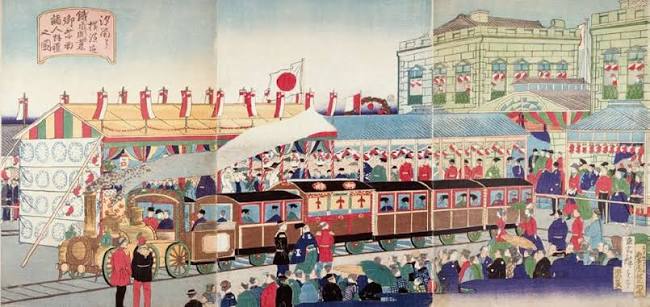
The Meiji Restoration was a political event that restored the executive power of the Emperor of Japan in 1868, under Emperor Meiji, and led to the Westernisation of Japan. Although there were ruling emperors before the Restoration, the events restored practical power to the emperor and consolidated the political system under him. The Restoration led to enormous changes in Japan's political and social structure and spanned both the late Edo period, often called the Bakumatsu, and the beginning of the Meiji era, a time in which Japan rapidly industrialised and adopted Western ideas, production methods and technology.
The Old Order
In the Edo period Japan was governed by a strict and rigid social order with inherited position. The emperor and his court were at the top, below them were the shogun and the daimyo, and below them were the various ranks of samurai, farmers, artisans and merchants. The historian Marius Jansen described the political organisation as "feudal autonomy": the shogun granted extensive control to the various daimyo over their own domains, in return for homage in the form of irregular taxation, permission for marriages and movement and systems such as alternate attendance. The families of samurai numbered around 5 to 6 per cent of a population of 30 million in the nineteenth century. By 1650 the shogun directly controlled land producing roughly 4.2 million koku of rice, and with his direct retainers, other members of the Tokugawa family and his vassals controlled a combined total of land producing 12.9 million koku out of a national 26 million. The remaining 9.8 million koku, just under 38 per cent, was divided among about 100 rival tozama daimyo, the descendants of those who had fought against the Tokugawa at the Battle of Sekigahara. Many of the strongest of those domains were in western Japan, away from the centres of power.
Pressure From Abroad
The origins of the Restoration lay in economic and political difficulties faced by the Tokugawa shogunate. These problems were made worse by the encroachment of foreign powers in the region, which challenged the Tokugawa policy of sakoku, or seclusion, and in particular by the arrival of the Perry Expedition, sent on the orders of United States President Millard Fillmore. In 1854, after talks that lasted 23 days, the Convention of Kanagawa was signed, which opened two treaty ports, Shimoda and Hakodate, and ensured the safety of American seamen. Under subsequent unequal treaties Japan was forced to open to the West, which called the shogun's ability to maintain Japanese sovereignty into question.
Purges, Assassinations and Reform
Aware of how unpopular the treaties were, the senior official Ii Naosuke set out to restore strong, centralised rule by the shogunate. He carried out the Ansei Purge, in which more than a hundred political enemies were punished, eight of them put to death, and many more forced into house arrest, a use of force by the shogunate that had not been seen in centuries. He obtained retrospective imperial support for the treaties from Emperor Komei. The principal ideology of conservative reform, kobu gattai, meant the "unity of Court and shogunate", and as part of it the shogun Tokugawa Iemochi was arranged to marry the emperor's sister, Kazunomiya. One of the people caught in Ii's purges was the samurai intellectual Yoshida Shoin, a shishi who came to believe that men of spirit should take direct action, and who was executed in 1859 for planning the assassination of an official. Ii himself was assassinated in 1860 by lower-ranking samurai angered by the heavy-handed exercise of authority, an act that gave rise to a new and violent consciousness centred on the principle of sonno joi, "revere the emperor, expel the barbarians".
A Divided Samurai Class
The emperor's rebuke of the actions of the shogunate led to an ideological divide within the samurai class, whose members were concerned about their feudal obligations to both the shogun and the emperor. Many lower- and middle-ranking samurai became shishi, "men of spirit", committed to the emperor's proclamations to expel the barbarians. Factional disputes within the domains brought some of them into conflict with the Tokugawa. After some initial setbacks the domains organised into an anti-Tokugawa alliance, and, led by Satsuma and Choshu, they overthrew the shogunal system.
The Restoration
On 3 January 1868 Emperor Meiji declared political power to be restored to the Imperial House. The goals of the restored government were set out by the new emperor in the Charter Oath. Subsequent Tokugawa resistance to the new government took the form of the Boshin War and the short-lived Republic of Ezo, but by the 1870s the emperor's authority was practically unquestioned. The capital, Edo, was renamed Tokyo on 3 September 1868, and the emperor took up residence in the city in 1869.
A Society Remade
The new government reorganised whole strata of society, abolishing the old currency, the domain system and eventually the class position of the samurai. The abolition of the shogunate and the industrialisation of society in emulation of foreign imperial powers led to backlash, including the Saga Rebellion and the Satsuma Rebellion, but ultimately ended feudalism in Japanese society.
Foundations of the Empire of Japan
The Meiji Restoration was the political process that laid the foundation for the institutions of the Empire of Japan, and it would have far-reaching consequences in East Asia as Japan pursued colonial interests against its neighbours. The Meiji Constitution of 1889 remained in place until the Allied occupation of Japan after the Second World War.
Why It Matters
The Meiji Restoration is among the most studied transformations in modern history, because it shows how a country faced with foreign pressure and internal division reorganised its institutions in little more than a generation. It turned a society based on feudal domains and hereditary status into a centralised state that adopted Western technology while keeping the emperor at its centre. It was also a turning point for the region: the same modern state that emerged from the Restoration became an imperial power in East Asia, with consequences that shaped the twentieth century.