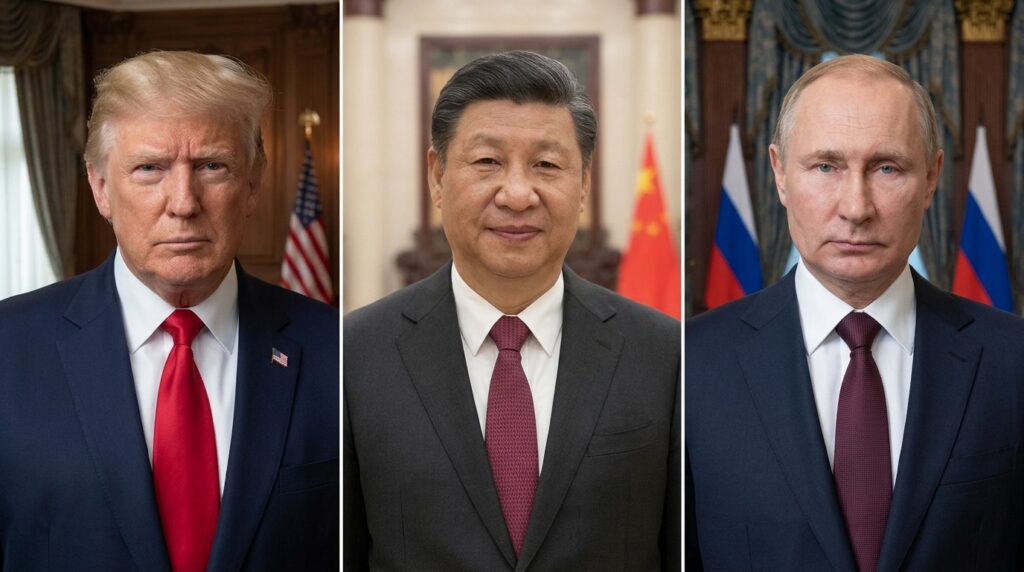
United States President Donald Trump is attending the Asia-Pacific Economic Cooperation (APEC) summit in Shenzhen, China, this week, where he is expected to meet Chinese President Xi Jinping and hold a three-way meeting with Xi and Russian President Vladimir Putin. A Trump-Xi meeting on the sidelines of the summit, which brings together 21 Pacific Rim economies, would be the third time the two leaders have met this year. The earlier meetings, with Xi hosting Trump in Beijing in May and Trump hosting Xi at the White House in September, were heavy on ceremonial pomp as both leaders sought to portray stability in a consequential relationship, but light on meaningful breakthroughs. Experts expect something similar in Shenzhen.
The case for optimism is that regular contact between the leaders has calmed a relationship that had been in free fall. US-China trade relations took a nosedive at the start of Trump's second term, when the president initially launched 10 percent tariffs on China for allegedly failing to crack down on the trade of fentanyl precursors. By April, additional US tariffs on Chinese goods had reached 145 percent and China's retaliatory tariffs on US goods had reached 125 percent. Trump and Xi agreed a yearlong truce in Busan, South Korea, in October of last year, and the deal was extended through 10 January 2027 after Xi's White House visit in September. The White House said the two countries have agreed to build "a constructive relationship of strategic stability on the basis of respect, fairness, and reciprocity" and announced plans for each to support the other at APEC and at the G20 summit in Florida in December.
Both sides have also taken small steps on artificial intelligence. In September, they pledged to set up a mechanism to quickly communicate AI-related incidents and to hold a dialogue on emerging risks. US Treasury Secretary Scott Bessent said last week that both sides "expect to exchange best practices for evaluating and testing advanced models before their release, and for keeping human judgment firmly in command of this technology". He added a note of caution: "we should harbour no illusions about the differences between the United States and China." Ali Wyne of Crisis Group predicted that Trump will work to strengthen his rapport with Xi but that the meeting is unlikely to produce substantive breakthroughs.
The case for scepticism rests on how little the earlier deals have delivered. A recent analysis by the Center for Strategic and International Studies found that US imports of Chinese rare earth minerals during the first 11 months of the truce remained 75 percent lower than before the escalation, a persistent gap between Beijing's commitments and actual export volumes. China also agreed to buy 25 million metric tonnes of US soya beans and, according to the White House, $17bn per year in US agricultural products in 2026, 2027 and 2028, but those purchases have lagged behind the commitments. US farmers were among those hit hardest by the trade war, an issue that resonated in the midterm elections.
Politics at home has changed Trump's position. The summit comes days after Democrats won commanding control of both chambers of Congress, which will be a significant check on the president in his final two years in office, and Beijing is increasingly looking beyond the Trump era. The resignation of Nvidia chief executive Jensen Huang, after revelations that he had an affair with an alleged Chinese spy, will also loom over any meeting even if it is not directly addressed. Huang accompanied Trump to Beijing in May and had pushed to ease restrictions on the sale of advanced AI chips to China, which has renewed questions about his influence on the US government. Commerce Secretary Howard Lutnick has faced scrutiny, including from Republicans, over reportedly lax enforcement of export controls. China denies that Alice Huang was working as a spy on its behalf, and Reuters reported that US officials say Trump is not expected to raise the issue with Xi.
Taiwan is the other flashpoint. After the Beijing summit in May, Trump said he had discussed US arms sales to the island with Xi "in great detail", and later called Taiwan a "very good negotiating chip" with China. He has since held up approval of a $14bn arms package. The United States has provided arms to Taiwan since 1979 under the Taiwan Relations Act, and under the 1982 Six Assurances has not consulted Beijing on such sales. Analysts Bonnie Glaser and Noah Munk of the German Marshall Fund wrote that Trump's language "invites Beijing to expect something in return for each future approval." The White House has defended the delay, citing limited production capacity, particularly during the US-Israel war with Iran, and the delicate nature of the trade truce. Taiwan, an APEC member, will be represented in Shenzhen by Acer Group founder Stan Shih.
The most significant outcome may be the three-way meeting. Putin's foreign policy adviser Yury Ushakov told reporters that "the significance and symbolism" of a meeting between the three leaders "are hard to overestimate". Ryan Hass of the Brookings Institution wrote that by sitting down with the leaders of the world's two most powerful countries, Putin "will be recognised as a major player on the world stage rather than a pariah", while Xi would "bask in the glow" of China acting as convener and agenda-setter. The benefit for Trump, whom the White House says will focus on denuclearisation, is less clear.
Wyne warned that a trilateral meeting "would showcase the extent to which both Trump and Putin seek to curry favour with Xi" and "would further unnerve US allies and partners that fear Trump's openness to an informal 'G2' or 'G3' arrangement". That concern is why allies will watch the photographs as closely as the communique. For Canada, South Korea, Japan and others, a summit in which three nuclear powers appear to set terms for the rest of the world carries risks, even if nothing concrete is agreed.
Taken together, the Shenzhen summit is likely to confirm a pattern: leaders who want to be seen managing a rivalry, a truce that expires on 10 January 2027 and obligations that remain only partly met. The tests will be whether the truce is extended, whether rare earth shipments recover, whether any AI safeguards are agreed beyond information-sharing, and whether Taiwan arms sales resume. If the answers are mostly no, Shenzhen will join Beijing and Washington as another summit remembered for atmosphere rather than outcome.