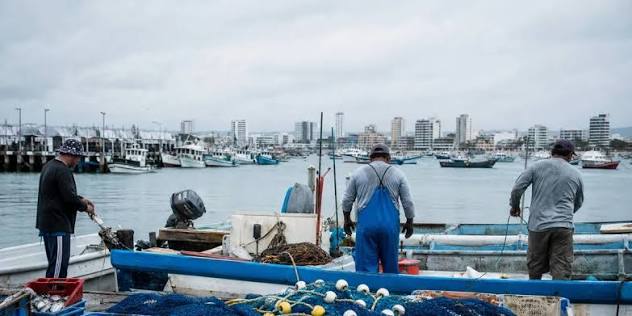
A group of fishermen from Ecuador has sued the administration of US President Donald Trump over a drone strike that sank their vessel and injured members of the crew in March. The lawsuit, filed on Monday in a federal court in Pennsylvania, seeks financial restitution and any additional relief the court considers just. It also asks the court to issue an order ending the administration's campaign of strikes on alleged drug trafficking boats in the Caribbean and the eastern Pacific, a campaign that experts have described as extrajudicial killing in violation of international law. The case was reported by Al Jazeera and Reuters.
The complaint centres on the sinking on 17 March of the fishing boat La Negra Francisca Duarte II, which is based in Ecuador. According to the filing, two drones were launched from a vessel operated by the United States and attacked the boat, setting it ablaze. Two of the 16 crew members suffered serious burns. "All of the Plaintiffs ended up jumping off the ship and into the sea," the filing says, adding that they then found their way onto small emergency boats. The complaint calls the strike part of an "unprecedented and manifestly unlawful US military campaign". After the attack, the crew say they made their way toward what they believed was a tuna fishing boat nearby, but were met by armed men who spoke English and wore military uniforms.
The boat's captain, Hernan Flores, told Reuters why the crew went to court. "We filed the lawsuit because the boat was all we had. Nobody in Ecuador is helping us," he said. "They did all that damage to us, and by the grace of God, we're alive." For a crew of fishermen, the loss of a vessel is the loss of an income, which helps explain why the plaintiffs are seeking financial restitution alongside the broader order.
Accountability for the strike is far from clear. The US government has not claimed responsibility for the attack on La Negra Francisca Duarte II or for two other Ecuadorian vessels that were attacked and sunk in recent months. A report in August by the Washington Post suggested the vessels were targeted by the CIA as part of a secret overseas mission, while other reports have raised the possibility that the attacks were carried out by a US government contractor or a regional ally. The reports Al Jazeera cites do not establish who exactly fired the drones, and the lawsuit's own account is that they were launched from a vessel operated by the US.
The attacks resemble an ongoing campaign that the US military has publicly acknowledged. Since September 2025, the US government has openly carried out a series of boat strikes with the stated aim of killing alleged "narcoterrorists", and at least 244 people have been killed in that campaign. Experts describe it as extrajudicial killing in violation of international law, according to Al Jazeera. Lethal strikes have continued in recent weeks, with a recent attack on 27 October. The US has also carried out non-lethal interceptions of suspected drug-trafficking boats.
The human toll is contested. No suspects have been identified in the boat strike campaign undertaken by the US military, and no evidence has been presented to the public, Al Jazeera notes. Families, however, have come forward to claim the dead as their loved ones, and many argue that the people killed were not drug traffickers but fishermen and informal workers. In December 2025, the family of a missing Colombian fisherman, Alejandro Carranza, filed a complaint through the Inter-American Commission on Human Rights, claiming that his right to life had been violated. A few weeks later, in January, the families of two workers from Trinidad and Tobago, Chad Joseph and Rishi Samaroo, filed a wrongful death lawsuit in a US federal court in Massachusetts. The men had reportedly been travelling home from Venezuela after taking work abroad.
Human Rights Watch has examined the non-lethal side of the policy. It says that the US and Ecuador intercepted at least eight vessels between late August and mid-September on the basis that they were being used to supply drug trafficking groups. Of the 160 crew members on those vessels, the group says, 56 were released without charge by court order, 40 were acquitted for lack of evidence, 50 are awaiting trial and 14 were not formally charged. Taken at face value, these numbers show that a large share of the people detained did not end up convicted, a pattern the critics cite when they question the intelligence behind the strikes. They do not, on their own, show how many of the vessels were in fact involved in smuggling.
The legal path for the Ecuadorian plaintiffs will be hard. Experts quoted by Al Jazeera say that holding the US government to account is difficult because of the lack of transparency surrounding the boat strikes. When a government does not acknowledge an operation, plaintiffs must prove who carried it out before they can argue that it was unlawful, and courts are often reluctant to second-guess military and intelligence decisions. The earlier wrongful death case in Massachusetts and the complaint at the Inter-American Commission show that families are trying several routes at the same time.
The case also sits within a wider policy. Since Trump returned to the White House in 2025, he has launched a hardline campaign to combat drug trafficking into the US, which has coincided with a policy of expanding US military operations across Latin America, often in collaboration with right-wing political allies in the region. Critics have raised concerns over transparency and potential rights abuses in these operations. Ecuador's own role, as a country whose boats have been hit and whose authorities have worked with the US on interceptions, adds a diplomatic dimension.
For now, the fishermen of La Negra Francisca Duarte II are asking a court for something that no government has offered: an explanation and compensation. Whether a Pennsylvania judge will agree to hear a case about an unacknowledged strike at sea is uncertain. But the lawsuit puts a human face on a campaign that has so far been described mostly in terms of numbers, and it adds to a growing set of legal challenges from families who say the people killed were fishermen and workers, not traffickers. The answers, if they come, will depend on how much the courts are able to learn about what happened in March.