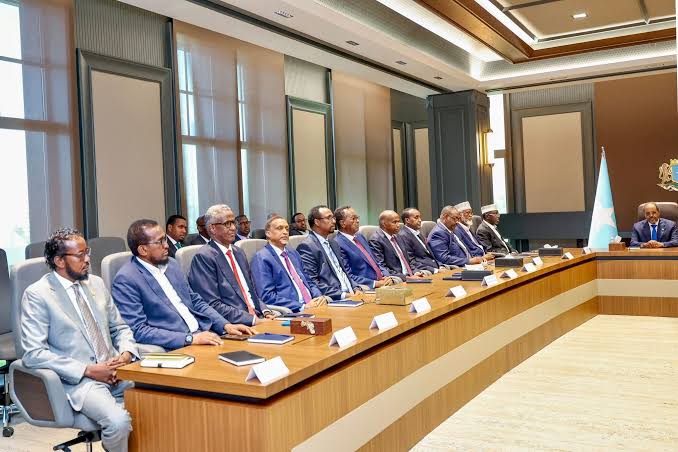
A day before Somalia's Supreme Court was due to rule on whether President Hassan Sheikh Mohamud had lawfully extended his term by a year, he dismissed the chief justice presiding over the case. According to Al Jazeera, the presidency removed Chief Justice Bashe Yusuf Ahmed on 4 November, citing complaints about the administration of justice. Five judges went ahead with the case the next day and ruled that constitutional amendments extending presidential and parliamentary terms from four to five years could not apply retrospectively to those already in office, and that their mandates had therefore expired. The government rejected the ruling and swore in a replacement chief justice straight away, setting up a direct confrontation between the president and the country's highest court over the end of his mandate and the timing of elections.
The president's supporters argue that the overhaul is overdue and that it completes the state. Al Jazeera reports that Mohamud and his allies believe stronger national institutions, clearer rules and direct elections will advance Somalia's decades-long state-building project. Parliament passed the first constitutional amendments in 2024 and approved the remaining changes in March 2026, closing a 14-year review process. The changes give Mogadishu greater authority over revenue collection and sharing, elections, and the conditions under which the federal government can intervene in member states. They also let citizens elect members of the federal lower house directly through a national electoral commission, although parliament will continue to choose the president. Ali Mohamed Omar, the state minister for foreign affairs, told Al Jazeera that the previous system, in which clan elders and delegates chose members of parliament, had left successive governments without the public legitimacy they needed, and that keeping parliament's power to elect the president was a compromise meant to win some opposition support. Federal lawmaker Mohamed Ibrahim Moalimuu called the decision to press ahead "daring" and said Somalia "cannot just remain stuck just because the changes made aren't considered perfect for everyone".
The opponents' case is that the changes rewrite a bargain that was never theirs to rewrite. The provisional constitution adopted in 2012 set up a federal framework for sharing power between Mogadishu and the regions, but it deferred some of the most contentious questions, including the division of powers and control of resources. Jethro Norman of the Danish Institute for International Studies told Al Jazeera the federal system is "crystallising into two camps": Villa Somalia presenting the constitution as completing the state, and Puntland and Jubaland seeing the changes as an imposition. In their view, he said, the 2012 constitution was a bargain between the centre and the regions that cannot be rewritten by a parliamentary majority in Mogadishu when the regions have rejected it. Puntland rejected the first amendments in 2024 and withdrew its cooperation with the federal government, and Jubaland followed after a dispute over electoral legislation. Both have their own security forces and revenue sources. Puntland's president, Said Abdullahi Deni, has warned that if a solution is not found, "Somalis must deliberate and decide on another alternative way to live together".
The dispute has already turned violent in places. In June, clashes between government forces and militias guarding a former president and prime minister brought part of the capital to a standstill for two days. The sharpest case is South West state, where a dispute over President Abdiaziz Hassan Laftagareen's re-election in March escalated into a struggle for control of the regional capital, Baidoa. Mogadishu rejected the vote and federal troops ousted him, and forces loyal to him have since seized several strategic towns around the city and clashed with government troops. South West then held Somalia's first direct election for a federal state assembly in May, which Al Jazeera calls a milestone for Mohamud's reforms, and the new assembly chose a Mohamud ally, Sheikh Adan Mohamed Nur Madobe, as regional president the following month. Laftagareen, now in exile in Nairobi, told Al Jazeera he intends to return and remove Madobe's government, and argued that separating powers between the centre and the regions "saved and kept Somalia together" while the changes are "driving the country apart". Even a supporter, Moalimuu, acknowledged that the recent elections "weren't totally free and fair", though he called giving citizens a vote an important first step.
The map of support is not simple. Al Jazeera reports that Mohamud's allies now lead four of Somalia's six states, where recent elections have also strengthened his Justice and Solidarity Party. Yet in Hirshabelle, one of those states, the outcome has prompted resistance in the Hiiraan region, where leaders and elders say grievances over political representation remain unaddressed, and armed fighters have occupied parts of the regional administration's offices in Beledweyne. A coalition of politicians that includes former presidents and prime ministers, the Somali Future Council, rejected Mohamud's invitation to talks in November. Its spokesperson, Mohamed Mahmoud Dirie, said the group's request for an international guarantor of any agreement was rejected, which would make it hard to ensure the government keeps its side of a bargain.
Foreign relations add another layer. Some federal states keep close commercial and security ties with the United Arab Emirates, which Mohamud, whose relations with Abu Dhabi are cold, has accused of backing regional leaders in their disputes with Mogadishu. In January his government announced the cancellation of the UAE's port and security agreements across Somalia, but the regional states rejected the decision. The stakes also rose with international recognition of the breakaway northern region of Somaliland: Israel became the first UN member state to recognise it at the end of 2025. Somali academic Afyare Elmi told Al Jazeera the government was weakening the fragile consensus behind the 2012 settlement by pushing through changes it could not enforce in states that opposed them, calling this "one of the most dangerous times the Somali political system has faced".
The international safety net is thinning at the same time. The UN political mission that supported constitutional negotiations, elections and reconciliation closed in October at the government's request. The African Union mission, AUSSOM, which supports Somali forces in their fight against al-Shabab, faces funding shortages and uncertainty over continued UN logistical support. Uganda has begun withdrawing its bilateral troops and plans to withdraw its AUSSOM contingent by the end of 2027, and humanitarian aid is shrinking. Mahad Wasuge of the Mogadishu think tank Somali Public Agenda said these changes could leave Somalia increasingly exposed at a time when "the trust between elites is low".
The calendar makes the standoff urgent. The electoral commission has scheduled parliamentary elections for 15 April 2027, followed by parliament's election of the president on 15 May. The timetable is based on the new five-year terms, even though the Supreme Court ruled that the extension could not apply to officials already in office. That means the government is organising a vote on a timetable that the highest court says rests on an invalid premise, while two federal states are outside the process and a coalition of former leaders refuses to take part without guarantees.
The question facing Somalia is whether a constitution can be completed by one side of a federation. Supporters say waiting for perfect consensus has kept the country stuck for fourteen years, while opponents say forcing change has put the union itself at risk. What is clear is that the fight is now about who has the authority to decide, with the presidency and the Supreme Court in open conflict, and Delima News will follow the run-up to the April vote.