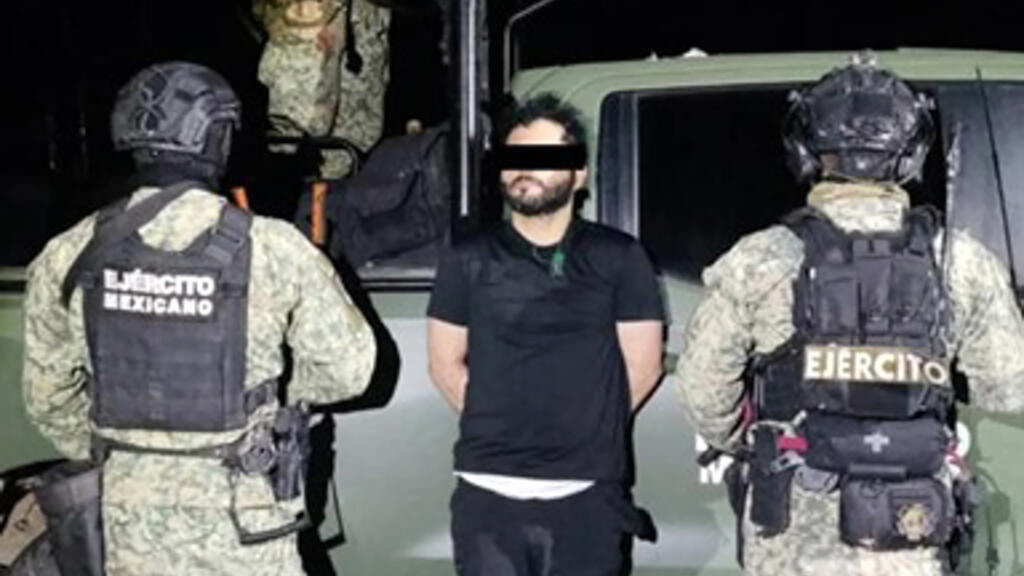
A Mexican drug lord who was on the FBI's Ten Most Wanted list has been arrested following a shoot-out with Mexican authorities. Fausto Isidro "Chapo Isidro" Meza Flores and seven others were detained by Mexican special forces in Guasave, in the state of Sinaloa, on Friday, according to Mexico's defence secretariat. Seven suspects were killed in the operation, as were four members of the Mexican army who were travelling to reinforce security in Guasave. The arrest is one of the most significant blows to organised crime in the country in recent months and comes amid sustained pressure from Washington on Mexico to confront the cartels.
Meza Flores is the leader of the Meza Flores Organisation, also known as the Guasave Cartel. He was wanted in Mexico on organised crime charges, while the FBI has accused him of "flooding the US with fentanyl, cocaine, heroin and other deadly drugs". The United States is now seeking his extradition. He is thought to have been active in the drug trafficking trade since the 1990s but managed to evade authorities until now by maintaining a relatively low profile, a contrast with the flamboyant style of some better-known cartel figures.
According to the defence secretariat, Mexican special forces used US intelligence on his whereabouts and descended on his location using "stealth and surprise", establishing a perimeter to prevent him from escaping and stop reinforcements arriving. The secretariat said the forces then "came under attack from gunfire and explosives" before entering the property and arresting Meza Flores. Videos circulating online appeared to show helicopters firing streams of bullets towards the ground in Guasave, while others seemed to show people at a baseball stadium fleeing as they heard gunfire.
Eight people in total were arrested, including Meza Flores' second-in-command, who is also his cousin, and his brother-in-law, who is the group's financial operator. Meza Flores, his cousin and his brother-in-law were flown to Mexico City to face prosecution, the defence secretariat said, while the other five remained in Sinaloa. Authorities also said they had seized multiple weapons, including a grenade launcher, as well as drugs and cash. The capture of the group's leadership and its financial manager may significantly disrupt the organisation's operations.
The aftermath of the arrest was violent. The US Consulate General in Hermosillo said it was "monitoring reports of ongoing security operations, armed clashes, road blockades, and vehicle fires that occurred overnight" in several areas, including Ahome, Guamúchil, Guasave and Navolato. It advised US citizens to remain alert for potential violence and told residents to shelter in place. Images from the region showed a number of vehicles burning on a highway near Los Mochis, Sinaloa. Such blockades and arson attacks are a common reaction by cartel members after a major arrest and are intended to create chaos and hamper security forces.
Meza Flores was added to the FBI's most-wanted list in 2025. At that time, the then-acting FBI director, Brian Driscoll, said he and his organisation had unleashed a "scourge of illicit drugs" into the US through its southern border with Mexico. He was accused of "heinous crimes" including kidnapping, extortion and torture. He was initially charged with drug trafficking in the US in 2012 and was charged again in 2019. At 44, he is alleged to have conspired to manufacture and distribute large quantities of cocaine, heroin, methamphetamine and marijuana between 2005 and 2019.
His criminal background is tied to the shifting alliances of Mexico's underworld. Meza Flores was originally a high-ranking member of the Beltrán Leyva Organization, but a split between rival factions led to a surge of violence and prompted him to establish his own cartel by 2013. His organisation has since been engaged in what US officials described as an "extremely violent turf war" with the Sinaloa Cartel, one of the most powerful drug trafficking gangs, which operates in the same region. He was added to the FBI's most-wanted list after Mexican authorities reportedly linked his cartel to 20 million fentanyl pills seized in 2024.
The arrest also has a political dimension. Mexico has stepped up efforts to tackle drug-related crime after coming under pressure from US President Donald Trump since he returned to the White House. Trump made stemming the flow of drugs into the US across its southern border one of his key election pledges. Mexican President Claudia Sheinbaum has taken a tougher stance on the country's cartels in a bid to resist US intervention on Mexican soil. Her government has welcomed closer collaboration with Washington but has resisted US boots on the ground, and a high-profile capture carried out by Mexican forces, with American intelligence support, fits that formula.
The operation also shows the human cost of the fight against organised crime. Four Mexican soldiers died while travelling to reinforce security in Guasave, a reminder that members of the armed forces regularly take heavy casualties in confrontations with well-armed groups. The seizure of a grenade launcher illustrates the firepower available to such cartels, which often operate with military-style weapons and tactics. Families of the fallen soldiers will mourn, and the operation will spark renewed debate about the strategy of targeting cartel leaders.
That debate is an old one. Many analysts have argued that capturing leaders can trigger power struggles and spikes in violence as rivals and lieutenants fight for control, while others say it is necessary to dismantle the command structure of criminal groups. The immediate violence in Sinaloa, with road blockades and burning vehicles, will fuel concerns that the arrest could destabilise an already volatile region. Whether it weakens the Guasave Cartel or merely reshuffles the balance of power with the Sinaloa Cartel will become clearer in the coming weeks.
Extradition will be the next test. The United States is seeking to bring Meza Flores to face charges, but he is also wanted in Mexico, where he must face prosecution first. Past cases have shown that the transfer of high-profile suspects between the two countries can be slow and politically sensitive. Mexican officials have at times preferred to keep suspects for domestic trial, while US prosecutors push for swift extradition. How the case is handled will say much about the state of cooperation between the two governments.
For now, the arrest is a significant moment for both countries. It gives the Sheinbaum government a major success to point to, and it hands the Trump administration a result in its campaign against fentanyl and other drugs. Yet the violence that followed shows how entrenched criminal groups remain in northwestern Mexico, and how much remains to be done. Residents of Sinaloa, who bear the brunt of cartel conflict, will be hoping that the arrest brings relief rather than a new wave of bloodshed.