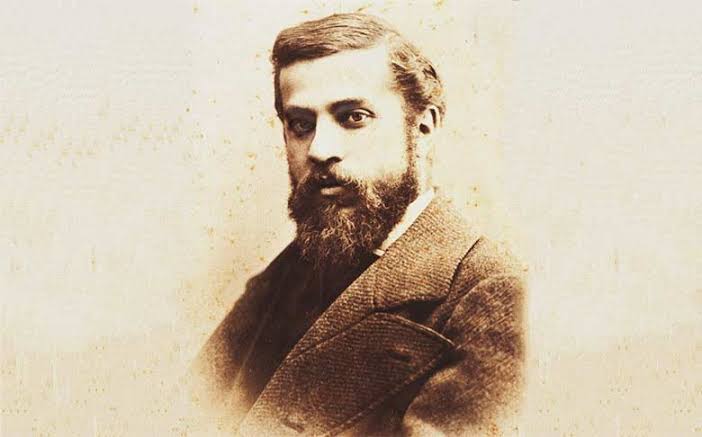
Antoni Gaudí (25 June 1852 to 10 June 1926) was a Spanish architect and designer, widely known as the greatest exponent of Catalan Modernisme. Most of his works stand in Barcelona, including his magnum opus, the Sagrada Família church. His style drew on architecture, nature and religion, and he considered every detail of his buildings, combining ceramics, stained glass, wrought iron and carpentry. This biography follows his life, buildings and legacy.
Antoni Gaudí at a Glance
| Full name | Antoni Gaudí i Cornet |
| Born | 25 June 1852, Reus (or possibly Riudoms), Catalonia, Spain |
| Died | 10 June 1926, Barcelona, Spain (aged 73) |
| Profession | Architect and designer |
| Movement | Catalan Modernisme |
| Best-known works | Sagrada Família, Casa Batlló, Casa Milà, Park Güell, Palau Güell |
| Main patron | Eusebi Güell |
| Honours | Seven of his works declared UNESCO World Heritage Sites between 1984 and 2005; declared Venerable in April 2025 |
Early Life and Family
Gaudí was born on 25 June 1852 in Reus, or possibly Riudoms, to the coppersmith Francesc Gaudí i Serra and Antònia Cornet i Bertran. He was the youngest of five children and outlived the two siblings who survived to adulthood, Rosa and Francesc. His exact birthplace is uncertain: most of his documents named Reus, but from 1915 he said on several occasions that he was born in Riudoms, his paternal family's village, possibly because of a later displeasure with Reus. He was baptised the day after his birth in the church of Sant Pere Apòstol in Reus.
He suffered poor health as a child, including rheumatism, which may have contributed to his reserved character. His health concerns and the theories of Sebastian Kneipp led him to adopt vegetarianism, and with his religious faith he undertook long and severe fasts, which in 1894 led to a life-threatening illness.
Education
He attended a nursery school run by Francesc Berenguer, whose son of the same name later became one of his main assistants, and enrolled in the Piarists school in Reus, where he showed artistic talent. He worked as an apprentice in the Vapor Nou textile mill. In 1868 he moved to Barcelona to study. Between 1875 and 1878 he did compulsory military service in the infantry as a military administrator, spending most of it on sick leave, which let him continue studying and kept him from fighting in the Third Carlist War.
In 1876 his mother died at 57 and his brother Francesc, who had just graduated as a physician, died aged 25. Gaudí studied architecture at the Llotja School and the Barcelona Higher School of Architecture, graduating in 1878, while working as a draughtsman for several architects to pay his fees. His grades were average and he sometimes failed courses. When handing over the degree, the school director Elies Rogent reportedly said: "We have given this academic title either to a fool or a genius. Time will show."
Patron and Early Works
His first projects were lampposts for the Plaça Reial in Barcelona and the Workers' Cooperative of Mataró building. He gained wider recognition with Casa Vicens. At the Paris World's Fair of 1878 he showed a wooden showcase made for a glove manufacturer, which impressed the Catalan entrepreneur Eusebi Güell. Güell commissioned some of his best work: the Bodegas Güell wine cellars, the Güell pavilions, the Palau Güell, Park Güell and the crypt of the church of the Colònia Güell. He also designed "El Capricho" in Comillas for the Marquess of Comillas, and the Episcopal Palace in Astorga and the Casa Botines in León.
Between 1904 and 1910 he built the Casa Batlló and the Casa Milà, two of his most emblematic works. Gaudí introduced new techniques with materials, such as trencadís, which uses waste ceramic pieces. He rarely drew detailed plans, preferring three-dimensional scale models and shaping details as he conceived them.
The Sagrada Família
In 1883 Gaudí took charge of the recently started Basílica i Temple Expiatori de la Sagrada Família in Barcelona. He changed the original design completely and gave it his own distinctive style. From 1915 until his death he devoted himself entirely to the project, which was commonly known as the "Cathedral of the Poor", and he took alms to keep building. During a convalescence in Puigcerdà in 1911, while ill with tuberculosis, he conceived the idea for the Passion façade.
The decade from 1910 was hard. He lost his niece Rosa in 1912, his main collaborator Francesc Berenguer in 1914, his friend Bishop Josep Torras i Bages in 1916 and his patron Eusebi Güell in 1918, while an economic crisis paralysed work on the Sagrada Família in 1915. "My good friends are dead; I have no family and no clients, no fortune nor anything," he told his collaborators. "Now I can dedicate myself entirely to the Church."
Personal Life
Gaudí remained single and devoted his life to his work. He is reported to have been attracted to one woman, the teacher Josefa Moreu, in 1884, who did not return his feelings. As a young man he dressed like a dandy and enjoyed the theatre and opera; the older Gaudí ate frugally, wore worn-out suits and sometimes was taken for a beggar. From 1906 he lived in a house in Park Güell, which is now the Gaudí Museum, and in 1925 he moved into the workshop of the Sagrada Família. His close friends included Güell, Bishop Torras i Bages and the writers Joan Maragall and Jacint Verdaguer.
Death
On 7 June 1926 Gaudí took his daily walk to the Sant Felip Neri church for prayer and confession. Crossing the Gran Via, he was struck by a tram and lost consciousness. Assumed to be a beggar, he received no immediate help, and passers-by eventually took him by taxi to the Santa Creu Hospital. The chaplain of the Sagrada Família recognised him the next day, but by then his condition was too serious. He died on 10 June 1926, aged 73. A large crowd attended his farewell in the crypt of the Sagrada Família, where he is buried.
Legacy
Gaudí's work is admired and studied around the world. The still-incomplete Sagrada Família is the most-visited monument in Spain, and seven of his works were declared UNESCO World Heritage Sites between 1984 and 2005. His Catholic faith deepened through his life and religious imagery fills his work, which earned him the nickname "God's Architect". The Archdiocese of Barcelona opened his cause for canonisation in 2003, and Pope Francis authorised his declaration as Venerable in April 2025.