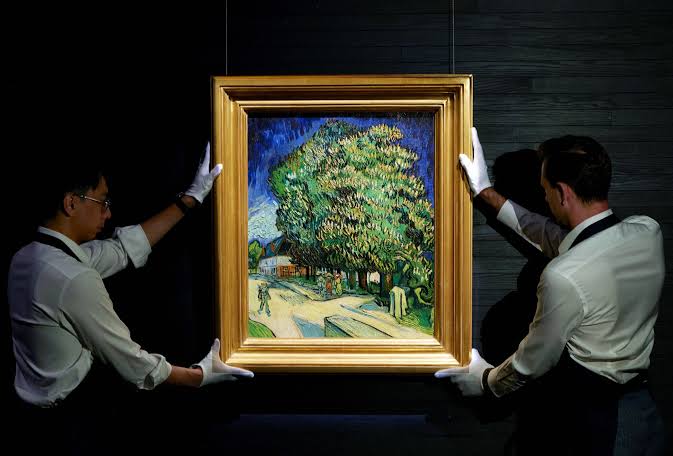
A painting by Vincent van Gogh has sold at auction in New York for a record $190.4 million (£144.8 million), according to the BBC. Sotheby's sold Châtaigniers en fleurs, or "Chestnut Trees in Blossom", on Wednesday, 18 November, more than $73 million above the artist's previous auction record of $117.2 million, which was set in 2022. The pre-sale estimate was $180 million. The buyer was not immediately identified. The sale was made possible by an agreement reached only hours earlier to resolve a dispute over claims that the work had been sold under duress during the rise of the Nazis.
The argument for the price is that the painting is rare in both date and quality. Van Gogh painted it in 1890, in the final two months of his life, and Sotheby's considers it one of the most important works from that period remaining in private hands. It was offered as part of the Blaquier-Arrieta Collection, and works of that standing seldom come to market. The higher-than-estimated result shows how strongly bidders respond when a masterpiece that has not been seen in public sale for decades comes up. It also suggests that the top end of the art market remains strong, since a single painting exceeded the artist's earlier record by a wide margin.
The case for caution is the painting's history, and it is the reason the sale nearly did not go ahead. Representatives of the heirs of the Fischer family, the prior German owners, had claimed the work may have been sold under duress during the rise of the Nazis. A lawyer for the heirs reportedly wrote to Sotheby's saying the painting was sold in Amsterdam before the Second World War because of financial losses the Fischer family's publishing company suffered under the Nazis. The BBC has sought comment from that lawyer. According to Sotheby's own provenance, the publisher Samuel Fischer acquired the painting in 1909, and it passed to his family after his death in 1934. It was deposited with Paul Cassirer in Amsterdam in 1932 or 1933, then went to Henriette and Marcel Kapferer in Paris in 1936, and the Blaquier family acquired it in 1975 and owned it for more than half a century.
The agreement reached before the sale is the most important detail for the art world. In the hours before the auction, Sotheby's announced that the Blaquier-Arrieta family and the Fischer heirs had reached what it called a "mutually satisfactory resolution" and that the work would be sold under their agreement. Sotheby's said the arrangement recognised "the painting's complex Nazi-era history and the suffering endured by the Fischer family during the Holocaust". The terms were not disclosed in the BBC's report, so it is not known how the proceeds are divided. What is clear is that the dispute was settled privately rather than being fought out in court, which allowed the sale to take place on schedule.
Why does this matter beyond one painting? Provenance has become central to the high-value art trade because many works changed hands in the 1930s under pressure from persecution. A buyer paying $190.4 million wants confidence that nobody else can lay claim to the work, and a seller wants to avoid a sale being halted. The case shows a pattern in which families, auction houses and heirs negotiate a settlement shortly before a sale when a claim emerges. It also illustrates that provenance research of the kind Sotheby's publishes on its website, with named owners and dates, can both support a sale and serve as the basis for a challenge.
For Van Gogh, the price is a belated confirmation of a reputation that was unimaginable in his lifetime. The painting was made in the last two months of his life, in 1890, when he was struggling, and it is now the most expensive of his works ever sold at auction. The record also shifts expectations for other major works by the artist that may come to market, because owners and auction houses will point to $190.4 million when setting estimates.
The conclusion is that this sale combines two stories: an artistic one, in which a late masterpiece sets a new benchmark, and a moral one, in which the past catches up with the present and demands acknowledgement. Whether the settlement is seen as adequate will depend on terms that are not yet public. Still, the fact that the Fischer heirs and the Blaquier-Arrieta family reached an agreement before the hammer fell suggests that the market is learning to deal with the history of its masterpieces openly. Delima News will report if the buyer or the terms are disclosed.