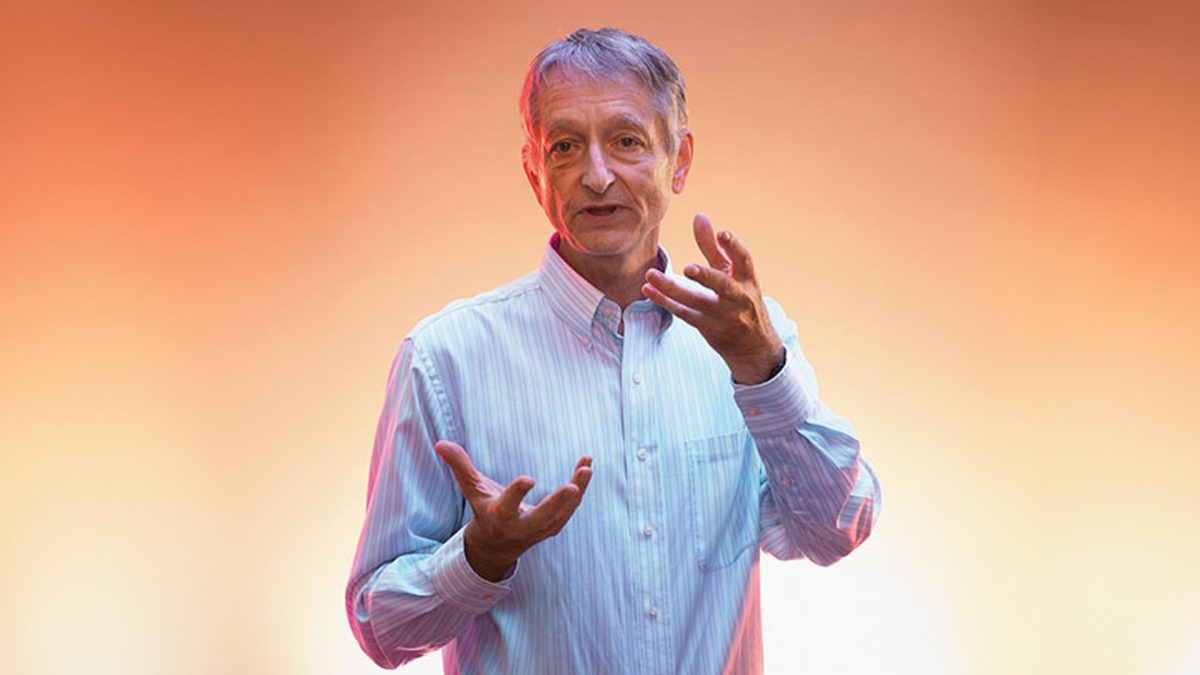
Geoffrey Everest Hinton (born 6 December 1947) is a British-Canadian computer scientist and cognitive psychologist known for his work on artificial neural networks, which earned him the title "the Godfather of AI". He shared the 2018 Turing Award and the 2024 Nobel Prize in Physics, and in May 2023 he left Google so that he could speak freely about the risks of AI. This biography follows his life and career up to November 2026.
Geoffrey Hinton at a Glance
| Full name | Geoffrey Everest Hinton |
| Born | 6 December 1947, Wimbledon, England |
| Age | 78 (as of November 2026) |
| Profession | Computer scientist and cognitive psychologist |
| Education | King's College, Cambridge (BA in experimental psychology, 1970); University of Edinburgh (PhD in artificial intelligence, 1978) |
| Current post | University Professor Emeritus, University of Toronto |
| Known for | Backpropagation; AlexNet; deep learning |
| Honours | Turing Award (2018, with Yoshua Bengio and Yann LeCun); Nobel Prize in Physics (2024, with John Hopfield); Fellow of the Royal Society (1998) |
Early Life and Education
Geoffrey Hinton was born in Wimbledon, England, and educated at Clifton College in Bristol. His father was the entomologist Howard Hinton, and his family tree includes the logician George Boole, a great-great-grandfather, and the surveyor George Everest, a relative after whom he takes his middle name. In 1967 he began at King's College, Cambridge, switched between natural sciences, history of art and philosophy, and graduated with a BA in experimental psychology in 1970. After a year as a carpentry apprentice he studied at the University of Edinburgh from 1972 to 1975, and he was awarded a PhD in artificial intelligence in 1978 for research supervised by Christopher Longuet-Higgins, who favoured the symbolic approach to AI over neural networks.
Career in Neural Networks
Hinton worked at the University of Sussex and the MRC Applied Psychology Unit, and, after difficulty getting funding in Britain, in the United States at the University of California, San Diego, and Carnegie Mellon University. He has been affiliated with the University of Toronto since 1987, apart from a period as founding director of the Gatsby Computational Neuroscience Unit at University College London from 1998 to 2001. In 1986 he co-authored a highly cited paper with David Rumelhart and Ronald J. Williams that popularised the backpropagation algorithm for training multi-layer neural networks.
In 2012, with his students Alex Krizhevsky and Ilya Sutskever, he built AlexNet, an image-recognition neural network that won the ImageNet challenge and was a breakthrough in computer vision. In March 2013 Google acquired his company DNNresearch for $44 million, and from 2013 to 2023 he divided his time between Google Brain and the University of Toronto. In 2017 he co-founded the Vector Institute in Toronto and became its chief scientific adviser.
Turing Award and Nobel Prize
In 2018 Hinton received the Turing Award with Yoshua Bengio and Yann LeCun for conceptual and engineering breakthroughs that made deep neural networks a critical component of computing. In 2022 he received the Princess of Asturias Award in the Scientific Research category, with LeCun, Bengio and Demis Hassabis. In 2024 he and John Hopfield were jointly awarded the Nobel Prize in Physics "for foundational discoveries and inventions that enable machine learning with artificial neural networks". He was elected a Fellow of the Royal Society of London in 1998.
Warnings About AI
In May 2023 Hinton publicly announced his resignation from Google so that he could "freely speak out about the risks of AI". He has voiced concerns about deliberate misuse by malicious actors, technological unemployment and existential risk from artificial general intelligence. He has said that establishing safety guidelines will require cooperation among those competing in AI, and after receiving the Nobel Prize he called for urgent research into how to control AI systems that are smarter than humans.
Personal Life
Hinton's first wife, Rosalind Zalin, died of ovarian cancer in 1994, and his second wife, Jacqueline "Jackie" Ford, died of pancreatic cancer in 2018. He injured his back at the age of 19, which makes sitting painful, and he has said that he has dealt with depression throughout his life.
Legacy
Hinton kept working on neural networks for decades when many researchers had dismissed them, and the ideas he championed now underpin much of modern AI. He has since become one of the best-known voices urging caution about the technology he helped create. This biography draws on [Wikipedia](https://en.wikipedia.org/wiki/Geoffrey_Hinton).