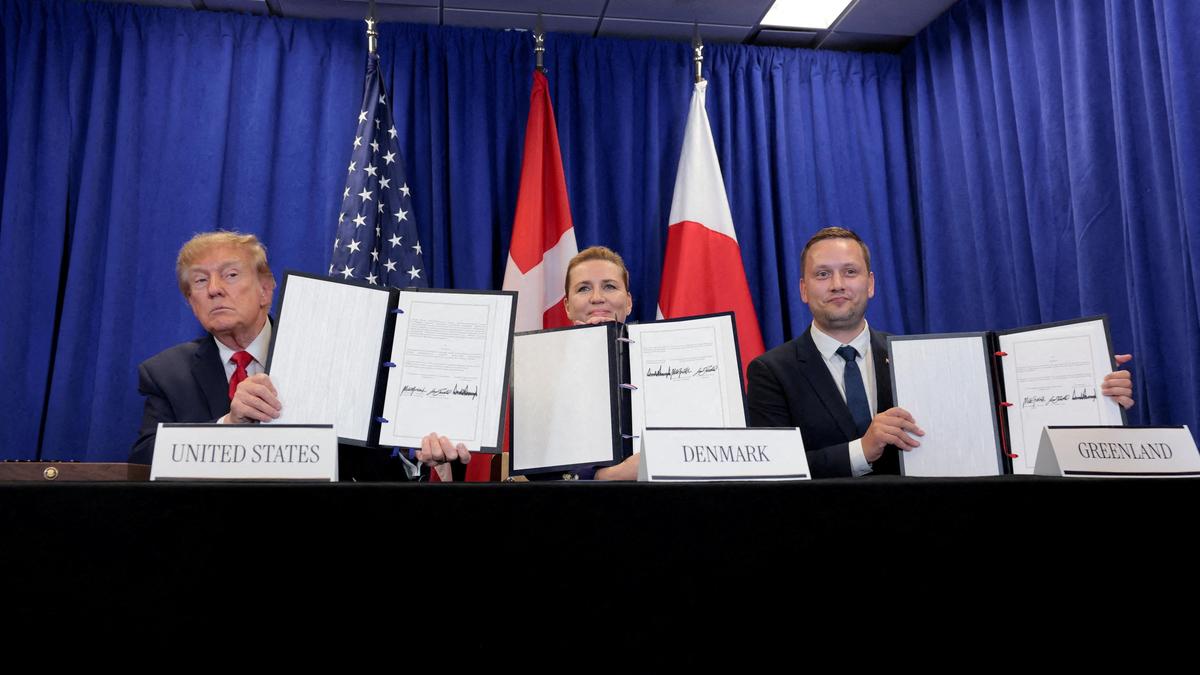
There is a particular kind of quiet that follows a very loud argument. For much of this year, Greenland, a vast, sparsely populated island with a population smaller than a mid-sized town, found itself at the center of a global conversation it had not asked for. Now, after months of pressure from Washington, the island’s parliament and Denmark’s have been moving to approve a trilateral security agreement that will shape the Arctic for years.
The deal is real, the votes are on record and the questions are far from over.
The votes so far
On Tuesday, November 3, Greenland’s parliament approved the agreement by a vote of 16 to 0, with seven abstentions, according to reporting by Al Jazeera, the Associated Press and others. The accord is trilateral, involving Greenland, Denmark and the United States, and was signed in September.
On the Danish side, Reuters reported that the bill was due for a first reading on November 11, followed by a second reading and vote on November 19. The outcome of that final vote had not been confirmed in available reporting at the time of writing. The agreement enters into force only once the necessary parliamentary processes of the Kingdom of Denmark, in conjunction with Greenland, are complete.
What the agreement does
Coverage describes the deal as paving the way for more US bases in Greenland. Several details stand out.
Greenland remains under Danish control. The agreement does not change the island’s sovereignty.
The agreement would still apply if Greenland eventually chooses independence, which is a real possibility the island’s government has openly discussed. That clause matters, because it means the arrangement is designed to outlast any future constitutional change.
It is an executive agreement on the American side, so it does not require approval from the US Senate.
None of that is trivial. Together, those features describe a partnership meant to be durable but, from the American side, flexible to adopt and potentially easier to revisit.
Why Greenland matters so much
If you look at a map from above the North Pole instead of the familiar flat one, Greenland’s importance becomes obvious. It sits between North America and Europe, along the shortest routes for missiles and aircraft crossing the Atlantic. It already hosts a US military installation and has done so since the Cold War. As Arctic ice thins, new shipping lanes and access to resources are opening, and competition from Russia and China in the region is a growing concern for NATO members.
For the United States, a stronger footprint in Greenland is a way of watching the northern approaches. For Denmark, it is a way of keeping a close ally engaged while staying in the driver’s seat on sovereignty. For Greenlanders, it is something more complicated: a deal made on their behalf and with their consent, but under the shadow of months of public pressure from the American president.
The pressure behind the deal
The phrase “following months of Trump’s pressure” appears in headlines across outlets for a reason. President Donald Trump has repeatedly expressed interest in Greenland, and the island’s people have repeatedly said it is not for sale. That tension frames how this agreement is being received.
Some Greenlanders see the deal as a sensible way to protect themselves by channeling American interest into a formal framework with limits. Others worry that it normalizes a dynamic in which a large power leans on a small one until it agrees. Both views can be sincere, and both deserve to be heard.
The abstentions in the 16-to-0 vote are telling. Nobody voted against, but seven members declined to vote in favor. That is not a ringing endorsement; it reads like a parliament that accepts the practical logic of the deal while remaining uneasy about its terms and the way it came about.
Does it pay off for Greenland?
This is the question the opposition keeps asking. The South China Morning Post framed the ratification as happening “despite questions about value,” and Naleraq party chairman Pele Broberg said that no economic benefit had been gained from the agreement.
That criticism cuts to something real. Security arrangements bring strategic benefits, but ordinary residents tend to ask more practical questions. Will there be jobs in construction and services? Will local businesses be able to bid for contracts? Will airports, ports and roads improve in ways that help the island’s own communities? Will environmental safeguards be respected, given the island’s fragile ecosystem and the history of past military installations?
Detailed public answers to all of those questions have not yet emerged, and it would be wrong to guess. They will likely define how the deal is judged in a year or two, long after the headline votes are forgotten.
Denmark’s delicate position
Denmark has had an uncomfortable year. It is a loyal NATO member and a close American partner, yet it has had to respond to talk of acquiring part of its own kingdom. Earlier, in June 2025, Danish lawmakers had already approved legislation allowing US military bases on Danish soil, a sign of how steadily Copenhagen has tried to accommodate Washington’s security interests while holding firm on sovereignty.
The trilateral format is a clever piece of diplomacy in that light. By bringing Greenland to the table as a party rather than a subject, Denmark preserves the principle that the island’s people have a voice. Whether Greenlanders feel that voice was loud enough is a separate matter, and one they will answer in their own politics.
The independence question
Perhaps the most intriguing clause is the one saying the agreement would survive Greenlandic independence. Greenland’s law already provides a route to independence if its people vote for it, and polls over the years have shown strong sentiment in favor, tempered by worries about the economy and living standards.
By tying the security arrangement to the island rather than to its constitutional status, negotiators are effectively saying that a future independent Greenland would inherit this partnership. Supporters call that stability. Skeptics call it a constraint on future choices made in the present. Reasonable people can land on either side.
What to watch next
Confirmation of the Danish vote and the date on which the agreement formally enters into force.
Publication of concrete details about new facilities, their locations and their legal status.
Any economic commitments, from jobs to infrastructure, that make the deal tangible for Greenland’s communities.
Reactions from Russia and China, both of which watch Arctic developments closely and have criticized Western military buildups in the north.
Whether the agreement quiets the broader debate about Greenland’s future or simply moves it to a new stage.
A human footnote
It is easy to treat Greenland as a pin on a strategic map. But the island’s roughly fifty-seven thousand residents live mostly in small coastal towns, where the cold is real, supplies arrive by ship and community ties run deep. Decisions that sound abstract in capitals are lived in kitchens and fishing harbors.
If there is one thing the past year has made clear, it is that those residents are not extras in someone else’s story. They voted, they debated and they are watching what comes next. A security deal can be signed in a day, but trust takes much longer to build, and in the Arctic, as everywhere, it is earned slowly.