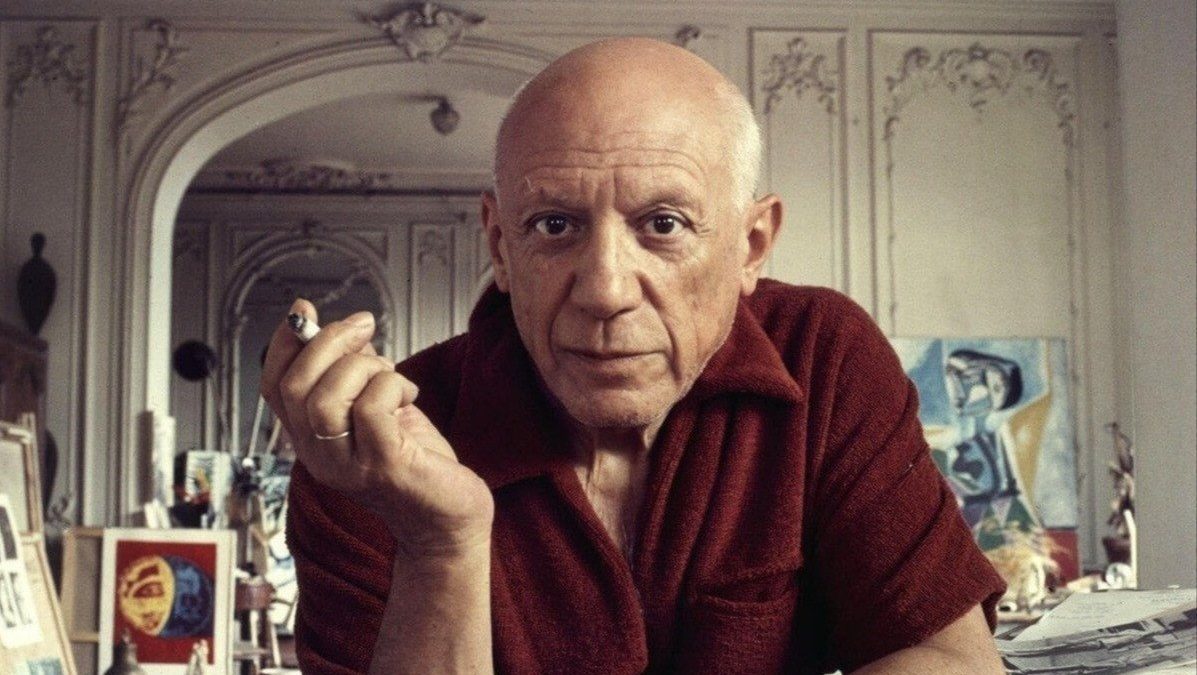
Pablo Picasso (Pablo Ruiz Picasso, 25 October 1881 to 8 April 1973) was a Spanish painter, sculptor and printmaker who spent most of his adult life in France. He co-founded Cubism with Georges Braque and painted Guernica in response to the bombing of the Basque town during the Spanish Civil War. He is regarded as one of the most influential artists of the 20th century. This biography follows his life and work from Málaga to his death in Mougins.
Pablo Picasso at a Glance
| Full name | Pablo Ruiz Picasso |
| Born | 25 October 1881, Málaga, Andalusia, Spain |
| Died | 8 April 1973, Mougins, Alpes-Maritimes, France (aged 91) |
| Profession | Painter, sculptor and printmaker |
| Movements | Blue Period, Rose Period, Cubism |
| Best-known works | Les Demoiselles d'Avignon (1907), Guernica (1937) |
| Spouses | Olga Khokhlova (married 1918); Jacqueline Roque (married 1961) |
| Children | Paulo, Maya, Claude and Paloma |
| Auction record | Les Femmes d'Alger (Version O) sold for $179.4 million in May 2015 |
Early Life and Training
Picasso was born in Málaga to José Ruiz y Blasco, a painter and art teacher, and María Picasso y López. His father trained him in drawing from the age of seven. At 13 he entered the advanced class at the School of Fine Arts in Barcelona, and at 16 he attended the Royal Academy of San Fernando in Madrid, although he soon stopped going to classes.
Blue and Rose Periods
From 1901 to 1904 Picasso painted in the blue tones and sombre subjects of his Blue Period, a time that includes La Vie (1903). The warmer Rose Period followed from 1904 to 1906, with circus performers and harlequins as favourite subjects. He settled in Paris, where he met many of the artists and writers of the avant-garde.
Cubism
In 1907 he painted Les Demoiselles d'Avignon, which broke with the traditions of perspective and began his African-influenced period from 1907 to 1909. With Georges Braque he developed Analytic Cubism between 1909 and 1912, in which objects are broken into fragments and shown from many viewpoints, and Synthetic Cubism from 1912 to 1919.
Guernica
Picasso painted Guernica in 1937 after the bombing of the Basque town of Guernica during the Spanish Civil War, and it was first shown in the Spanish Pavilion at the 1937 Paris International Exposition. The large black, white and grey work became one of the best-known anti-war images in the world.
Family and Death
Picasso married the Russian dancer Olga Khokhlova in 1918, and they separated in 1941. His other partners included Marie-Thérèse Walter, Dora Maar and Françoise Gilot, and in 1961 he married Jacqueline Roque. He had four children: Paulo, Maya, Claude and Paloma. He died in Mougins, France, on 8 April 1973, aged 91.
Legacy
In May 2015 Picasso's Les Femmes d'Alger (Version O) sold at Christie's in New York for $179.4 million, a record for a painting at auction at the time, until it was passed by Leonardo da Vinci's Salvator Mundi in 2017. The Museu Picasso in Barcelona holds a large collection of his early work. Cubism changed how artists approached form and space, and his influence is still felt across modern art.